
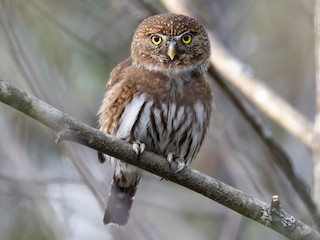
Where does the Northern Pygmy-Owl live?
Glaucidium gnoma
Spotted a bird? Identify it instantly with the Birdby app
Open the appThe Northern Pygmy-Owl lives in specific habitats and regions. Knowing where, and when, to look improves your chances of a successful sighting.
Biomes
Coniferous forests, mixed coniferous-deciduous forests, riparian woodlands.
Geographic range
Western North America, from southeastern Alaska and British Columbia southward through the western United States, extending into Mexico (specifically the Sierra Madre Occidental).
Preferred environments
Mature and old-growth forests with a mix of coniferous and deciduous trees, often near riparian areas or forest edges that provide a varied prey base. Requires snags or dead trees for nesting cavities.
Elevation range
Sea level up to 3,000 meters (10,000 ft), depending on latitude, typically found in montane forests.
Where to look
Forests
Active in coniferous or mixed forests, particularly mature stands near clearings, riparian zones, or forest edges. Look in mountains and foothills throughout its western North American range.
Snags/Dead Trees
These owls require old woodpecker cavities for nesting. Search areas with standing dead trees or trees with large natural hollows.
Bird Feeders (indirect)
While they don't eat seeds, these owls are often attracted to areas with high concentrations of small songbirds (e.g., feeders) as prey.
Field tips
- Listen for Calls. The most effective way to find a Northern Pygmy-Owl is by listening for its distinct hooting song, especially at dawn and dusk, or even during the day from late winter through spring.
- Look for Mobbing Birds. Small songbirds (e.g., chickadees, jays, nuthatches) often mob and scold perched pygmy-owls. Follow the commotion to locate the owl.
- Scan Conspicuous Perches. These owls frequently perch in the open on exposed branches, often at mid-story height or higher, to scan for prey. Use binoculars to carefully scan such perches.
- Check Tree Cavities. During the breeding season, look for activity around old woodpecker holes in snags or mature trees, which they use for nesting.
Migration
Generally resident throughout its range. Some elevational migration may occur in mountainous regions, moving to lower elevations during harsh winters.
Explore the Northern Pygmy-Owl
Identify birds anywhere
Free on iOS, Android, and Web. Photo & sound identification, full species database, and your personal life list.