
Spotted a bird? Identify it instantly with the Birdby app
Open the appAbout
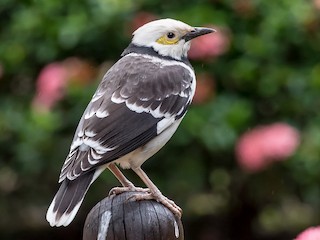
The Black-collared Starling is a medium-sized passerine bird belonging to the starling family. It is easily recognizable by its striking black and white plumage, particularly the prominent black collar. It is a common and conspicuous bird across much of Southeast Asia, often found in open habitats and human-modified landscapes.
Size & lifespan
- Length
- 25-30 cm
- Wingspan
- 40-45 cm
- Weight
- 100-150 g
- Lifespan
- 5-10 years in the wild
- Diet
- Omnivore
Physical characteristics
- Plumage
- Adults have a white head, neck, and underparts, contrasting sharply with a broad, glossy black collar that extends from the nape across the breast. The back, wings, and tail are dark brown to black, often with a greenish-blue sheen in good light. A prominent white patch is visible on the primary coverts and bases of the primaries, forming a distinct wing panel in flight. The rump is white.
- Beak shape
- The bill is relatively stout and conical, yellowish-orange with a darker, often reddish, base.
- Eye color
- Pale yellow to whitish-yellow, surrounded by a patch of bare yellow skin.
- Leg color
- Yellowish-orange to orange-brown.
- Distinguishing features
- The combination of a white head, broad black collar, and yellow bare skin around the eye is diagnostic. The white wing patch is also a key field mark, especially in flight.
- Juvenile appearance
- Juveniles are duller overall, with a brownish-grey head and neck, and a less defined, duller brown collar. The bare skin around the eye is less prominent and paler. The bill is duller, often brownish-yellow. They gradually acquire adult plumage over their first year.
- Seasonal changes
- No significant seasonal plumage changes. The plumage remains consistent throughout the year.
- Sexual dimorphism
- Males and females are generally monomorphic in plumage, appearing identical. There might be slight size differences, with males being marginally larger, but this is not reliably discernible in the field.
How to identify
- 1
Head and Neck
Look for the entirely white head and neck, which is a striking contrast to the rest of the body.
- 2
Black Collar
Identify the broad, glossy black band that wraps around the nape and extends across the upper breast, forming a distinct 'collar'.
- 3
Eye Patch
Note the bare, bright yellow skin around the pale yellow eye. This is a very distinctive feature.
- 4
Bill and Legs
Observe the yellowish-orange bill with a reddish base and the yellowish-orange legs.
- 5
Wing Patch
In flight, look for the prominent white patch on the primary coverts and bases of the primaries, which stands out against the dark wings.
- 6
Rump
The white rump is also a good field mark, especially when the bird is in flight or perched with its back to you.
- 7
Vocalizations
Listen for its varied and often melodious song, which includes whistles, trills, and chattering, as well as its harsh 'churr' calls.
Habitat & range
- Biomes
- Tropical and subtropical grasslands, savannas, shrublands, wetlands (marshes, swamps), and urban/suburban areas.
- Geographic range
- Southeast Asia, including southern China (Yunnan, Guangxi, Guangdong, Hainan), Myanmar, Thailand, Laos, Cambodia, Vietnam, and parts of Peninsular Malaysia. It has also been introduced to Taiwan.
- Elevation range
- Typically found from sea level up to approximately 1,500 meters (5,000 feet).
- Preferred environments
- Favors open country, agricultural land, parks, gardens, golf courses, urban fringes, and areas with scattered trees and short grass. It is often associated with human habitation and disturbed environments.
Behavior
- Activity time
- Diurnal. Most active during daylight hours, particularly in the morning and late afternoon.
- Feeding habits
- Highly omnivorous. Forages primarily on the ground, walking with a confident gait, probing the soil with its bill. Diet includes a wide variety of invertebrates (insects, worms, snails), small vertebrates (lizards, frogs), fruits, berries, seeds, and human food scraps. Often seen foraging in short grass, lawns, and cultivated fields.
- Social behavior
- Highly gregarious, especially outside the breeding season. Often seen in pairs or small family groups, but can form large flocks, sometimes numbering hundreds or even thousands, particularly at communal roosts. These large flocks can be quite noisy and conspicuous.
- Flight pattern
- Flight is strong and direct, often in undulating patterns over longer distances. The white wing patches are very noticeable in flight.
- Migration pattern
- Primarily a resident species throughout its range, with no significant migratory movements. Local movements may occur in response to food availability or habitat changes.
- Territoriality
- During the breeding season, pairs establish and defend a nesting territory. Outside of breeding, they are less territorial and more tolerant of other individuals.
Song & calls
- Song
- The song is a varied and often melodious series of whistles, trills, chattering notes, and mimicry of other birds. It can be quite complex and prolonged, delivered from a prominent perch.
- Call
- Common calls include a harsh, grating 'churr', a sharp 'chew-wit', and various squeaky or whistling notes. Alarm calls are typically harsher and more insistent. They are generally quite vocal birds.
- When they vocalize
- Vocalizes throughout the day, but particularly active in the morning and evening. Breeding season sees increased singing activity.
Breeding & reproduction
- Breeding season
- Varies geographically, but generally from March to August, peaking in April-June in many areas.
- Nesting habits
- Nests are typically bulky, untidy structures made of twigs, grass, leaves, and other plant material, lined with finer materials like rootlets or feathers. They are usually placed in tree cavities, old woodpecker holes, crevices in buildings, or sometimes in dense foliage of trees or palms. Both parents participate in nest building.
- Clutch size
- 3-5 eggs, occasionally up to 6.
- Egg description
- Typically 3-5 eggs, pale blue or greenish-blue, sometimes with faint reddish-brown spots or speckles.
- Incubation period
- Approximately 14-15 days, primarily by the female, though the male may assist.
- Fledging period
- Chicks fledge around 20-23 days after hatching. Both parents feed the young.
- Parental care
- Both male and female parents share incubation duties (though female does most) and extensively participate in feeding and caring for the nestlings and fledglings.
Where to find
Agricultural Areas
Common in rice paddies, cultivated fields, and orchards where food is abundant.
Urban and Suburban Parks/Gardens
Frequently seen in human-modified landscapes, including city parks, gardens, golf courses, and roadside trees.
Open Woodlands and Savannas
Prefers open areas with scattered trees rather than dense forests.
Wetland Edges
Can be found near marshes, swamps, and other wetland habitats, especially where there are open grassy areas.
Field tips
- Look on the ground. These starlings primarily forage on the ground in short grass, so scan lawns, fields, and open areas.
- Listen for calls. Their varied and often loud vocalizations make them easy to locate, even before you see them.
- Check communal roosts. Outside the breeding season, look for large flocks gathering at communal roost sites, often in tall trees, especially at dusk.
- Observe in pairs or small groups. They are rarely solitary, so if you see one, there are likely others nearby.
Similar species
Common Myna
Acridotheres tristis
The Common Myna lacks the prominent black collar and white head of the Black-collared Starling. It has a dark brown body, yellow bill and legs, and a yellow patch behind the eye. Its head is dark brown, not white.
Pied Myna
Gracupica contra
The Pied Myna (also known as Asian Pied Starling) has a black and white plumage pattern, but its white areas are more extensive on the wings and underparts, and it lacks the distinct broad black collar of the Black-collared Starling. Its head is black with white patches, not entirely white.
Javan Myna
Acridotheres javanicus
The Javan Myna is mostly dark grey to black with a white vent and white wing patches. It lacks the white head and prominent black collar of the Black-collared Starling. Its bill and legs are yellow.
Quick facts
- Distinguishing Mark:
- White head, black collar, yellow eye patch
- Habitat Preference:
- Open country, agricultural land, urban areas
- Diet:
- Omnivorous (insects, fruits, seeds, scraps)
- Sociality:
- Highly gregarious, forms large flocks
- Conservation Status:
- Least Concern (stable population)
Fun facts
- The Black-collared Starling is known for its ability to mimic the calls of other birds, adding them to its own complex song.
- Despite its striking appearance, it is a very common and adaptable species, thriving in human-modified environments.
- Large communal roosts can be quite spectacular, with hundreds or thousands of birds gathering in a single tree or grove.
- Its scientific name 'nigricollis' literally means 'black-necked', referring to its most prominent feature.
Scientific classification
- Kingdom
- Animalia
- Phylum
- Chordata
- Class
- Aves
- Order
- Passeriformes
- Family
- Sturnidae
- Genus
- Gracupica
- Species
- nigricollis
Explore the Black-collared Starling
Identify birds anywhere
Free on iOS, Android, and Web. Photo & sound identification, full species database, and your personal life list.