
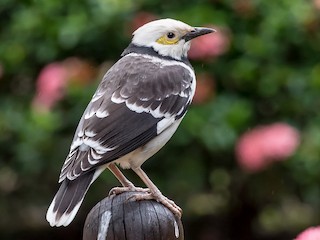
Where does the Black-collared Starling live?
Gracupica nigricollis
Spotted a bird? Identify it instantly with the Birdby app
Open the appThe Black-collared Starling lives in specific habitats and regions. Knowing where, and when, to look improves your chances of a successful sighting.
Biomes
Tropical and subtropical grasslands, savannas, shrublands, wetlands (marshes, swamps), and urban/suburban areas.
Geographic range
Southeast Asia, including southern China (Yunnan, Guangxi, Guangdong, Hainan), Myanmar, Thailand, Laos, Cambodia, Vietnam, and parts of Peninsular Malaysia. It has also been introduced to Taiwan.
Preferred environments
Favors open country, agricultural land, parks, gardens, golf courses, urban fringes, and areas with scattered trees and short grass. It is often associated with human habitation and disturbed environments.
Elevation range
Typically found from sea level up to approximately 1,500 meters (5,000 feet).
Where to look
Agricultural Areas
Common in rice paddies, cultivated fields, and orchards where food is abundant.
Urban and Suburban Parks/Gardens
Frequently seen in human-modified landscapes, including city parks, gardens, golf courses, and roadside trees.
Open Woodlands and Savannas
Prefers open areas with scattered trees rather than dense forests.
Wetland Edges
Can be found near marshes, swamps, and other wetland habitats, especially where there are open grassy areas.
Field tips
- Look on the ground. These starlings primarily forage on the ground in short grass, so scan lawns, fields, and open areas.
- Listen for calls. Their varied and often loud vocalizations make them easy to locate, even before you see them.
- Check communal roosts. Outside the breeding season, look for large flocks gathering at communal roost sites, often in tall trees, especially at dusk.
- Observe in pairs or small groups. They are rarely solitary, so if you see one, there are likely others nearby.
Migration
Primarily a resident species throughout its range, with no significant migratory movements. Local movements may occur in response to food availability or habitat changes.
Explore the Black-collared Starling
Identify birds anywhere
Free on iOS, Android, and Web. Photo & sound identification, full species database, and your personal life list.