
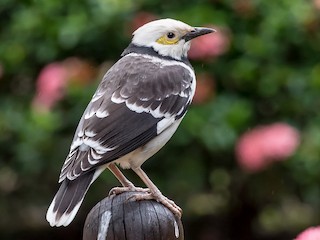
How to identify the Black-collared Starling
Gracupica nigricollis
Spotted a bird? Identify it instantly with the Birdby app
Open the appTo correctly identify the Black-collared Starling (Gracupica nigricollis), check each of these features. Birds can be tricky: habit, habitat, and call often confirm a sighting that a single photo cannot.
Size at a glance
- Length
- 25-30 cm
- Wingspan
- 40-45 cm
- Weight
- 100-150 g
Physical features to check
- 1
Plumage
Overall feather coloration and pattern.
Adults have a white head, neck, and underparts, contrasting sharply with a broad, glossy black collar that extends from the nape across the breast. The back, wings, and tail are dark brown to black, often with a greenish-blue sheen in good light. A prominent white patch is visible on the primary coverts and bases of the primaries, forming a distinct wing panel in flight. The rump is white.
- 2
Beak shape
Shape and color of the bill: a key field mark.
The bill is relatively stout and conical, yellowish-orange with a darker, often reddish, base.
- 3
Eye color
Iris color and any distinctive eye markings.
Pale yellow to whitish-yellow, surrounded by a patch of bare yellow skin.
- 4
Leg color
Leg and foot color.
Yellowish-orange to orange-brown.
- 5
Distinguishing features
Standout features that separate this species.
The combination of a white head, broad black collar, and yellow bare skin around the eye is diagnostic. The white wing patch is also a key field mark, especially in flight.
- 6
Juvenile appearance
How young birds differ from adults.
Juveniles are duller overall, with a brownish-grey head and neck, and a less defined, duller brown collar. The bare skin around the eye is less prominent and paler. The bill is duller, often brownish-yellow. They gradually acquire adult plumage over their first year.
- 7
Seasonal changes
Plumage variation between breeding and non-breeding seasons.
No significant seasonal plumage changes. The plumage remains consistent throughout the year.
- 8
Sexual dimorphism
How males and females differ.
Males and females are generally monomorphic in plumage, appearing identical. There might be slight size differences, with males being marginally larger, but this is not reliably discernible in the field.
Key field marks
- Head and Neck. Look for the entirely white head and neck, which is a striking contrast to the rest of the body.
- Black Collar. Identify the broad, glossy black band that wraps around the nape and extends across the upper breast, forming a distinct 'collar'.
- Eye Patch. Note the bare, bright yellow skin around the pale yellow eye. This is a very distinctive feature.
- Bill and Legs. Observe the yellowish-orange bill with a reddish base and the yellowish-orange legs.
- Wing Patch. In flight, look for the prominent white patch on the primary coverts and bases of the primaries, which stands out against the dark wings.
- Rump. The white rump is also a good field mark, especially when the bird is in flight or perched with its back to you.
- Vocalizations. Listen for its varied and often melodious song, which includes whistles, trills, and chattering, as well as its harsh 'churr' calls.
Explore the Black-collared Starling
Identify birds anywhere
Free on iOS, Android, and Web. Photo & sound identification, full species database, and your personal life list.