
Spotted a bird? Identify it instantly with the Birdby app
Open the appAbout
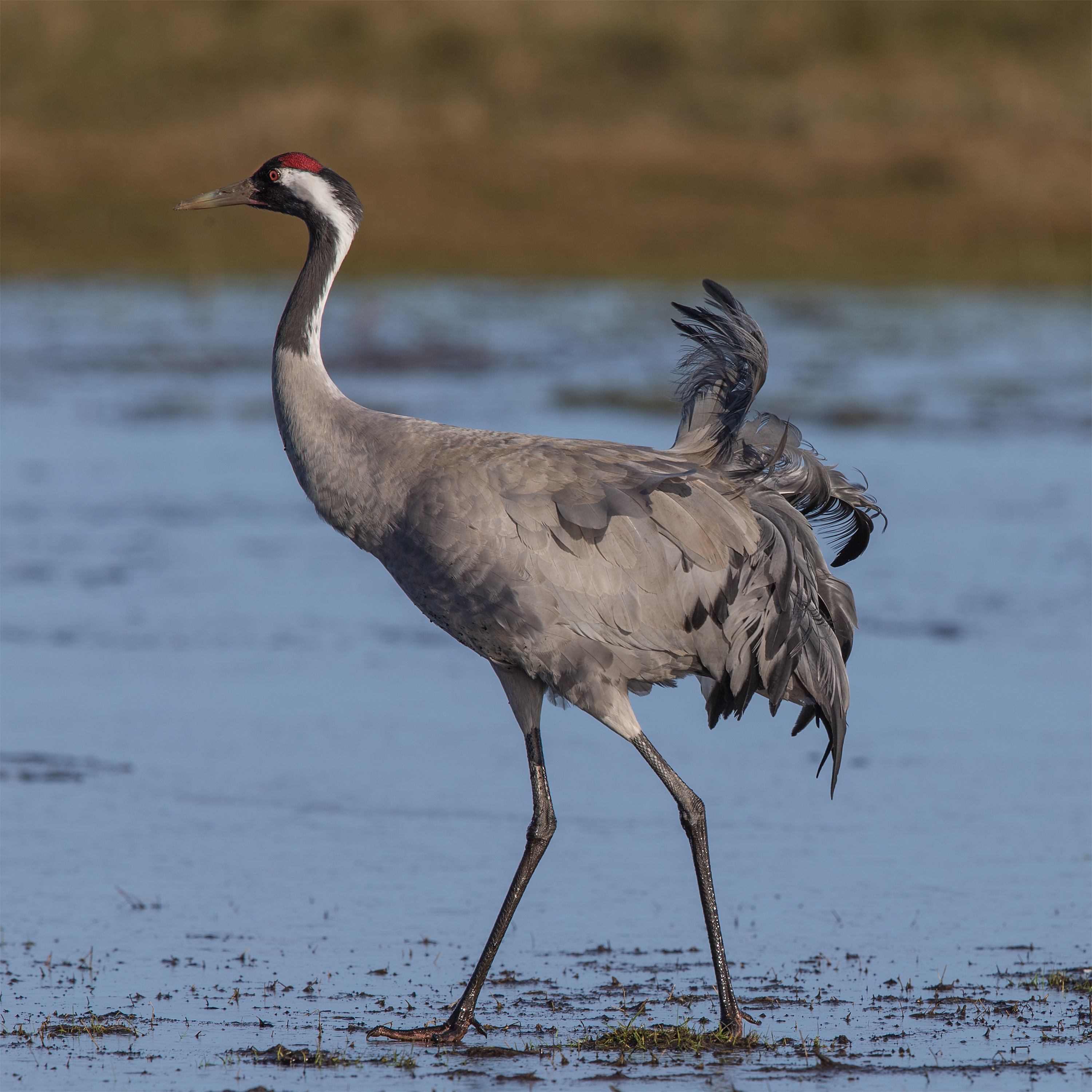
The Common Crane, also known as the Eurasian Crane, is a large, long-legged, long-necked bird of the crane family. It is known for its elegant appearance, distinctive trumpeting call, and elaborate courtship dances. These migratory birds are iconic symbols of wild wetlands and open landscapes across much of the Palearctic.
Size & lifespan
- Length
- 100-130 cm (39-51 in)
- Wingspan
- 180-240 cm (71-94 in)
- Weight
- 3.0-6.1 kg (6.6-13.5 lb), with males generally larger than females
- Lifespan
- Up to 30 years in the wild, though typically 10-20 years.
- Diet
- Omnivorous, consisting of grains, seeds, roots, leaves, berries, insects, snails, frogs, small reptiles, and rodents, varying seasonally.
Physical characteristics
- Plumage
- Adults have mostly slate-grey plumage over the body, with a prominent white stripe extending from behind the eye down the neck. The crown is black with a distinctive bare patch of red skin, which is brighter during breeding season. The primaries and secondaries are black, while the tertials are elongated, dark, and plume-like, forming a 'bustle' over the tail. Juveniles are brownish-grey with a feathered, reddish-brown head.
- Beak shape
- Long, conical, and sharp, yellowish-green to olive-brown.
- Eye color
- Reddish-orange.
- Leg color
- Dark grey to black.
- Distinguishing features
- Bare red crown patch, white stripe from eye to upper back, and drooping, bushy tertiary feathers (bustle) which cover the tail.
- Juvenile appearance
- Young birds are light brownish-grey overall, lacking the distinct white stripe and red crown patch of adults. Their head is fully feathered, with a brownish wash. The tertial plumes are shorter and less developed.
- Seasonal changes
- The red crown patch intensifies in color during the breeding season. Plumage color may become slightly lighter or more worn outside of breeding. No major seasonal plumage changes like molting into a distinct non-breeding plumage.
- Sexual dimorphism
- Males and females are similar in appearance, though males are generally slightly larger and have a marginally larger red crown patch. Behaviorally, their display calls can differentiate sexes.
How to identify
- 1
Size and Shape
Very large, tall, grey wading bird with long legs, long neck, and heavy, pointed bill. Erect posture both standing and in flight.
- 2
Plumage
Overall slate-grey with black wingtips. Look for the striking white stripe running from behind the eye down the side of the neck. The black crown has a bare red patch.
- 3
Tertial Plumes
Distinctive elongated, dark, shaggy tertial feathers that droop over the tail, creating a 'bustle' or 'tail-like' appearance. This is a key identification feature.
- 4
Flight Profile
Flies with neck and legs outstretched, unlike herons which retract their neck. Often in V-formation or long lines, characterized by powerful, graceful wingbeats.
- 5
Vocalization
Listen for their loud, bugling, trumpeting calls, especially heard during migration or paired displays. These calls are very distinctive and carry long distances.
- 6
Behavior
Often seen foraging in open fields or wet meadows. Watch for their characteristic courtship dances during breeding season, involving bowing, jumping, and tossing vegetation.
Habitat & range
- Biomes
- Temperate forests, boreal forests, grasslands, steppes, marshes, fens, bogs, and agricultural plains.
- Geographic range
- Breeds across Northern Europe and Asia, from Scandinavia and Eastern Europe eastward through Russia and Siberia to northeastern China and Mongolia. Winters in Southern Europe, North Africa (e.g., Sudan, Ethiopia), the Middle East, India, and parts of East Asia (e.g., China, Korea, Japan).
- Elevation range
- Primarily lowlands and wetlands, though can be found at higher elevations during migration over mountain ranges.
- Preferred environments
- Extensive wetlands, peatlands, bogs, and fens for breeding. During migration and winter, they utilize agricultural fields (especially stubble fields after harvest), damp grasslands, and shallow flooded areas for feeding and roosting.
Behavior
- Activity time
- Diurnal, most active during daylight hours for feeding and movement. Roosts communally at night, often in shallow water or on sandbars, for safety.
- Feeding habits
- Forages by walking slowly and probing the ground with its long bill. They graze on cultivated grains (wheat, barley, corn) in agricultural fields, dig for roots and tubers, and catch invertebrates and small vertebrates in wetlands and pastures.
- Social behavior
- Highly social, especially outside the breeding season, forming large flocks of hundreds or even thousands of birds at roosting and feeding sites. During breeding season, they are more territorial and often found in pairs.
- Flight pattern
- Powerful and direct, with slow, deep wing beats. They fly with their neck outstretched and legs trailing behind, often in V-formations or long lines during migration.
- Migration pattern
- Long-distance migrant, undertaking annual journeys between breeding grounds in the north and wintering grounds in the south. Spring migration occurs from late February to May, and autumn migration from August to November. Migratory routes are well-established.
- Territoriality
- Breeding pairs are territorial, defending their nesting areas against other cranes. During non-breeding seasons, they are more communal, though individuals may defend prime foraging spots.
Song & calls
- Song
- The 'unison call' is a characteristic feature, performed by pairs during courtship and territorial display. It is a loud, far-carrying, resonant trumpeting, often described as 'krru-krru-krru'.
- Call
- Aside from the unison call, they emit loud, bugling calls in flight, alarm calls, and contact calls. The calls are produced by a long trachea coiling within the sternum, acting as a resonator.
- When they vocalize
- Most vocal during the breeding season (courtship and nesting) and during migration when large flocks communicate.
Breeding & reproduction
- Breeding season
- Typically April to June, varying with geographic location.
- Nesting habits
- Monogamous pairs. Nests are usually large mounds of vegetation (grasses, sedges, mosses) built on the ground in shallow water, dense reedbeds, or on small islands within wetlands. Both parents construct the nest.
- Clutch size
- Typically 2 eggs.
- Egg description
- Usually 2 eggs (occasionally 1 or 3), oval to sub-elliptical, dull olive-brown to pale buff with darker brown or reddish-brown speckles and blotches.
- Incubation period
- 28-31 days, shared by both parents.
- Fledging period
- 65-70 days. Chicks are precocial and can walk and feed shortly after hatching, but remain dependent on parents for food and protection for an extended period.
- Parental care
- Both parents share incubation duties and care for the young, leading them to food sources and protecting them from predators. The family unit often stays together until the next breeding season.
Where to find
Breeding Grounds
Extensive wetlands, bogs, fens, and shallow marshy areas with dense vegetation across Northern Europe and Asia. Look near lakes, slow-moving rivers, and flooded woodlands.
Migration Stopovers
Large open agricultural fields (especially stubble fields after harvest), wet grasslands, and shallow wetlands along established migratory routes. Key sites include reservoirs and managed nature reserves.
Wintering Grounds
Large, open agricultural plains, irrigated fields, and shallow wetlands in Southern Europe (e.g., Spain, France), North Africa, the Middle East, and parts of Asia (e.g., India, China).
Field tips
- Listen for Calls. Their loud, bugling calls are often heard before the birds are seen, especially during migration when flocks are high overhead. These sounds can guide you to their presence.
- Scan Open Landscapes. Cranes prefer open areas for foraging and roosting. Use binoculars or a scope to scan large fields, floodplains, and wetlands from a distance to avoid disturbing them.
- Visit Known Migration Hotspots. Research specific crane migration routes and major stopover sites (e.g., Lac du Der in France, Hornborga Lake in Sweden, Hula Valley in Israel, Keoladeo National Park in India) during peak migration periods for spectacular viewing opportunities.
- Early Morning/Late Evening. Cranes are often most active and visible during dawn and dusk as they move between roosting sites and feeding grounds.
- Look for Distant Flocks. During migration, large flocks can be seen high in the sky, often forming V-patterns. Even if they are tiny specks, their characteristic flight formation can reveal them.
Similar species
Sandhill Crane
Antigone canadensis
The Sandhill Crane has a more uniformly grey body, lacks the distinct white stripe on the neck, and its red crown patch is larger and extends further onto the face. Its tertial plumes are less bushy and elegant than the Common Crane's. Sandhill Cranes are primarily found in North America.
Siberian Crane
Leucogeranus leucogeranus
The Siberian Crane is almost entirely white, except for black primaries and a distinctive bare red face extending from the bill. Its size is comparable to the Common Crane, but its striking white plumage makes it easily distinguishable.
Demoiselle Crane
Anthropoides virgo
The Demoiselle Crane is considerably smaller than the Common Crane. It has a similar grey body but features striking white ear tufts and a black neck with a pendant chest plume. It also lacks the distinct red crown patch of the Common Crane.
Quick facts
- Average clutch size:
- 2 eggs
- Incubation period:
- 28-31 days
- Fledging period:
- 65-70 days
- Social behavior:
- Highly social in non-breeding season, solitary pairs during breeding
- Migration:
- Long-distance migrant
Fun facts
- Common Cranes perform elaborate, ritualized dances, not only for courtship but also as a form of social bonding and stress relief. These dances involve bowing, wing-flapping, jumping, and throwing objects.
- Their loud, resonant call is due to a long trachea that coils within the sternum, acting as a natural resonating chamber, similar to a trombone.
- Cranes are considered symbols of longevity, happiness, and peace in many cultures, particularly in East Asia.
- Remarkably, they sometimes use 'tool use' by applying mud or vegetation to their plumage during incubation. This is thought to be camouflage or an insect deterrent.
Scientific classification
- Kingdom
- Animalia
- Phylum
- Chordata
- Class
- Aves
- Order
- Gruiformes
- Family
- Gruidae
- Genus
- Grus
- Species
- Grus grus
Explore the Common Crane
Identify birds anywhere
Free on iOS, Android, and Web. Photo & sound identification, full species database, and your personal life list.