
How to identify the Common Crane
Grus grus
Spotted a bird? Identify it instantly with the Birdby app
Open the appTo correctly identify the Common Crane (Grus grus), check each of these features. Birds can be tricky: habit, habitat, and call often confirm a sighting that a single photo cannot.
Size at a glance
- Length
- 100-130 cm (39-51 in)
- Wingspan
- 180-240 cm (71-94 in)
- Weight
- 3.0-6.1 kg (6.6-13.5 lb), with males generally larger than females
Physical features to check
- 1
Plumage
Overall feather coloration and pattern.
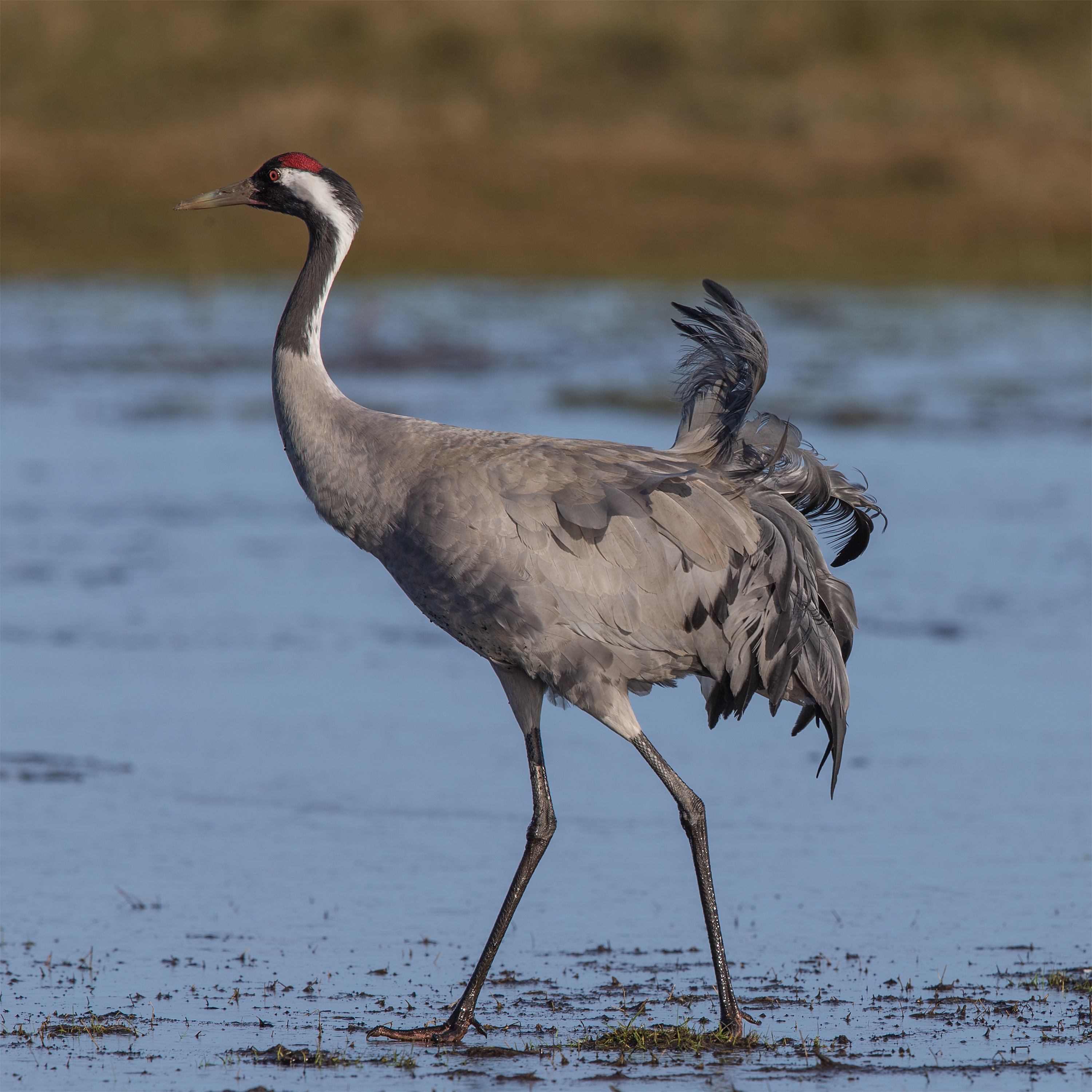
Adults have mostly slate-grey plumage over the body, with a prominent white stripe extending from behind the eye down the neck. The crown is black with a distinctive bare patch of red skin, which is brighter during breeding season. The primaries and secondaries are black, while the tertials are elongated, dark, and plume-like, forming a 'bustle' over the tail. Juveniles are brownish-grey with a feathered, reddish-brown head.
- 2
Beak shape
Shape and color of the bill: a key field mark.
Long, conical, and sharp, yellowish-green to olive-brown.
- 3
Eye color
Iris color and any distinctive eye markings.
Reddish-orange.
- 4
Leg color
Leg and foot color.
Dark grey to black.
- 5
Distinguishing features
Standout features that separate this species.
Bare red crown patch, white stripe from eye to upper back, and drooping, bushy tertiary feathers (bustle) which cover the tail.
- 6
Juvenile appearance
How young birds differ from adults.
Young birds are light brownish-grey overall, lacking the distinct white stripe and red crown patch of adults. Their head is fully feathered, with a brownish wash. The tertial plumes are shorter and less developed.
- 7
Seasonal changes
Plumage variation between breeding and non-breeding seasons.
The red crown patch intensifies in color during the breeding season. Plumage color may become slightly lighter or more worn outside of breeding. No major seasonal plumage changes like molting into a distinct non-breeding plumage.
- 8
Sexual dimorphism
How males and females differ.
Males and females are similar in appearance, though males are generally slightly larger and have a marginally larger red crown patch. Behaviorally, their display calls can differentiate sexes.
Key field marks
- Size and Shape. Very large, tall, grey wading bird with long legs, long neck, and heavy, pointed bill. Erect posture both standing and in flight.
- Plumage. Overall slate-grey with black wingtips. Look for the striking white stripe running from behind the eye down the side of the neck. The black crown has a bare red patch.
- Tertial Plumes. Distinctive elongated, dark, shaggy tertial feathers that droop over the tail, creating a 'bustle' or 'tail-like' appearance. This is a key identification feature.
- Flight Profile. Flies with neck and legs outstretched, unlike herons which retract their neck. Often in V-formation or long lines, characterized by powerful, graceful wingbeats.
- Vocalization. Listen for their loud, bugling, trumpeting calls, especially heard during migration or paired displays. These calls are very distinctive and carry long distances.
- Behavior. Often seen foraging in open fields or wet meadows. Watch for their characteristic courtship dances during breeding season, involving bowing, jumping, and tossing vegetation.
Explore the Common Crane
Identify birds anywhere
Free on iOS, Android, and Web. Photo & sound identification, full species database, and your personal life list.