
Spotted a bird? Identify it instantly with the Birdby app
Open the appAbout
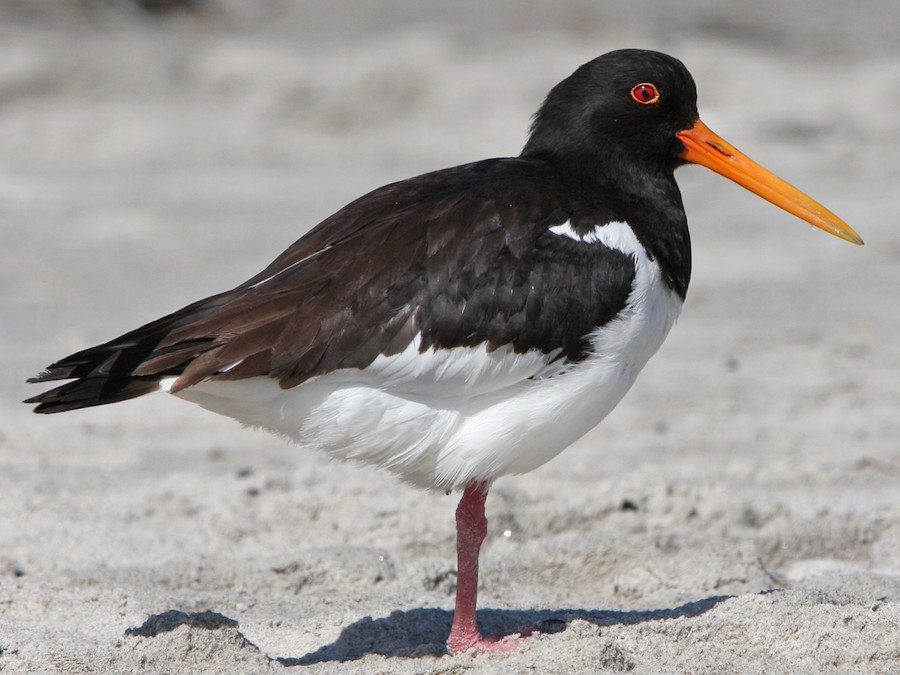
The Eurasian Oystercatcher is a large, distinctive wader known for its striking black and white plumage, long orange-red bill, and loud, piping calls. It is a common and conspicuous bird of coastal areas and increasingly, inland agricultural fields across much of Eurasia.
Size & lifespan
- Length
- 40-45 cm
- Wingspan
- 80-86 cm
- Weight
- 420-820 g
- Lifespan
- Up to 30 years in the wild, typically 10-15 years.
- Diet
- Carnivore, primarily feeding on bivalve molluscs (mussels, cockles), polychaete worms, crustaceans, and sometimes insects and small fish. They use their specialized bills to pry open or hammer shells.
Physical characteristics
- Plumage
- Adults have glossy black upperparts (head, neck, back, wings) and pure white underparts (belly, rump, flanks). A prominent white wing-bar is visible in flight. The tail is black with a white base.
- Beak shape
- Long (7-10 cm), straight, chisel-tipped, and bright orange-red, fading slightly at the tip. The bill is laterally compressed, ideal for prying open shells.
- Eye color
- Bright red iris with a narrow orange-red orbital ring.
- Leg color
- Strong, relatively short, pinkish-red legs and feet.
- Distinguishing features
- The combination of entirely black head and upperparts, white underparts, long orange-red bill, and pinkish-red legs is unique among European waders. The white wing-bar and white rump are also key in flight.
- Juvenile appearance
- Juveniles have duller, browner black plumage, often with pale fringes to feathers, giving a scaly appearance. Their bill is duller orange-yellow with a dark tip, and their legs are greyish-pink. The eye is dark brown, gradually turning red.
- Seasonal changes
- Breeding plumage is crisp black and white. In non-breeding (winter) plumage, adults develop a variable white half-collar or crescent across the throat, which can sometimes extend to a full collar. The bill color may also be slightly duller.
- Sexual dimorphism
- Males and females are largely monomorphic in plumage. Females tend to have slightly longer bills on average, but this is not a reliable field mark for individual identification.
How to identify
- 1
Plumage
Look for the stark contrast of glossy black upperparts (head, neck, back, wings) and pure white underparts. A white wing-bar is prominent in flight.
- 2
Bill
The long, straight, bright orange-red bill is unmistakable. It's chisel-tipped and often appears slightly paler at the very tip.
- 3
Legs
Pinkish-red legs are a key feature, contrasting with the black and white body.
- 4
Eye
Bright red eyes with an orange-red orbital ring are distinctive.
- 5
Call
Listen for the loud, piping 'kleep' or 'pic' calls, often given rapidly in a 'piping display' or as an alarm.
- 6
Habitat
Typically found on coastal mudflats, estuaries, and beaches, though increasingly inland on agricultural land during breeding.
Habitat & range
- Biomes
- Coastal marine, estuarine, freshwater wetlands, agricultural land.
- Geographic range
- Widespread across temperate Eurasia, from Iceland and Western Europe east to Siberia and China. Winters mainly in Western Europe, the Mediterranean, and parts of Africa and Asia.
- Elevation range
- Primarily found at sea level, occasionally up to a few hundred meters inland.
- Preferred environments
- Rocky and sandy coasts, mudflats, estuaries, saltmarshes, shingle beaches, and increasingly, inland grasslands, arable fields, and riverbanks, especially during breeding season.
Behavior
- Activity time
- Diurnal, but also feeds nocturnally on tidal flats when the tide is out, especially during full moon periods.
- Feeding habits
- Highly specialized feeders. They probe soft mud or sand for worms, or use their strong bills to pry open bivalves (e.g., mussels, cockles) or hammer them open. They often feed in flocks, especially outside the breeding season, following the tide line. They are opportunistic and will also take crabs, limpets, and insects.
- Social behavior
- Highly social outside the breeding season, forming large flocks on coastal mudflats and roosts. During breeding, they are territorial and typically found in pairs, though loose colonies can occur.
- Flight pattern
- Strong, direct flight with rapid, shallow wingbeats. Often flies in V-formations or long lines during migration. The prominent white wing-bar and white rump are very noticeable in flight.
- Migration pattern
- Most populations are migratory, moving south and west for the winter. Birds from northern and eastern Europe migrate to the coasts of Western Europe and the Mediterranean. Some western European populations are resident or undertake short-distance movements. They migrate in large flocks.
- Territoriality
- Strongly territorial during the breeding season, defending nesting sites and feeding areas from conspecifics and other waders with aggressive displays and loud calls.
Song & calls
- Song
- The 'song' is a loud, rapid, and excited 'klee-klee-klee-klee-klee' or 'pic-pic-pic-pic' often given in a 'piping display' where several birds run together with bills pointed downwards, calling loudly. This display is used in territorial defense and courtship.
- Call
- The most common call is a loud, sharp, and far-carrying 'kleep' or 'pic' often repeated. Alarm calls are sharper and more insistent. Contact calls are softer 'kip-kip'.
- When they vocalize
- Vocalizes year-round, but most frequently and intensely during the breeding season, especially during territorial disputes and courtship displays. Also very vocal when disturbed or in flight.
Breeding & reproduction
- Breeding season
- April to July, with peak egg-laying in May.
- Nesting habits
- Nests are typically shallow scrapes on the ground, often lined with small stones, shell fragments, or vegetation. They are usually located on open ground, such as shingle beaches, sand dunes, saltmarshes, coastal fields, or even inland arable land.
- Clutch size
- 2-4 eggs (most commonly 3).
- Egg description
- Typically 2-4 (usually 3) eggs. Eggs are pale buff to olive-brown, heavily blotched and spotted with dark brown or black, providing excellent camouflage.
- Incubation period
- 24-27 days, incubated by both parents.
- Fledging period
- Chicks are precocial and leave the nest shortly after hatching. They are able to feed themselves but are guarded by parents. They fledge (become capable of sustained flight) at 30-35 days.
- Parental care
- Both parents share incubation duties and care for the young. They are highly protective of their chicks, often performing distraction displays to lure predators away.
Where to find
Coastal Mudflats and Estuaries
Excellent places to find large flocks, especially during migration and winter, as they feed on exposed invertebrates.
Shingle and Sandy Beaches
Often found foraging along the tideline or nesting on less disturbed sections of beaches.
Saltmarshes
Used for feeding and roosting, particularly during high tide.
Inland Agricultural Fields
Increasingly common breeding sites in some regions, particularly near coasts or large rivers.
Field tips
- Look for movement. Their distinctive feeding behavior, probing or hammering shells, makes them stand out on mudflats.
- Listen for calls. Their loud, piping calls are often heard before the bird is seen, especially when disturbed or during territorial displays.
- Check tide times. They are most active on mudflats and estuaries when the tide is out, exposing their food sources.
- Scan open areas. They prefer open, unobstructed areas for feeding and nesting, making them relatively easy to spot.
Similar species
American Oystercatcher
Haematopus palliatus
The American Oystercatcher has a brown back and wings, contrasting with its black head and white belly. The Eurasian Oystercatcher has an entirely black back and wings.
African Oystercatcher
Haematopus moquini
The African Oystercatcher is entirely black with a red bill and legs, lacking the white underparts of the Eurasian Oystercatcher.
Pied Oystercatcher
Haematopus longirostris
Found in Australia, similar black and white pattern but typically has a more extensive white wing-bar and slightly different bill shape. Geographic range is a key differentiator.
Quick facts
- Distinctive Feature:
- Long orange-red bill
- Primary Diet:
- Bivalve molluscs
- Nesting Site:
- Ground scrape on open areas
- Sociality:
- Highly social in winter, territorial in breeding
- Migration:
- Mostly migratory, some resident
Fun facts
- The Eurasian Oystercatcher's bill is highly specialized. Individuals can be 'stabbers' (probing for worms), 'hammerers' (smashing shells), or 'priyers' (opening bivalves), and this skill is learned from their parents.
- Despite their name, oysters are not their primary food source; mussels and cockles are much more common prey.
- They are one of the few wader species that have successfully adapted to breeding inland on agricultural land, a relatively recent behavioral shift.
- The 'piping display' is a remarkable courtship and territorial ritual where several birds run in a tight circle or line, calling loudly with bills pointed downwards.
- Their bright red eyes and orbital ring are thought to play a role in communication and display.
Scientific classification
- Kingdom
- Animalia
- Phylum
- Chordata
- Class
- Aves
- Order
- Charadriiformes
- Family
- Haematopodidae
- Genus
- Haematopus
- Species
- Haematopus ostralegus
Explore the Eurasian Oystercatcher
Identify birds anywhere
Free on iOS, Android, and Web. Photo & sound identification, full species database, and your personal life list.