
How to identify the Eurasian Oystercatcher
Haematopus ostralegus
Spotted a bird? Identify it instantly with the Birdby app
Open the appTo correctly identify the Eurasian Oystercatcher (Haematopus ostralegus), check each of these features. Birds can be tricky: habit, habitat, and call often confirm a sighting that a single photo cannot.
Size at a glance
- Length
- 40-45 cm
- Wingspan
- 80-86 cm
- Weight
- 420-820 g
Physical features to check
- 1
Plumage
Overall feather coloration and pattern.
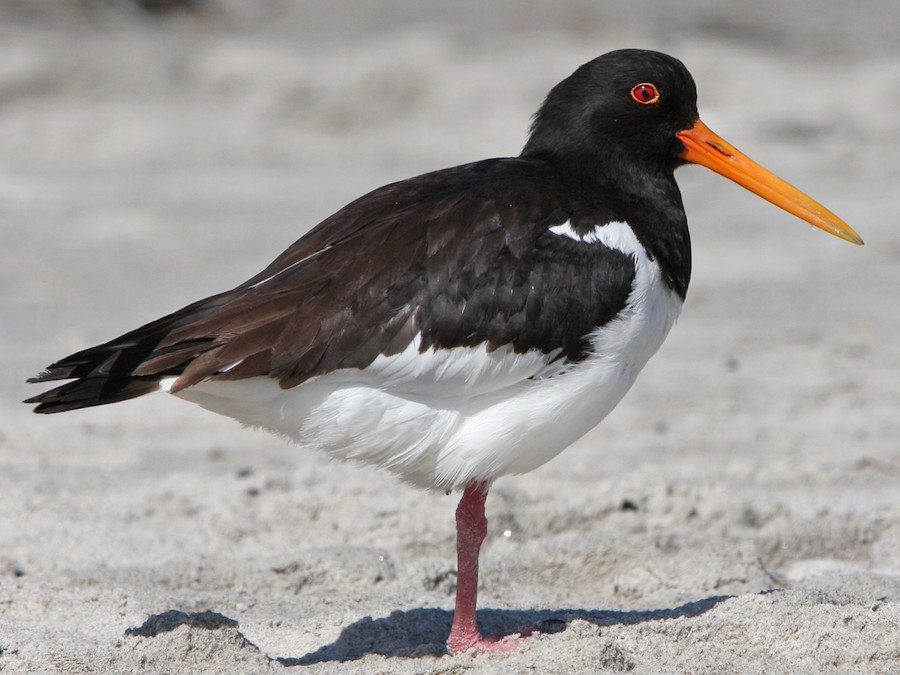
Adults have glossy black upperparts (head, neck, back, wings) and pure white underparts (belly, rump, flanks). A prominent white wing-bar is visible in flight. The tail is black with a white base.
- 2
Beak shape
Shape and color of the bill: a key field mark.
Long (7-10 cm), straight, chisel-tipped, and bright orange-red, fading slightly at the tip. The bill is laterally compressed, ideal for prying open shells.
- 3
Eye color
Iris color and any distinctive eye markings.
Bright red iris with a narrow orange-red orbital ring.
- 4
Leg color
Leg and foot color.
Strong, relatively short, pinkish-red legs and feet.
- 5
Distinguishing features
Standout features that separate this species.
The combination of entirely black head and upperparts, white underparts, long orange-red bill, and pinkish-red legs is unique among European waders. The white wing-bar and white rump are also key in flight.
- 6
Juvenile appearance
How young birds differ from adults.
Juveniles have duller, browner black plumage, often with pale fringes to feathers, giving a scaly appearance. Their bill is duller orange-yellow with a dark tip, and their legs are greyish-pink. The eye is dark brown, gradually turning red.
- 7
Seasonal changes
Plumage variation between breeding and non-breeding seasons.
Breeding plumage is crisp black and white. In non-breeding (winter) plumage, adults develop a variable white half-collar or crescent across the throat, which can sometimes extend to a full collar. The bill color may also be slightly duller.
- 8
Sexual dimorphism
How males and females differ.
Males and females are largely monomorphic in plumage. Females tend to have slightly longer bills on average, but this is not a reliable field mark for individual identification.
Key field marks
- Plumage. Look for the stark contrast of glossy black upperparts (head, neck, back, wings) and pure white underparts. A white wing-bar is prominent in flight.
- Bill. The long, straight, bright orange-red bill is unmistakable. It's chisel-tipped and often appears slightly paler at the very tip.
- Legs. Pinkish-red legs are a key feature, contrasting with the black and white body.
- Eye. Bright red eyes with an orange-red orbital ring are distinctive.
- Call. Listen for the loud, piping 'kleep' or 'pic' calls, often given rapidly in a 'piping display' or as an alarm.
- Habitat. Typically found on coastal mudflats, estuaries, and beaches, though increasingly inland on agricultural land during breeding.
Explore the Eurasian Oystercatcher
Identify birds anywhere
Free on iOS, Android, and Web. Photo & sound identification, full species database, and your personal life list.