
Spotted a bird? Identify it instantly with the Birdby app
Open the appAbout
The House Finch is a small-bodied passerine bird native to western North America and introduced to eastern North America and Hawaii. It is a common and adaptable species, often found in urban and suburban environments, known for the male's distinctive reddish coloration and its cheerful, warbling song. They are primarily seed-eaters and frequently visit bird feeders.
Size & lifespan
- Length
- 12.5-15 cm (5-6 in)
- Wingspan
- 20-25 cm (7.9-9.8 in)
- Weight
- 16-27 g (0.56-0.95 oz)
- Lifespan
- 2-7 years (up to 11 years in the wild)
- Diet
- Herbivore (primarily granivorous)
Physical characteristics
- Plumage
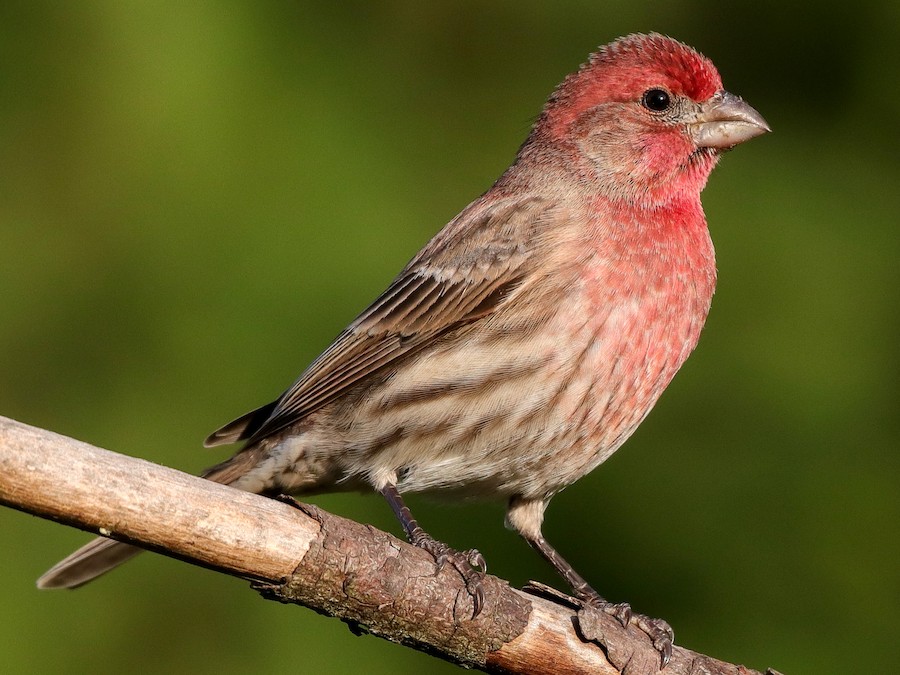
- Males typically have a rosy red forehead, supercilium, throat, and upper breast, contrasting with brown streaked flanks and belly. The back, wings, and tail are brown, often with faint streaking. Females are duller, lacking the red coloration, and are uniformly streaked brown and gray, with a plain face and indistinct streaking on the underparts. Both sexes have a relatively short, conical bill and a notched tail.
- Beak shape
- Short, stout, conical bill, adapted for cracking seeds. Color is typically grayish-horn.
- Eye color
- Dark brown
- Leg color
- Dark gray to blackish
- Distinguishing features
- Males: rosy red on head and breast, streaked underparts. Females: heavily streaked brown and gray overall, lacking strong facial patterns. Notched tail. Relatively small size.
- Juvenile appearance
- Juveniles resemble adult females, being dull brown and streaked. Young males may show faint hints of reddish coloration as they mature.
- Seasonal changes
- No significant seasonal plumage changes. The intensity of the male's red coloration can vary based on diet (carotenoid intake), ranging from bright red to orange or even yellowish.
- Sexual dimorphism
- Pronounced. Males display rosy red on the head, throat, and breast, while females are dull brown and heavily streaked, lacking any red.
How to identify
- 1
Male Plumage
Look for the rosy red coloration on the forehead, throat, and upper breast. Note the brown streaking on the flanks and belly, which distinguishes it from the more uniformly colored Purple Finch.
- 2
Female Plumage
Observe the overall dull brown and heavily streaked appearance. The face is plain, lacking strong facial markings like a distinct supercilium or malar stripe, which helps differentiate it from female Purple Finches.
- 3
Bill Shape
Both sexes have a relatively short, stout, conical bill, typical for a seed-eating finch.
- 4
Tail Shape
The tail is moderately notched, a characteristic finch trait.
- 5
Song
Listen for the cheerful, jumbled, warbling song, often ending with a rising 'veeer' note. This distinctive song is a key identifier, especially in urban areas.
- 6
Habitat and Behavior
House Finches are very common in human-modified environments (suburbs, parks, cities) and are frequent visitors to bird feeders. Their social nature and tendency to forage in flocks are also good clues.
Habitat & range
- Biomes
- Temperate forests, grasslands, urban/suburban areas, deserts, chaparral, agricultural lands.
- Geographic range
- Native to western North America from southern Canada to Mexico. Introduced populations are widespread across eastern North America (from southern Canada to Florida) and Hawaii.
- Elevation range
- Sea level up to 2,500 meters (8,200 feet), occasionally higher in some parts of its native range.
- Preferred environments
- Highly adaptable, preferring semi-open areas with scattered trees, shrubs, and human structures. Common in residential areas, parks, farms, orchards, and urban centers. Less common in dense forests or open grasslands without cover.
Behavior
- Activity time
- Diurnal
- Feeding habits
- Primarily granivorous, feeding on a wide variety of seeds, including those from weeds, grasses, and trees. They also consume buds, fruits (berries, cherries), and occasionally small insects (especially when feeding young). They are frequent visitors to bird feeders, preferring black oil sunflower seeds and nyjer. They forage on the ground, in shrubs, and in trees.
- Social behavior
- Highly social, especially outside the breeding season, forming flocks that can number in the hundreds. During breeding, they are found in pairs but may nest in loose colonies. They are often seen foraging in groups.
- Flight pattern
- Undulating flight pattern, typical of finches, with rapid wing beats followed by a brief glide on closed wings. Often flies in small, cohesive flocks.
- Migration pattern
- Generally resident throughout most of their range. Northern populations may undertake short-distance, irruptive movements in winter, especially in response to food availability. Eastern populations are largely sedentary.
- Territoriality
- Males defend a small territory around the nest during the breeding season, primarily through singing. Flocks are not territorial.
Song & calls
- Song
- A long, jumbled, cheerful, and often rambling series of warbled notes, often ending with a rising 'veeer' or 'wheeeer' note. It can sound somewhat unorganized but is generally pleasant and musical. Males sing frequently from prominent perches.
- Call
- Common calls include a sharp 'cheep' or 'chit' note, often given in flight or when agitated. They also have a softer 'tew' or 'weet' contact call.
- When they vocalize
- Males sing most frequently during the breeding season (spring and summer) to attract mates and defend territory. Calls are given year-round.
Breeding & reproduction
- Breeding season
- Typically March to August, but can vary geographically and may extend longer in warmer climates or with multiple broods.
- Nesting habits
- Nests are built by the female, usually in dense shrubs, conifers, deciduous trees, cacti, or on human structures like eaves, window ledges, hanging baskets, and streetlights. The nest is a cup-shaped structure made of twigs, grasses, weeds, leaves, and sometimes artificial materials like string or feathers, lined with finer materials.
- Clutch size
- 2-6 eggs, most commonly 4-5.
- Egg description
- 3-6 eggs, typically pale bluish-green to whitish, speckled with fine black, purple, or olive spots and streaks, often concentrated at the larger end. Eggs measure approximately 19 x 14 mm.
- Incubation period
- 12-14 days, primarily by the female.
- Fledging period
- 11-19 days after hatching. Young are fed by both parents.
- Parental care
- Both parents feed the nestlings and fledglings. The male often feeds the female on the nest during incubation. Females may start a second clutch while the male continues to feed the first brood.
Where to find
Suburban and Urban Areas
Backyards, parks, gardens, city streets, and any area with human habitation and scattered vegetation.
Agricultural Lands
Orchards, farms, and cultivated areas where food sources are abundant.
Desert Edges and Chaparral
In their native western range, they can be found in arid and semi-arid scrublands near water sources.
Bird Feeders
One of the most common visitors to feeders, especially those offering sunflower or nyjer seeds.
Field tips
- Listen for the Song. Their distinctive, rambling song is often the first indication of their presence, especially from a high perch.
- Check Bird Feeders. House Finches are highly attracted to feeders, particularly those with black oil sunflower seeds. They often dominate feeders.
- Look in Shrubs and Trees. They forage and nest in a variety of vegetation, from small shrubs to tall trees. Check dense foliage for movement.
- Observe Social Behavior. Outside of breeding, they are often in flocks. Look for groups of small, streaky brown birds.
- Note Male Coloration. The male's red plumage is quite variable. Don't be surprised to see individuals with orange or yellowish tints, which is still characteristic of the species.
Similar species
Purple Finch
Haemorhous purpureus
Male Purple Finches have a more uniform raspberry-red wash over the head, back, and breast, appearing 'dipped in raspberry juice,' without the distinct streaking on the flanks seen in House Finches. Their facial pattern is less defined. Female Purple Finches have a strong white supercilium (eyebrow stripe) and a dark malar stripe, giving them a more patterned face than female House Finches. Purple Finches also have a larger, more conical bill and a less notched tail.
Cassin's Finch
Haemorhous cassinii
Male Cassin's Finches have a brighter, more restricted red crown, with a pinkish wash on the breast and back, and less streaking on the flanks than House Finches. They often show a slightly peaked crown. Female Cassin's Finches are more finely streaked on the underparts and have a more distinct facial pattern with a pale eye-ring and faint supercilium compared to female House Finches. Cassin's Finches typically inhabit higher elevation coniferous forests.
Pine Siskin
Spinus pinus
Pine Siskins are smaller, more slender, and heavily streaked brown overall, with distinctive yellow patches in the wings and at the base of the tail (visible in flight). Their bill is more slender and pointed than a House Finch's. They often have a more erratic, buzzy call.
Quick facts
- Diet:
- Almost exclusively seeds, buds, and fruits
- Habitat:
- Urban, suburban, agricultural, semi-open areas
- Sociality:
- Highly social, often in flocks
- Migration:
- Mostly resident, some short-distance movements
- Nest Location:
- Trees, shrubs, cacti, human structures
- Clutch Size:
- 2-6 eggs
Fun facts
- The House Finch was originally a western species. In 1940, a small number were illegally released in Long Island, New York, and they rapidly expanded their range across eastern North America, becoming one of the most common backyard birds.
- The intensity of a male House Finch's red plumage is directly related to the amount of carotenoid pigments in its diet. Brighter red males are generally considered more attractive by females and may be healthier.
- House Finches are known to occasionally hybridize with Purple Finches where their ranges overlap, though this is rare.
- They are highly adaptable and have learned to nest in a variety of unusual places, including hanging flower baskets, old Christmas wreaths, and even inside outdoor light fixtures.
- House Finches are susceptible to Mycoplasmal conjunctivitis (House Finch Eye Disease), which can cause swollen, crusty eyes and lead to blindness and death. This disease significantly impacted eastern populations in the 1990s but populations have shown some recovery and resistance.
Scientific classification
- Kingdom
- Animalia
- Phylum
- Chordata
- Class
- Aves
- Order
- Passeriformes
- Family
- Fringillidae
- Genus
- Haemorhous
- Species
- Haemorhous mexicanus
Explore the House Finch
Identify birds anywhere
Free on iOS, Android, and Web. Photo & sound identification, full species database, and your personal life list.