
How to identify the House Finch
Haemorhous mexicanus
Spotted a bird? Identify it instantly with the Birdby app
Open the appTo correctly identify the House Finch (Haemorhous mexicanus), check each of these features. Birds can be tricky: habit, habitat, and call often confirm a sighting that a single photo cannot.
Size at a glance
- Length
- 12.5-15 cm (5-6 in)
- Wingspan
- 20-25 cm (7.9-9.8 in)
- Weight
- 16-27 g (0.56-0.95 oz)
Physical features to check
- 1
Plumage
Overall feather coloration and pattern.
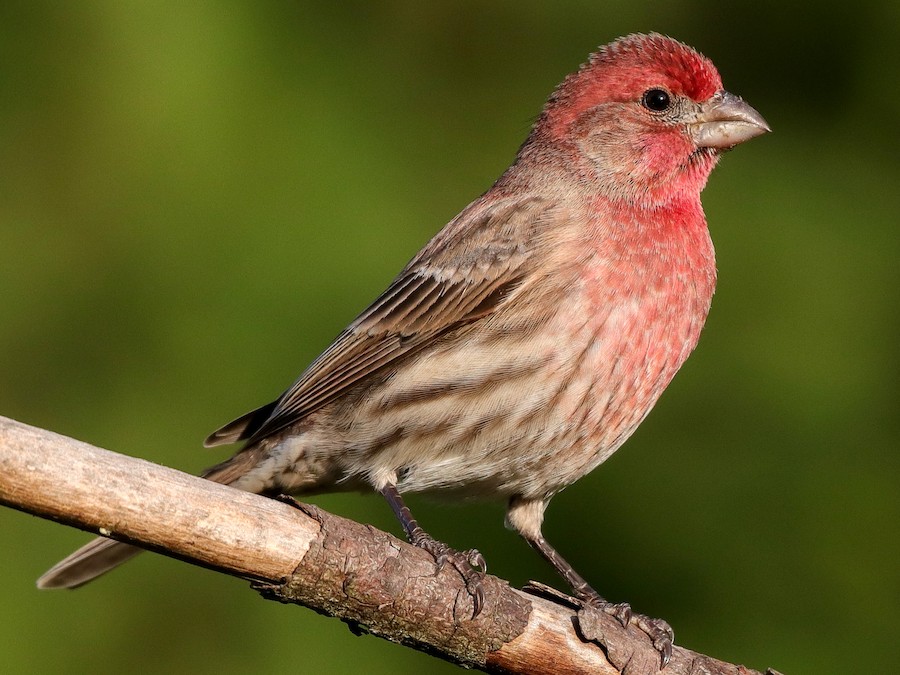
Males typically have a rosy red forehead, supercilium, throat, and upper breast, contrasting with brown streaked flanks and belly. The back, wings, and tail are brown, often with faint streaking. Females are duller, lacking the red coloration, and are uniformly streaked brown and gray, with a plain face and indistinct streaking on the underparts. Both sexes have a relatively short, conical bill and a notched tail.
- 2
Beak shape
Shape and color of the bill: a key field mark.
Short, stout, conical bill, adapted for cracking seeds. Color is typically grayish-horn.
- 3
Eye color
Iris color and any distinctive eye markings.
Dark brown
- 4
Leg color
Leg and foot color.
Dark gray to blackish
- 5
Distinguishing features
Standout features that separate this species.
Males: rosy red on head and breast, streaked underparts. Females: heavily streaked brown and gray overall, lacking strong facial patterns. Notched tail. Relatively small size.
- 6
Juvenile appearance
How young birds differ from adults.
Juveniles resemble adult females, being dull brown and streaked. Young males may show faint hints of reddish coloration as they mature.
- 7
Seasonal changes
Plumage variation between breeding and non-breeding seasons.
No significant seasonal plumage changes. The intensity of the male's red coloration can vary based on diet (carotenoid intake), ranging from bright red to orange or even yellowish.
- 8
Sexual dimorphism
How males and females differ.
Pronounced. Males display rosy red on the head, throat, and breast, while females are dull brown and heavily streaked, lacking any red.
Key field marks
- Male Plumage. Look for the rosy red coloration on the forehead, throat, and upper breast. Note the brown streaking on the flanks and belly, which distinguishes it from the more uniformly colored Purple Finch.
- Female Plumage. Observe the overall dull brown and heavily streaked appearance. The face is plain, lacking strong facial markings like a distinct supercilium or malar stripe, which helps differentiate it from female Purple Finches.
- Bill Shape. Both sexes have a relatively short, stout, conical bill, typical for a seed-eating finch.
- Tail Shape. The tail is moderately notched, a characteristic finch trait.
- Song. Listen for the cheerful, jumbled, warbling song, often ending with a rising 'veeer' note. This distinctive song is a key identifier, especially in urban areas.
- Habitat and Behavior. House Finches are very common in human-modified environments (suburbs, parks, cities) and are frequent visitors to bird feeders. Their social nature and tendency to forage in flocks are also good clues.
Explore the House Finch
Identify birds anywhere
Free on iOS, Android, and Web. Photo & sound identification, full species database, and your personal life list.