
Spotted a bird? Identify it instantly with the Birdby app
Open the appAbout
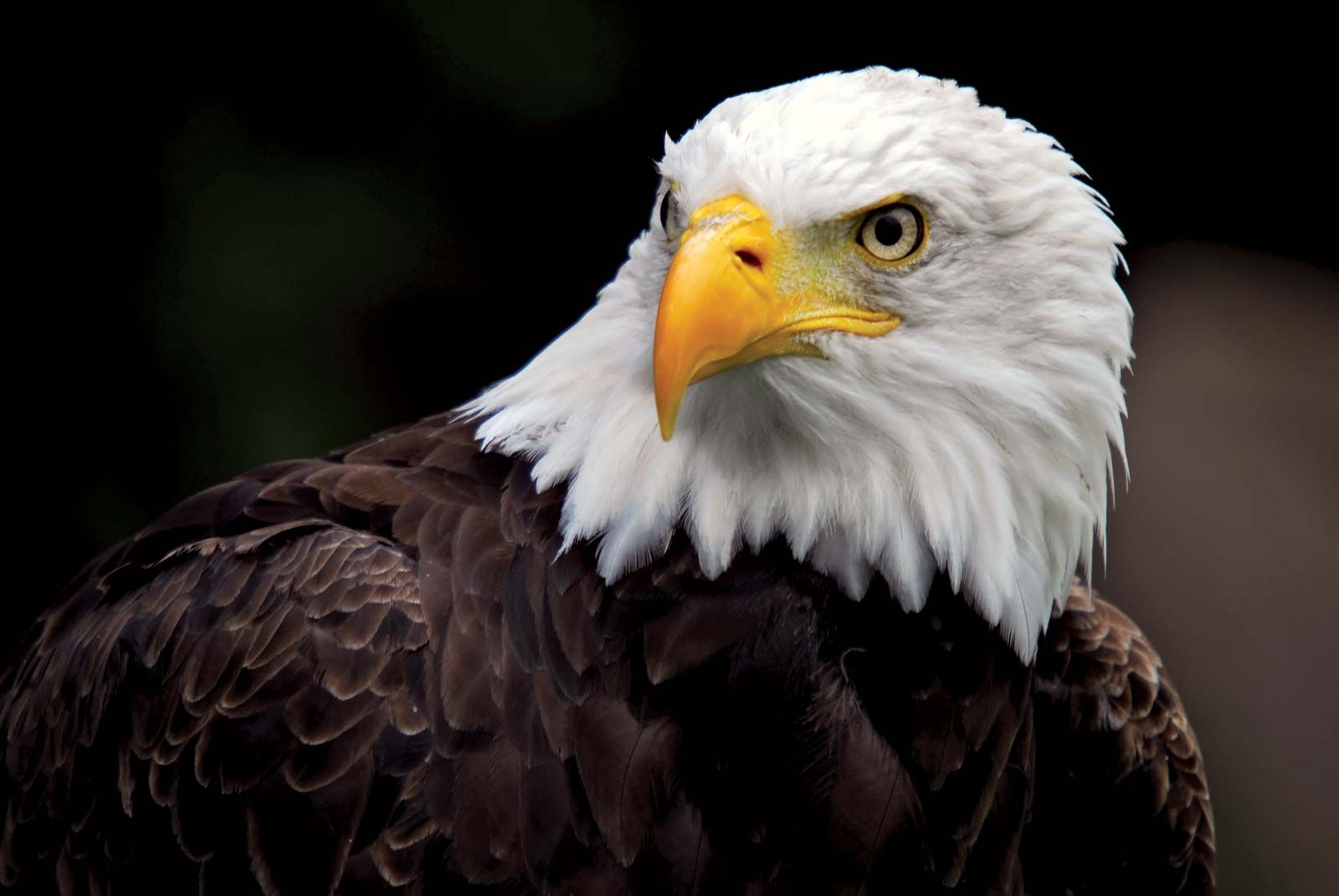
The Bald Eagle is a large, powerful raptor native to North America, renowned for its distinctive white head and tail in adulthood. It is the national bird of the United States and a symbol of strength and freedom. As an opportunistic carnivore, it primarily preys on fish but also consumes other birds, small mammals, and carrion. Its impressive size and majestic appearance make it a prominent figure in its diverse habitats.
Size & lifespan
- Length
- 70-102 cm (28-40 in)
- Wingspan
- 1.8-2.3 m (5.9-7.5 ft)
- Weight
- 3-6.3 kg (6.6-13.9 lbs)
- Lifespan
- Up to 20 years in the wild, over 30 years in captivity
- Diet
- Carnivore (primarily fish, also waterfowl, small mammals, carrion)
Physical characteristics
- Plumage
- Adults have a dark brown body and wings, contrasting sharply with a pure white head and tail. Juveniles are mostly dark brown with varying amounts of white mottling on the underparts, underwing coverts, and tail, gradually acquiring adult plumage over 4-5 years.
- Beak shape
- Large, heavy, hooked beak; bright yellow in adults, dark in juveniles.
- Eye color
- Bright yellow in adults, dark brown in juveniles.
- Leg color
- Bright yellow in adults, duller yellow to grayish in juveniles.
- Distinguishing features
- Adults are unmistakable with their white head and tail. Juveniles can be distinguished from other large raptors by their overall dark appearance with irregular white mottling, large size, and powerful flight.
- Juvenile appearance
- First-year birds are almost entirely dark brown with some white mottling on the belly and underwings. The beak is dark. Over subsequent years, white gradually increases on the head, tail, and underparts, and the beak and eyes lighten, reaching full adult plumage by 4-5 years.
- Seasonal changes
- No significant seasonal plumage changes; plumage varies by age class rather than season.
- Sexual dimorphism
- Females are typically 25% larger and heavier than males, but plumage is identical.
How to identify
- 1
Adult Plumage
Look for the unmistakable pure white head and tail contrasting with a dark brown body and wings. The beak and eyes are bright yellow.
- 2
Juvenile Plumage
Observe the overall dark brown body with varying amounts of white mottling, especially on the belly, underwing coverts, and tail. The beak is dark, and eyes are dark brown. The amount of white increases with age until full adult plumage is achieved around 4-5 years.
- 3
Size and Shape
Note the very large size, broad wings, and relatively short, wedge-shaped tail (adults). In flight, wings are held flat or in a slight dihedral. The head projects prominently forward, and the tail is relatively short.
- 4
Flight Style
Watch for powerful, deep wing beats when actively flying, and long periods of soaring on thermals with stable flight. They do not typically 'teeter' like vultures.
- 5
Habitat
Always look for them near large bodies of water (rivers, lakes, coastlines) with tall trees for perching and nesting.
- 6
Vocalization
Listen for their distinctive, high-pitched, reedy 'kleek-kik-kik-kik' calls, which are surprisingly weak for their size.
Habitat & range
- Biomes
- Forests, wetlands, coastal areas, mountains, grasslands, tundra
- Geographic range
- North America, from Alaska and Canada south through the contiguous United States and into northern Mexico.
- Elevation range
- Sea level up to 3,000 meters (10,000 feet), typically near large bodies of water.
- Preferred environments
- Large, mature trees (conifers or deciduous) for nesting and perching, located near expansive bodies of water such as rivers, lakes, reservoirs, and coastlines that provide abundant fish and open foraging areas. Requires undisturbed areas for breeding.
Behavior
- Activity time
- Diurnal, most active during daylight hours, especially morning and late afternoon for hunting.
- Feeding habits
- Primarily piscivorous, catching fish by swooping down and snatching them from the water with their talons. Also preys on waterfowl (ducks, geese), small mammals, and carrion. Known to steal food from other raptors (kleptoparasitism), especially Ospreys. They are opportunistic feeders.
- Social behavior
- Generally solitary or found in pairs during the breeding season. May congregate in large numbers at communal roosts or abundant food sources (e.g., salmon runs) during winter.
- Flight pattern
- Powerful, steady flight with slow, deep wing beats. Often soars on thermals, holding wings flat or in a slight dihedral. Can achieve impressive speeds when diving for prey. Distinctive 'rowing' flight when actively hunting.
- Migration pattern
- Northern populations are migratory, moving south for the winter to areas with open water and food. Southern populations are largely resident. Migration routes often follow major river systems or coastlines.
- Territoriality
- Highly territorial during the breeding season, defending their nesting area. Non-breeding birds may be less territorial, especially at communal feeding or roosting sites.
Song & calls
- Song
- Bald Eagles do not have a complex song. Their vocalizations are primarily calls.
- Call
- A series of high-pitched, whistling or chirping notes, often described as a 'kleek-kik-kik-kik' or 'kwe-kwe-kwe'. The calls are surprisingly weak and reedy for such a large bird, often sounding more like a gull than a powerful raptor. They also produce a lower-pitched 'chuckle' call.
- When they vocalize
- Most vocal around the nest, during courtship, or when agitated. Less vocal during migration or when foraging alone.
Breeding & reproduction
- Breeding season
- Varies geographically; typically November-March in the south, March-August in the north.
- Nesting habits
- Builds massive stick nests, often the largest of any North American bird, in tall, sturdy trees near water. Nests can be 1.5-3 meters (5-10 ft) deep and 1.5-2.5 meters (5-8 ft) wide, weighing over a ton. Both parents contribute to nest building and maintenance, often reusing and adding to the same nest for many years.
- Clutch size
- 1-3 eggs, typically 2.
- Egg description
- 1-3 (rarely 4) dull white, unmarked eggs, roughly 7.3 cm (2.9 in) long.
- Incubation period
- 34-36 days, primarily by the female, but male also participates.
- Fledging period
- 10-12 weeks (70-98 days) after hatching. Young remain dependent on parents for several weeks after fledging.
- Parental care
- Both parents share incubation duties and feed the young. After fledging, parents continue to provide food and teach hunting skills for several weeks to months.
Where to find
Rivers and Lakes
Look along major river systems, large lakes, and reservoirs, especially where there are abundant fish populations and tall trees for perching and nesting.
Coastal Areas
Estuaries, bays, and coastlines provide excellent foraging opportunities, particularly during salmon runs or when fish are plentiful.
Winter Roosts
In northern areas, Bald Eagles often congregate at communal winter roosts near open water, especially below dams or in areas with reliable food sources.
National Parks and Wildlife Refuges
Many protected areas with suitable habitat are excellent places to observe Bald Eagles, often with designated viewing areas.
Field tips
- Scan Tall Trees. Bald Eagles often perch conspicuously at the very top of the tallest trees, providing excellent vantage points for hunting and surveying their territory.
- Look for Soaring Birds. Keep an eye on the sky for large raptors soaring on thermals, especially over water. Their broad wings and stable flight are characteristic.
- Observe Fishing Behavior. Watch for them swooping down to snatch fish from the water's surface. This is a classic and exciting behavior to witness.
- Visit During Winter. In many regions, winter offers the best viewing opportunities as migratory eagles move south and concentrate in areas with open water and food.
- Use Binoculars/Spotting Scope. Their large size makes them visible from a distance, but good optics are essential for detailed observation and distinguishing age classes.
Similar species
Golden Eagle
Aquila chrysaetos
Adult Bald Eagles have a white head and tail; adult Golden Eagles are uniformly dark brown with a golden nape. Juvenile Bald Eagles have extensive white mottling on the body and underwings, and a dark beak that lightens with age. Juvenile Golden Eagles have a distinct white patch at the base of the primary feathers and a white tail with a dark terminal band; their beak is dark throughout. Golden Eagles typically prefer more arid, open country and mountains, while Bald Eagles are tied to water.
Turkey Vulture
Cathartes aura
While both soar, Turkey Vultures hold their wings in a strong dihedral (V-shape) and often teeter or wobble in flight. Bald Eagles hold wings flat or in a slight dihedral and have a more stable flight. Turkey Vultures have a smaller, featherless red head (adults) or dark head (juveniles) and a two-toned underwing (silvery flight feathers, dark coverts). Bald Eagles are much larger and more robust, with a feathered head.
Osprey
Pandion haliaetus
Ospreys are smaller than Bald Eagles, have a distinctive dark eye stripe, and a white head with a dark crown. Their underparts are white, and their wings have a distinct 'M' shape in flight. Ospreys dive feet-first into the water to catch fish, while Bald Eagles snatch fish from the surface. Bald Eagles often harass Ospreys to steal their catch.
Quick facts
- National Bird:
- United States of America
- Primary Diet:
- Fish
- Nest Size:
- Largest in North America (up to 10 ft deep, 8 ft wide)
- Plumage Maturity:
- 4-5 years
- Conservation Success:
- Recovered from near extinction due to DDT
Fun facts
- Bald Eagles do not actually go bald; their name comes from an older meaning of 'bald' meaning white-headed.
- They have exceptional eyesight, estimated to be 4-8 times better than a human's, allowing them to spot fish from great heights.
- Bald Eagles are known for their impressive aerial displays during courtship, including locking talons and free-falling in a spiral.
- Their calls are often dubbed over in movies with the more powerful scream of a Red-tailed Hawk, as their actual calls are less dramatic.
- They can live for decades, with the oldest known wild Bald Eagle living to be at least 38 years old.
Scientific classification
- Kingdom
- Animalia
- Phylum
- Chordata
- Class
- Aves
- Order
- Accipitriformes
- Family
- Accipitridae
- Genus
- Haliaeetus
- Species
- Haliaeetus leucocephalus
Explore the Bald Eagle
Identify birds anywhere
Free on iOS, Android, and Web. Photo & sound identification, full species database, and your personal life list.