
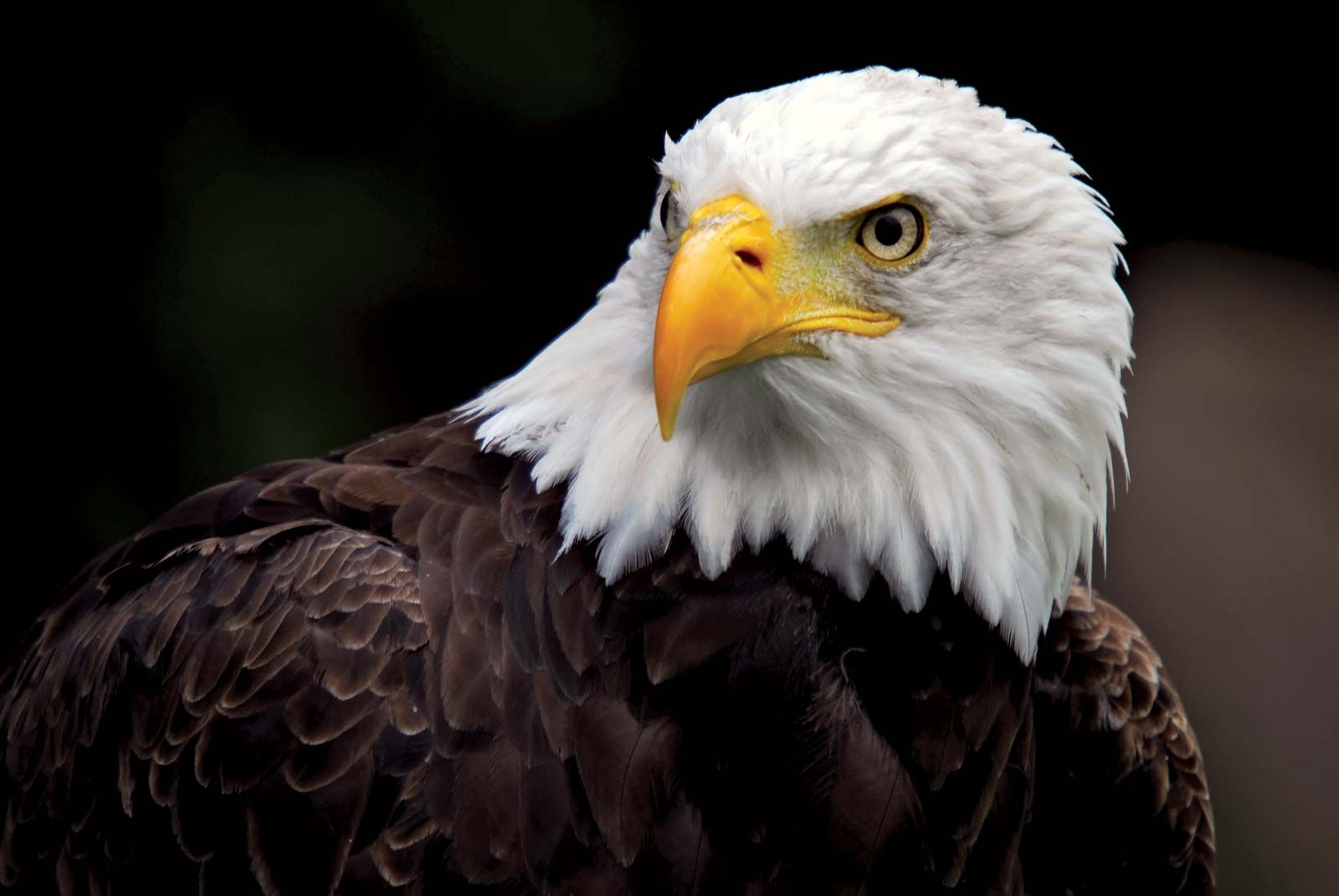
How to identify the Bald Eagle
Haliaeetus leucocephalus
Spotted a bird? Identify it instantly with the Birdby app
Open the appTo correctly identify the Bald Eagle (Haliaeetus leucocephalus), check each of these features. Birds can be tricky: habit, habitat, and call often confirm a sighting that a single photo cannot.
Size at a glance
- Length
- 70-102 cm (28-40 in)
- Wingspan
- 1.8-2.3 m (5.9-7.5 ft)
- Weight
- 3-6.3 kg (6.6-13.9 lbs)
Physical features to check
- 1
Plumage
Overall feather coloration and pattern.
Adults have a dark brown body and wings, contrasting sharply with a pure white head and tail. Juveniles are mostly dark brown with varying amounts of white mottling on the underparts, underwing coverts, and tail, gradually acquiring adult plumage over 4-5 years.
- 2
Beak shape
Shape and color of the bill: a key field mark.
Large, heavy, hooked beak; bright yellow in adults, dark in juveniles.
- 3
Eye color
Iris color and any distinctive eye markings.
Bright yellow in adults, dark brown in juveniles.
- 4
Leg color
Leg and foot color.
Bright yellow in adults, duller yellow to grayish in juveniles.
- 5
Distinguishing features
Standout features that separate this species.
Adults are unmistakable with their white head and tail. Juveniles can be distinguished from other large raptors by their overall dark appearance with irregular white mottling, large size, and powerful flight.
- 6
Juvenile appearance
How young birds differ from adults.
First-year birds are almost entirely dark brown with some white mottling on the belly and underwings. The beak is dark. Over subsequent years, white gradually increases on the head, tail, and underparts, and the beak and eyes lighten, reaching full adult plumage by 4-5 years.
- 7
Seasonal changes
Plumage variation between breeding and non-breeding seasons.
No significant seasonal plumage changes; plumage varies by age class rather than season.
- 8
Sexual dimorphism
How males and females differ.
Females are typically 25% larger and heavier than males, but plumage is identical.
Key field marks
- Adult Plumage. Look for the unmistakable pure white head and tail contrasting with a dark brown body and wings. The beak and eyes are bright yellow.
- Juvenile Plumage. Observe the overall dark brown body with varying amounts of white mottling, especially on the belly, underwing coverts, and tail. The beak is dark, and eyes are dark brown. The amount of white increases with age until full adult plumage is achieved around 4-5 years.
- Size and Shape. Note the very large size, broad wings, and relatively short, wedge-shaped tail (adults). In flight, wings are held flat or in a slight dihedral. The head projects prominently forward, and the tail is relatively short.
- Flight Style. Watch for powerful, deep wing beats when actively flying, and long periods of soaring on thermals with stable flight. They do not typically 'teeter' like vultures.
- Habitat. Always look for them near large bodies of water (rivers, lakes, coastlines) with tall trees for perching and nesting.
- Vocalization. Listen for their distinctive, high-pitched, reedy 'kleek-kik-kik-kik' calls, which are surprisingly weak for their size.
Explore the Bald Eagle
Identify birds anywhere
Free on iOS, Android, and Web. Photo & sound identification, full species database, and your personal life list.