
Spotted a bird? Identify it instantly with the Birdby app
Open the appAbout
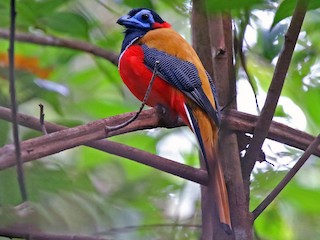
The Red-naped Trogon is a strikingly colored forest bird native to Southeast Asia. It is known for its quiet, perch-and-sally feeding behavior and vibrant plumage. Like other trogons, it often perches upright and motionless for extended periods, making it challenging to spot despite its bright colors.
Size & lifespan
- Length
- 32-35 cm (12.6-13.8 in)
- Wingspan
- Approximately 40-45 cm (15.7-17.7 in)
- Weight
- 80-110 g (2.8-3.9 oz)
- Lifespan
- Up to 10-15 years in the wild, though precise data for this species is limited.
- Diet
- Primarily large insects such as beetles, stick insects, cicadas, and mantises. It also consumes small lizards and some fruit, especially figs.
Physical characteristics
- Plumage
- Male: Head and upper breast are black with a brilliant red nape and a broad red crescent on the lower breast. Upperparts are glossy black with a blue sheen. Remiges are black with fine white vermiculation, forming a white panel on the folded wing. Underparts below the red breast band are white. Female: General plumage is duller. Head and breast are dark brown, not black. The red nape is present but often less intense, and the red breast crescent is replaced by a paler, often brownish-orange band, or is absent/incomplete. Upperparts are brown, and the white vermiculation on the wings is less pronounced. Both sexes have a bluish orbital ring and gular stripe.
- Beak shape
- Robust, broad at the base, and slightly hooked, ivory to pale bluish-yellow with a darker culmen.
- Eye color
- Dark brown, almost black, surrounded by a distinct blue orbital ring.
- Leg color
- Fleshy pinkish-brown to purplish-gray.
- Distinguishing features
- The combination of the glossy black (males) or dark brown (females) head and breast contrasting with the vivid red nape and breast band (male) or paler breast band (female), and the bright blue orbital ring. The white undertail coverts and white panel on the folded wing are also notable.
- Juvenile appearance
- Juveniles resemble duller females, with brownish plumage and often lacking the distinct red nape and breast band. The orbital ring might be less intensely blue. They gradually attain adult plumage over their first year.
- Seasonal changes
- No significant seasonal plumage changes have been documented; plumage remains consistent year-round.
- Sexual dimorphism
- Strongly sexually dimorphic in plumage coloration, with males being much more brightly colored and distinctly marked than females.
How to identify
- 1
Male Plumage
Distinctive black head and upper breast, glossy black upperparts, brilliant red nape, and a narrow red crescent across the lower breast. White belly and white markings on folded wings.
- 2
Female Plumage
Duller dark brown head and breast, brown upperparts, less vibrant red nape (sometimes orange-brown), and a paler, incomplete breast band (often dull reddish-orange or brownish). White belly.
- 3
Orbital Ring
Both sexes possess a striking blue orbital ring around the dark eye, which is a key field mark.
- 4
Vocalization
Listen for its characteristic, mournful, frog-like 'too-wah... too-wah... too-wah' song, which is often easier to detect than sighting the bird.
- 5
Behavior
Observe for its typical trogon behavior of perching quietly and upright for long periods, often in the mid-story or understory of dense forest, before making short sally flights to catch prey.
Habitat & range
- Biomes
- Tropical and subtropical moist lowland forests, primary and mature secondary forests.
- Geographic range
- Found in the Malay Peninsula (southern Thailand, Peninsular Malaysia) and the Greater Sunda Islands (Sumatra, Borneo).
- Elevation range
- Typically found from sea level up to 800 meters (2,600 feet), occasionally higher in some localities, rarely exceeding 1,000 meters (3,300 feet).
- Preferred environments
- Prefers the understory and mid-story of dense, evergreen lowland rainforests. It requires tall trees for nesting and perching, and an abundant invertebrate prey base often found in moist, shaded forest interiors.
Behavior
- Activity time
- Diurnal. Most active during the early morning and late afternoon, though they can be observed throughout the day.
- Feeding habits
- Forages by 'sallying' from a perch to snatch insects from foliage, branches, or in the air, a behavior characteristic of trogons. It also descends to the forest floor to pick up ground-dwelling insects or small vertebrates. It can remain motionless for long periods, watching for prey.
- Social behavior
- Generally solitary or found in pairs. They are not known to form flocks. Often observed singly, perched quietly and inconspicuous.
- Flight pattern
- Flight is typically short, undulating, and direct, characterized by rapid wing beats. They generally fly short distances from one perch to another within the forest canopy.
- Migration pattern
- Sedentary; this species is a resident throughout its range and does not exhibit migratory behavior.
- Territoriality
- Presumed to be territorial, with pairs defending a breeding territory, but specific details on territorial size and defense mechanisms are not well documented.
Song & calls
- Song
- The song is a distinctive series of evenly spaced, low-pitched, mournful 'toah' or 'tyao' notes, often repeated 5-10 times: 'too-wah... too-wah... too-wah'. It sounds somewhat frog-like or owl-like, and carries well through the forest.
- Call
- Calls include a soft, descending 'too-uh' and a more rapid, often excited 'tuk-tuk-tuk-tuk' series given when agitated or in alarm. Another call is a sharp 'chew' or 'kyaw'.
- When they vocalize
- Most vocal during the breeding season, especially in the early morning and late afternoon. Calls can also be heard intermittently throughout the day.
Breeding & reproduction
- Breeding season
- Breeding season varies geographically but generally occurs between February and August, peaking during the dry months or early wet season.
- Nesting habits
- Nests in cavities excavated by themselves in rotten tree stumps, dead trees, or occasionally in termite nests. The entrance hole is typically round, and the nest chamber is unlined.
- Clutch size
- Usually 2 eggs, sometimes 1 or 3.
- Egg description
- Eggs are typically pale cream to yellowish-white, unspotted, and oval to elliptical in shape.
- Incubation period
- Approximately 17-19 days.
- Fledging period
- Chicks fledge around 18-22 days after hatching.
- Parental care
- Both parents participate in incubation and provisioning of the nestlings. Young are fed primarily insects.
Where to find
Primary Rainforests
Focus on intact, undisturbed lowland primary rainforests, particularly areas with dense undergrowth and mature trees. These provide the preferred habitat and food sources.
National Parks and Reserves
Visit protected areas in Peninsular Malaysia (e.g., Taman Negara), Sumatra (e.g., Leuser Ecosystem, Way Kambas), and Borneo (e.g., Danum Valley, Kinabalu Park), where suitable habitat is conserved.
Forest Edges
While preferring interior forests, they can sometimes be seen near clearings, logging tracks, or river edges within large forest blocks.
Field tips
- Listen for their call. Their distinctive, somewhat melancholic 'too-wah' call is often the first indication of their presence. Learn to recognize it. They are difficult to spot visually but relatively easy to locate by sound.
- Look up and down. Trogons often perch at various heights within the forest mid-story to understory, from 3 to 15 meters. Scan tree branches, especially dead snags, as they favor these for perching.
- Be patient and still. Trogons are notoriously cryptic. Remain motionless for extended periods in suitable habitat. Their quiet nature means they may go unnoticed if you're moving quickly.
- Use binoculars. Essential for clear views of their plumage details and for spotting them among dense foliage.
- Early morning and late afternoon. These are generally the most active times for foraging and vocalization, increasing chances of observation.
Similar species
Scarlet-rumped Trogon
Harpactes duvaucelii
The Red-naped Trogon lacks the scarlet rump of the Scarlet-rumped Trogon. Males of H. duvaucelii have a much broader red breast band, and a brighter red on the lower belly, often extending to the vent, whereas H. kasumba has a distinct red crescent on the breast and white on the lower belly. Females of H. duvaucelii are also typically browner overall with a more prominent red rump.
Diard's Trogon
Harpactes diardii
Diard's Trogon males have a prominent blue facial patch and a much broader, deep crimson breast band, almost a vest, compared to the red nape and crescent of the Red-naped Trogon. Females of Diard's Trogon have a largely dull brown head and breast, lacking the red nape of H. kasumba, and often a more rufous-brown tone to the underparts.
Quick facts
- Distinctive Feature:
- Vivid red nape (male) and blue eye-ring.
- Diet:
- Large insects, small lizards, some fruit.
- Habitat:
- Lowland rainforest understory and mid-story.
- Status:
- Near Threatened (NT).
- Behavior:
- Quiet, solitary ambush hunter.
- Vocalization:
- Mournful, frog-like 'too-wah' notes.
Fun facts
- Trogons are unique among birds for having a 'heterodactyl' toe arrangement, where the first and second toes point backward and the third and fourth toes point forward (most birds are 'zygodactyl' with two forward, two backward).
- Despite their bright colors, Red-naped Trogons are notoriously difficult to spot in their natural habitat due to their habit of sitting motionless for long periods, blending into the dappled light of the forest.
- Their scientific name, 'Harpactes', comes from Greek, meaning 'robber' or 'plunderer', reflecting their predatory nature on insects.
Scientific classification
- Kingdom
- Animalia
- Phylum
- Chordata
- Class
- Aves
- Order
- Trogoniformes
- Family
- Trogonidae
- Genus
- Harpactes
- Species
- Harpactes kasumba
Explore the Red-naped Trogon
Identify birds anywhere
Free on iOS, Android, and Web. Photo & sound identification, full species database, and your personal life list.