
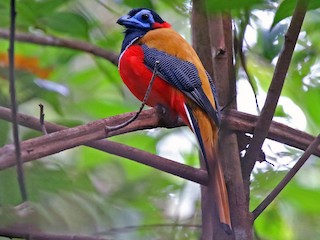
Where does the Red-naped Trogon live?
Harpactes kasumba
Spotted a bird? Identify it instantly with the Birdby app
Open the appThe Red-naped Trogon lives in specific habitats and regions. Knowing where, and when, to look improves your chances of a successful sighting.
Biomes
Tropical and subtropical moist lowland forests, primary and mature secondary forests.
Geographic range
Found in the Malay Peninsula (southern Thailand, Peninsular Malaysia) and the Greater Sunda Islands (Sumatra, Borneo).
Preferred environments
Prefers the understory and mid-story of dense, evergreen lowland rainforests. It requires tall trees for nesting and perching, and an abundant invertebrate prey base often found in moist, shaded forest interiors.
Elevation range
Typically found from sea level up to 800 meters (2,600 feet), occasionally higher in some localities, rarely exceeding 1,000 meters (3,300 feet).
Where to look
Primary Rainforests
Focus on intact, undisturbed lowland primary rainforests, particularly areas with dense undergrowth and mature trees. These provide the preferred habitat and food sources.
National Parks and Reserves
Visit protected areas in Peninsular Malaysia (e.g., Taman Negara), Sumatra (e.g., Leuser Ecosystem, Way Kambas), and Borneo (e.g., Danum Valley, Kinabalu Park), where suitable habitat is conserved.
Forest Edges
While preferring interior forests, they can sometimes be seen near clearings, logging tracks, or river edges within large forest blocks.
Field tips
- Listen for their call. Their distinctive, somewhat melancholic 'too-wah' call is often the first indication of their presence. Learn to recognize it. They are difficult to spot visually but relatively easy to locate by sound.
- Look up and down. Trogons often perch at various heights within the forest mid-story to understory, from 3 to 15 meters. Scan tree branches, especially dead snags, as they favor these for perching.
- Be patient and still. Trogons are notoriously cryptic. Remain motionless for extended periods in suitable habitat. Their quiet nature means they may go unnoticed if you're moving quickly.
- Use binoculars. Essential for clear views of their plumage details and for spotting them among dense foliage.
- Early morning and late afternoon. These are generally the most active times for foraging and vocalization, increasing chances of observation.
Migration
Sedentary; this species is a resident throughout its range and does not exhibit migratory behavior.
Explore the Red-naped Trogon
Identify birds anywhere
Free on iOS, Android, and Web. Photo & sound identification, full species database, and your personal life list.