
How to identify the Red-naped Trogon
Harpactes kasumba
Spotted a bird? Identify it instantly with the Birdby app
Open the appTo correctly identify the Red-naped Trogon (Harpactes kasumba), check each of these features. Birds can be tricky: habit, habitat, and call often confirm a sighting that a single photo cannot.
Size at a glance
- Length
- 32-35 cm (12.6-13.8 in)
- Wingspan
- Approximately 40-45 cm (15.7-17.7 in)
- Weight
- 80-110 g (2.8-3.9 oz)
Physical features to check
- 1
Plumage
Overall feather coloration and pattern.
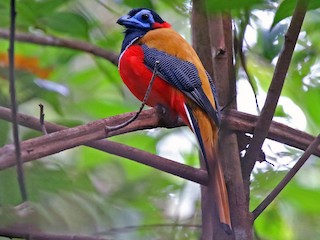
Male: Head and upper breast are black with a brilliant red nape and a broad red crescent on the lower breast. Upperparts are glossy black with a blue sheen. Remiges are black with fine white vermiculation, forming a white panel on the folded wing. Underparts below the red breast band are white. Female: General plumage is duller. Head and breast are dark brown, not black. The red nape is present but often less intense, and the red breast crescent is replaced by a paler, often brownish-orange band, or is absent/incomplete. Upperparts are brown, and the white vermiculation on the wings is less pronounced. Both sexes have a bluish orbital ring and gular stripe.
- 2
Beak shape
Shape and color of the bill: a key field mark.
Robust, broad at the base, and slightly hooked, ivory to pale bluish-yellow with a darker culmen.
- 3
Eye color
Iris color and any distinctive eye markings.
Dark brown, almost black, surrounded by a distinct blue orbital ring.
- 4
Leg color
Leg and foot color.
Fleshy pinkish-brown to purplish-gray.
- 5
Distinguishing features
Standout features that separate this species.
The combination of the glossy black (males) or dark brown (females) head and breast contrasting with the vivid red nape and breast band (male) or paler breast band (female), and the bright blue orbital ring. The white undertail coverts and white panel on the folded wing are also notable.
- 6
Juvenile appearance
How young birds differ from adults.
Juveniles resemble duller females, with brownish plumage and often lacking the distinct red nape and breast band. The orbital ring might be less intensely blue. They gradually attain adult plumage over their first year.
- 7
Seasonal changes
Plumage variation between breeding and non-breeding seasons.
No significant seasonal plumage changes have been documented; plumage remains consistent year-round.
- 8
Sexual dimorphism
How males and females differ.
Strongly sexually dimorphic in plumage coloration, with males being much more brightly colored and distinctly marked than females.
Key field marks
- Male Plumage. Distinctive black head and upper breast, glossy black upperparts, brilliant red nape, and a narrow red crescent across the lower breast. White belly and white markings on folded wings.
- Female Plumage. Duller dark brown head and breast, brown upperparts, less vibrant red nape (sometimes orange-brown), and a paler, incomplete breast band (often dull reddish-orange or brownish). White belly.
- Orbital Ring. Both sexes possess a striking blue orbital ring around the dark eye, which is a key field mark.
- Vocalization. Listen for its characteristic, mournful, frog-like 'too-wah... too-wah... too-wah' song, which is often easier to detect than sighting the bird.
- Behavior. Observe for its typical trogon behavior of perching quietly and upright for long periods, often in the mid-story or understory of dense forest, before making short sally flights to catch prey.
Explore the Red-naped Trogon
Identify birds anywhere
Free on iOS, Android, and Web. Photo & sound identification, full species database, and your personal life list.