
Spotted a bird? Identify it instantly with the Birdby app
Open the appAbout
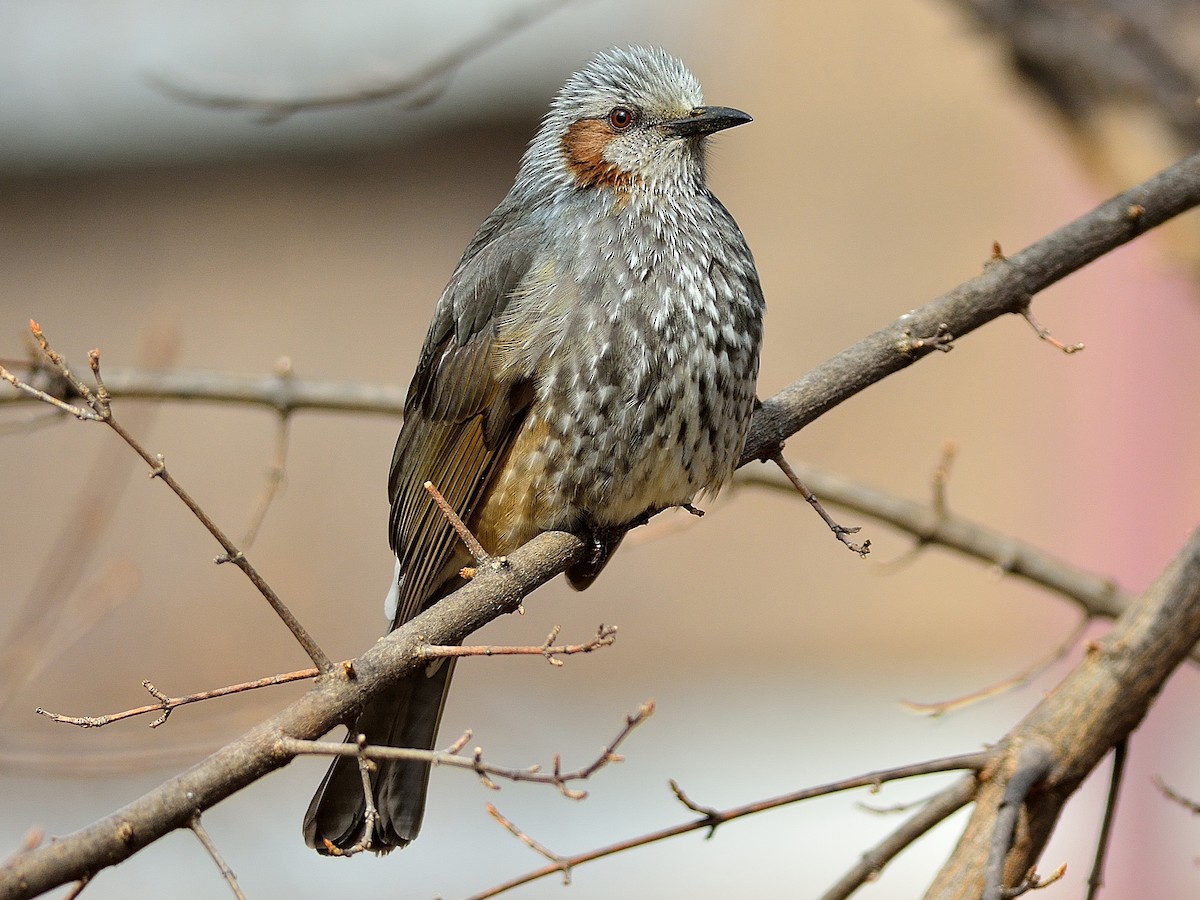
The Brown-eared Bulbul is a medium-sized passerine bird characterized by its distinctive brown ear-coverts and overall dusky plumage. It is a highly vocal and common species across much of its East Asian range, often found in a variety of wooded habitats, from urban parks to dense forests. Known for its gregarious nature, it frequently forms large flocks, especially outside the breeding season.
Size & lifespan
- Length
- 27-29 cm
- Wingspan
- 38-42 cm
- Weight
- 50-80 g
- Lifespan
- 5-10 years in the wild
- Diet
- Omnivore
Physical characteristics
- Plumage
- Adults have a dark grey-brown body plumage, often appearing almost blackish, with a slightly paler belly. The most striking feature is the prominent reddish-brown ear-coverts, which contrast with the dark head. The nape and hindneck are streaked with white, giving a somewhat scaly appearance. The wings and tail are dark brown, sometimes with a faint greenish or olive tinge, especially on the flight feathers. The undertail coverts are typically a rufous-brown.
- Beak shape
- The beak is relatively slender, slightly decurved, and sharply pointed. It is dark grey to blackish.
- Eye color
- Dark brown.
- Leg color
- Dark grey to blackish.
- Distinguishing features
- The combination of dark overall plumage, prominent reddish-brown ear-coverts, and white streaking on the nape are key identification features. Its relatively large size for a bulbul also stands out.
- Juvenile appearance
- Juveniles are generally duller than adults, with less distinct brown ear-coverts and often a more uniform brownish-grey plumage. The white streaking on the nape may be less pronounced or absent. Their plumage can appear softer and less defined.
- Seasonal changes
- There are no significant seasonal plumage changes. The plumage remains consistent throughout the year.
- Sexual dimorphism
- Males and females are monomorphic in plumage, appearing identical. There are no discernible visual differences between the sexes.
How to identify
- 1
Ear-coverts
Look for the distinctive reddish-brown patch covering the ear region. This is the most reliable field mark.
- 2
Nape streaking
Observe the white streaking on the nape and hindneck, which gives a scaly appearance against the dark plumage.
- 3
Overall color
Note the dark, dusky grey-brown body plumage, which can appear almost blackish in certain light conditions.
- 4
Size and shape
It's a relatively large bulbul with a somewhat long tail and a slender, slightly decurved bill.
- 5
Vocalizations
Listen for its loud, chattering, and often harsh calls, especially when in flocks. Its noisy nature is a strong indicator.
Habitat & range
- Biomes
- Forests, woodlands, urban parks, gardens, agricultural areas, coastal scrub, and open country with scattered trees.
- Geographic range
- East Asia, including Japan (Hokkaido, Honshu, Shikoku, Kyushu, Ryukyu Islands), Korea, Taiwan, the Philippines (Batanes and Babuyan Islands), and parts of northeastern China and southeastern Russia (Sakhalin, Kuril Islands).
- Elevation range
- Sea level up to approximately 2,000 meters, though more commonly found at lower to mid-elevations.
- Preferred environments
- Highly adaptable, it thrives in both natural and anthropogenic landscapes. It prefers areas with dense foliage for cover and foraging, such as forest edges, secondary growth, and well-vegetated urban areas.
Behavior
- Activity time
- Diurnal, active from dawn to dusk.
- Feeding habits
- Primarily frugivorous, consuming a wide variety of fruits and berries, especially those of native trees and shrubs. It also feeds on insects, particularly during the breeding season, and occasionally nectar. It forages actively in trees and shrubs, often in noisy groups.
- Social behavior
- Highly gregarious, especially outside the breeding season, forming large, noisy flocks that can number in the hundreds. During the breeding season, pairs become more territorial but may still forage in loose associations. They are known to mob predators.
- Flight pattern
- Flight is strong and direct, often undulating over longer distances. Within trees, it moves with agile, short flights between branches.
- Migration pattern
- Northern populations (e.g., Hokkaido, northern Honshu, Sakhalin, Kuril Islands) are migratory, moving south for the winter. Southern populations (e.g., southern Japan, Taiwan, Philippines) are largely resident or undertake short-distance altitudinal movements. Migratory movements can involve large, conspicuous flocks.
- Territoriality
- During the breeding season, pairs establish and defend a breeding territory, primarily against conspecifics. Outside of breeding, they are less territorial and often forage in communal flocks.
Song & calls
- Song
- The song is a complex, varied, and often loud series of chattering, whistling, and squeaky notes. It lacks a distinct, melodious pattern but is characterized by its energetic and somewhat jumbled quality. It can include mimicry of other bird species.
- Call
- A wide repertoire of calls, including a harsh, scolding 'chee-chee-chee' or 'kyu-kyu-kyu', a sharp 'kweek', and various chattering or squealing notes. These calls are often given in rapid succession, especially when in flocks or agitated.
- When they vocalize
- Highly vocal throughout the day, particularly active in the mornings and evenings. Calls are frequent year-round, while song is more prominent during the breeding season.
Breeding & reproduction
- Breeding season
- Typically from April to August, with peak activity in May and June, varying slightly by geographic location.
- Nesting habits
- Nests are cup-shaped, constructed from twigs, grass, leaves, moss, and rootlets, often lined with finer materials like hair or feathers. They are usually placed in the fork of a tree or shrub, often well-concealed within dense foliage, at varying heights from the ground.
- Clutch size
- 3-5 eggs, most commonly 4.
- Egg description
- Eggs are typically pale pinkish-white to reddish-brown, heavily spotted and blotched with darker reddish-brown, purplish-brown, or grey markings, often concentrated at the larger end. They are oval-shaped.
- Incubation period
- Approximately 11-14 days, primarily by the female.
- Fledging period
- Chicks fledge around 10-14 days after hatching.
- Parental care
- Both parents participate in feeding the nestlings and fledglings. The female primarily incubates, but both sexes contribute to nest building and defense.
Where to find
Urban Parks and Gardens
Common in well-vegetated urban areas, especially those with mature trees and fruiting shrubs. Look for them in city parks, botanical gardens, and large residential gardens.
Forest Edges and Secondary Growth
Frequently found at the edges of forests, in regenerating woodlands, and areas with dense undergrowth, where they can find both food and cover.
Agricultural Areas
Can be seen in orchards, plantations, and farmlands with scattered trees, where they feed on fruits and insects.
Coastal Areas
In some parts of its range, it inhabits coastal scrub and wooded areas near the sea.
Field tips
- Listen for their calls. Brown-eared Bulbuls are very vocal. Their loud, chattering calls often give away their presence before they are seen. Listen for noisy flocks.
- Look for movement in fruiting trees. They are primarily frugivorous, so check fruiting trees and shrubs, especially during autumn and winter when other food sources are scarce.
- Observe flocks. Outside the breeding season, they often move in large, conspicuous flocks. Scan tree canopies and open areas for these groups.
- Check for migratory movements. In northern parts of their range, look for large migratory flocks during spring and autumn migration periods.
Similar species
Light-vented Bulbul
Pycnonotus sinensis
The Light-vented Bulbul has a distinct white patch on the nape and a white vent, contrasting with its greyish-brown body. It lacks the prominent reddish-brown ear-coverts of the Brown-eared Bulbul. Its overall coloration is generally lighter.
Black Bulbul
Hypsipetes leucocephalus
The Black Bulbul is entirely black or dark grey, often with a white head in some subspecies, and has bright red legs and beak. It lacks the brown ear-coverts and streaked nape of the Brown-eared Bulbul.
Quick facts
- Diet:
- Omnivorous (fruits, insects, nectar)
- Sociality:
- Highly gregarious, forms large flocks
- Vocalization:
- Loud, chattering, varied calls and song
- Key ID Feature:
- Reddish-brown ear-coverts
- Habitat Adaptability:
- Thrives in diverse wooded habitats, including urban areas
Fun facts
- The Brown-eared Bulbul is considered a pest in some agricultural areas due to its consumption of cultivated fruits.
- It is one of the most common and widespread bird species in Japan, often seen even in the heart of major cities.
- During migration, large flocks can be observed flying over open water, demonstrating impressive endurance.
- Its scientific name 'amaurotis' means 'dark-eared', referring to its distinctive ear-coverts.
Scientific classification
- Kingdom
- Animalia
- Phylum
- Chordata
- Class
- Aves
- Order
- Passeriformes
- Family
- Pycnonotidae
- Genus
- Hypsipetes
- Species
- H. amaurotis
Explore the Brown-eared Bulbul
Identify birds anywhere
Free on iOS, Android, and Web. Photo & sound identification, full species database, and your personal life list.