
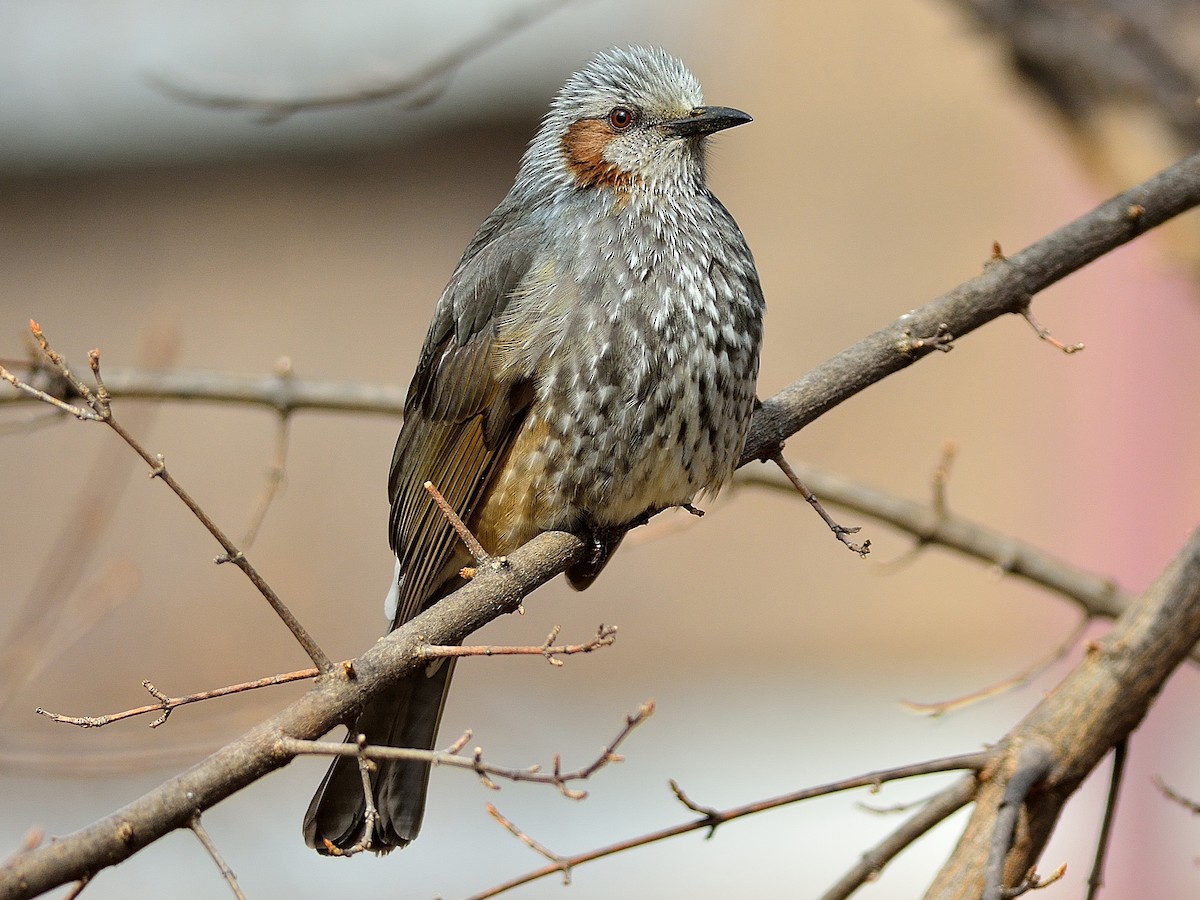
Where does the Brown-eared Bulbul live?
Hypsipetes amaurotis
Spotted a bird? Identify it instantly with the Birdby app
Open the appThe Brown-eared Bulbul lives in specific habitats and regions. Knowing where, and when, to look improves your chances of a successful sighting.
Biomes
Forests, woodlands, urban parks, gardens, agricultural areas, coastal scrub, and open country with scattered trees.
Geographic range
East Asia, including Japan (Hokkaido, Honshu, Shikoku, Kyushu, Ryukyu Islands), Korea, Taiwan, the Philippines (Batanes and Babuyan Islands), and parts of northeastern China and southeastern Russia (Sakhalin, Kuril Islands).
Preferred environments
Highly adaptable, it thrives in both natural and anthropogenic landscapes. It prefers areas with dense foliage for cover and foraging, such as forest edges, secondary growth, and well-vegetated urban areas.
Elevation range
Sea level up to approximately 2,000 meters, though more commonly found at lower to mid-elevations.
Where to look
Urban Parks and Gardens
Common in well-vegetated urban areas, especially those with mature trees and fruiting shrubs. Look for them in city parks, botanical gardens, and large residential gardens.
Forest Edges and Secondary Growth
Frequently found at the edges of forests, in regenerating woodlands, and areas with dense undergrowth, where they can find both food and cover.
Agricultural Areas
Can be seen in orchards, plantations, and farmlands with scattered trees, where they feed on fruits and insects.
Coastal Areas
In some parts of its range, it inhabits coastal scrub and wooded areas near the sea.
Field tips
- Listen for their calls. Brown-eared Bulbuls are very vocal. Their loud, chattering calls often give away their presence before they are seen. Listen for noisy flocks.
- Look for movement in fruiting trees. They are primarily frugivorous, so check fruiting trees and shrubs, especially during autumn and winter when other food sources are scarce.
- Observe flocks. Outside the breeding season, they often move in large, conspicuous flocks. Scan tree canopies and open areas for these groups.
- Check for migratory movements. In northern parts of their range, look for large migratory flocks during spring and autumn migration periods.
Migration
Northern populations (e.g., Hokkaido, northern Honshu, Sakhalin, Kuril Islands) are migratory, moving south for the winter. Southern populations (e.g., southern Japan, Taiwan, Philippines) are largely resident or undertake short-distance altitudinal movements. Migratory movements can involve large, conspicuous flocks.
Explore the Brown-eared Bulbul
Identify birds anywhere
Free on iOS, Android, and Web. Photo & sound identification, full species database, and your personal life list.