
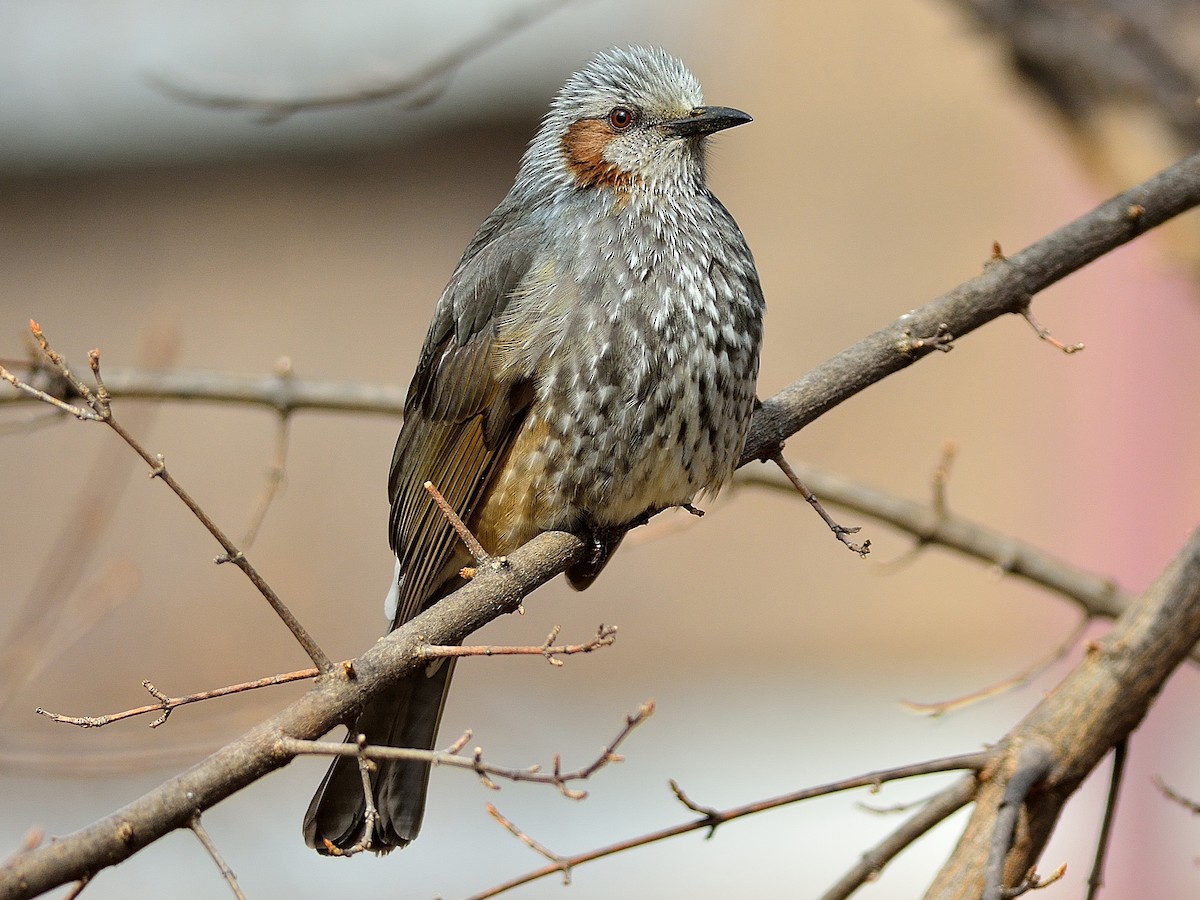
How to identify the Brown-eared Bulbul
Hypsipetes amaurotis
Spotted a bird? Identify it instantly with the Birdby app
Open the appTo correctly identify the Brown-eared Bulbul (Hypsipetes amaurotis), check each of these features. Birds can be tricky: habit, habitat, and call often confirm a sighting that a single photo cannot.
Size at a glance
- Length
- 27-29 cm
- Wingspan
- 38-42 cm
- Weight
- 50-80 g
Physical features to check
- 1
Plumage
Overall feather coloration and pattern.
Adults have a dark grey-brown body plumage, often appearing almost blackish, with a slightly paler belly. The most striking feature is the prominent reddish-brown ear-coverts, which contrast with the dark head. The nape and hindneck are streaked with white, giving a somewhat scaly appearance. The wings and tail are dark brown, sometimes with a faint greenish or olive tinge, especially on the flight feathers. The undertail coverts are typically a rufous-brown.
- 2
Beak shape
Shape and color of the bill: a key field mark.
The beak is relatively slender, slightly decurved, and sharply pointed. It is dark grey to blackish.
- 3
Eye color
Iris color and any distinctive eye markings.
Dark brown.
- 4
Leg color
Leg and foot color.
Dark grey to blackish.
- 5
Distinguishing features
Standout features that separate this species.
The combination of dark overall plumage, prominent reddish-brown ear-coverts, and white streaking on the nape are key identification features. Its relatively large size for a bulbul also stands out.
- 6
Juvenile appearance
How young birds differ from adults.
Juveniles are generally duller than adults, with less distinct brown ear-coverts and often a more uniform brownish-grey plumage. The white streaking on the nape may be less pronounced or absent. Their plumage can appear softer and less defined.
- 7
Seasonal changes
Plumage variation between breeding and non-breeding seasons.
There are no significant seasonal plumage changes. The plumage remains consistent throughout the year.
- 8
Sexual dimorphism
How males and females differ.
Males and females are monomorphic in plumage, appearing identical. There are no discernible visual differences between the sexes.
Key field marks
- Ear-coverts. Look for the distinctive reddish-brown patch covering the ear region. This is the most reliable field mark.
- Nape streaking. Observe the white streaking on the nape and hindneck, which gives a scaly appearance against the dark plumage.
- Overall color. Note the dark, dusky grey-brown body plumage, which can appear almost blackish in certain light conditions.
- Size and shape. It's a relatively large bulbul with a somewhat long tail and a slender, slightly decurved bill.
- Vocalizations. Listen for its loud, chattering, and often harsh calls, especially when in flocks. Its noisy nature is a strong indicator.
Explore the Brown-eared Bulbul
Identify birds anywhere
Free on iOS, Android, and Web. Photo & sound identification, full species database, and your personal life list.