
Spotted a bird? Identify it instantly with the Birdby app
Open the appAbout
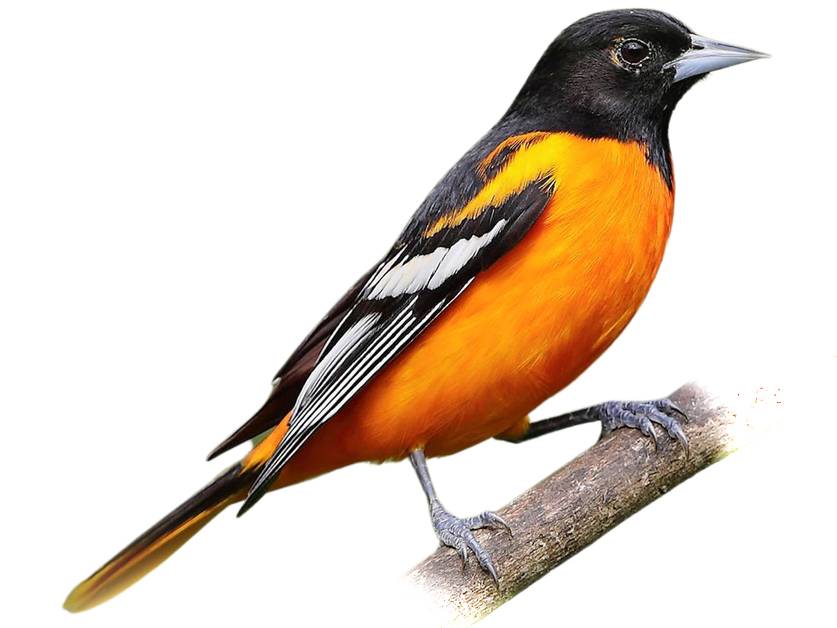
The Baltimore Oriole is a medium-sized passerine bird known for its striking orange and black plumage in males. It is a migratory species, breeding across eastern North America and wintering in Central and South America. Renowned for its beautiful, fluty song and intricately woven hanging nests, it is a beloved harbinger of spring.
Size & lifespan
- Length
- 17-22 cm (6.7-8.7 in)
- Wingspan
- 23-30 cm (9.1-11.8 in)
- Weight
- 30-40 g (1.1-1.4 oz)
- Lifespan
- Up to 11 years in the wild, typically 4-5 years
- Diet
- Omnivore, primarily insects and fruits, also nectar
Physical characteristics
- Plumage
- Adult males are brilliant orange on the underparts, rump, and shoulder patches, contrasting with a black head, back, wings, and tail. There is a single white wing bar. Adult females are duller, typically yellowish-orange to brownish-orange on the underparts, with an olive-brown back, grayish head, and two white wing bars. Some older females can be quite bright, approaching male coloration.
- Beak shape
- Conical, sharply pointed, and straight; dark gray to black.
- Eye color
- Dark brown.
- Leg color
- Dark gray to black.
- Distinguishing features
- Males are unmistakable with their vibrant orange and black pattern. Females and immatures are identified by their yellowish-orange underparts, two white wing bars, and pointed bill. The overall sleek body shape and active foraging behavior are also characteristic.
- Juvenile appearance
- Juveniles resemble adult females but are even duller, with more olive-brown tones and less distinct orange or yellow. They have two prominent white wing bars. First-year males will show some black feathering on the head and back, gradually acquiring adult male plumage over their first year.
- Seasonal changes
- No significant seasonal plumage changes in adults; breeding and non-breeding plumages are essentially the same. First-year males gradually molt into adult plumage.
- Sexual dimorphism
- Pronounced. Males are bright orange and black, while females are duller yellowish-orange and olive-brown. Some older females can develop brighter plumage, mimicking males.
How to identify
- 1
Plumage (Males)
Look for the unmistakable combination of brilliant orange underparts, rump, and shoulder patches, contrasting with a solid black head, back, wings, and tail. Note the single white wing bar.
- 2
Plumage (Females/Immatures)
Identify by yellowish-orange to brownish-orange underparts, olive-brown back, grayish head, and two distinct white wing bars. The pointed bill is also a key feature.
- 3
Song
Listen for the distinctive, rich, fluty, whistled song, often described as a series of clear, deliberate notes. It's a strong indicator of their presence, especially in spring.
- 4
Nest
If you find a unique, deep, pendulous, woven pouch-like nest hanging from a slender branch, it's almost certainly a Baltimore Oriole nest.
- 5
Feeding Behavior
Observe them actively gleaning insects from leaves in the canopy or visiting feeders for fruit and jelly. Their agility in trees is characteristic.
Habitat & range
- Biomes
- Temperate deciduous forests, open woodlands, riparian zones, suburban parks, orchards.
- Geographic range
- Breeds across eastern North America, from southern Canada south to the Gulf Coast states. Winters from southern Mexico through Central America and northern South America.
- Elevation range
- Typically found from sea level up to 1,500 meters (5,000 feet), though primarily in lower elevations during breeding.
- Preferred environments
- Prefers open deciduous woodlands, forest edges, shade trees in residential areas, and parks. Often associated with tall trees like elms, maples, and poplars, especially near water.
Behavior
- Activity time
- Diurnal.
- Feeding habits
- Forages actively in trees and shrubs, gleaning insects from foliage and bark. Also consumes a wide variety of fruits (berries, cherries, grapes) and nectar from flowers. Will visit hummingbird feeders and specialized oriole feeders (orange halves, jelly).
- Social behavior
- Solitary or in pairs during the breeding season. During migration and winter, they can be found in loose flocks, sometimes mixed with other species.
- Flight pattern
- Strong, undulating flight over long distances during migration. Within territories, flight is direct and purposeful, often between tree canopies.
- Migration pattern
- Long-distance Neotropical migrant. Arrives on breeding grounds in late April to early May and departs for wintering grounds in late July to September. Migrates primarily at night.
- Territoriality
- Males establish and defend breeding territories through song and displays. Females also participate in territory defense.
Song & calls
- Song
- A rich, fluty, whistled song consisting of a series of short, clear notes, often described as 'here, here, come right here, dear'. It has a somewhat disjointed, yet musical quality, with varying phrases and pitches. Males sing frequently to attract mates and defend territory.
- Call
- Common calls include a sharp, chattering 'churr' or 'whistle' and a short, sharp 'hew-li'. Alarm calls are harsher and more rapid.
- When they vocalize
- Most vocal during the breeding season (spring and early summer). Males sing from arrival on breeding grounds until incubation begins. Calls are given year-round, especially during foraging and social interactions.
Breeding & reproduction
- Breeding season
- May to July.
- Nesting habits
- Builds a remarkable pendulous, woven nest, typically hanging from the tip of a slender branch high in a deciduous tree (often elm, maple, or sycamore). The nest is a deep, flexible pouch woven from plant fibers, grass, hair, and string, taking several days to a week to construct. Only the female builds the nest.
- Clutch size
- 3-7 eggs, usually 4-5.
- Egg description
- 3-7 eggs, typically 4-5. Eggs are pale bluish-white to grayish-white, irregularly marked with dark brown, black, or purple spots, streaks, and blotches, often concentrated at the larger end.
- Incubation period
- 12-14 days, primarily by the female.
- Fledging period
- 12-14 days after hatching.
- Parental care
- Both parents feed the nestlings. The female primarily incubates, but the male may bring food to her on the nest. After fledging, both parents continue to feed the young for several weeks.
Where to find
Deciduous Woodlands
Look in open deciduous forests, especially those with tall trees like elms, maples, and poplars.
Forest Edges and Riparian Zones
They often prefer the edges of forests and areas along rivers or streams where trees are abundant.
Suburban Parks and Gardens
Many Baltimore Orioles adapt well to human-modified landscapes, frequenting parks, large gardens, and orchards with mature trees.
Feeders
During migration and breeding season, they are attracted to feeders offering orange halves, grape jelly, or sugar water.
Field tips
- Listen for their song. Their distinctive, fluty song is often heard before the bird is seen, especially in spring. Learn to recognize it.
- Look high in trees. Baltimore Orioles spend much of their time in the canopy of tall deciduous trees, so scan the upper branches carefully.
- Offer food. Putting out orange halves or grape jelly in spring can attract them to your yard, providing excellent viewing opportunities.
- Check for movement. They are active foragers, constantly moving through foliage. Look for flashes of orange or yellow among the leaves.
Similar species
Bullock's Oriole
Icterus bullockii
The Bullock's Oriole is the western counterpart and was formerly considered conspecific with the Baltimore Oriole (forming the 'Northern Oriole'). Males have more orange on the face, a black line through the eye, and a larger white wing patch. Females are generally paler yellow with a grayer back and more extensive white in the wings. Their ranges overlap in the Great Plains, where hybridization occurs.
Orchard Oriole
Icterus spurius
Orchard Orioles are smaller and adult males are chestnut and black, not orange. Females are yellowish-green with two white wing bars, but lack the bright orange tones of female Baltimore Orioles. Their songs are also distinct.
Scarlet Tanager
Piranga olivacea
Male Scarlet Tanagers are brilliant red and black, not orange. They have a thicker, more conical bill and lack the white wing bars of orioles. Females are yellowish-green with dark wings, but again, lack the oriole's bill shape and specific plumage patterns.
Quick facts
- Primary Color (Male):
- Orange and Black
- Nest Type:
- Pendulous, woven pouch
- Diet Preference:
- Insects, fruits, nectar
- Migration Status:
- Long-distance migrant
- Distinctive Feature:
- Fluty song, bright male plumage
Fun facts
- The Baltimore Oriole is the state bird of Maryland, named after Lord Baltimore, whose family colors were orange and black.
- Its intricate, hanging nest is a marvel of avian architecture, often taking the female several days to a week to construct using hundreds of individual strands of material.
- Baltimore Orioles are important dispersers of seeds for various fruit-bearing plants due to their diet.
- They have a sweet tooth and are famously attracted to orange halves and grape jelly, making them a favorite backyard visitor for many birdwatchers.
- For a period, the Baltimore Oriole and Bullock's Oriole were considered a single species called the 'Northern Oriole' due to extensive hybridization in their overlapping range in the Great Plains.
Scientific classification
- Kingdom
- Animalia
- Phylum
- Chordata
- Class
- Aves
- Order
- Passeriformes
- Family
- Icteridae
- Genus
- Icterus
- Species
- Icterus galbula
Explore the Baltimore Oriole
Identify birds anywhere
Free on iOS, Android, and Web. Photo & sound identification, full species database, and your personal life list.