
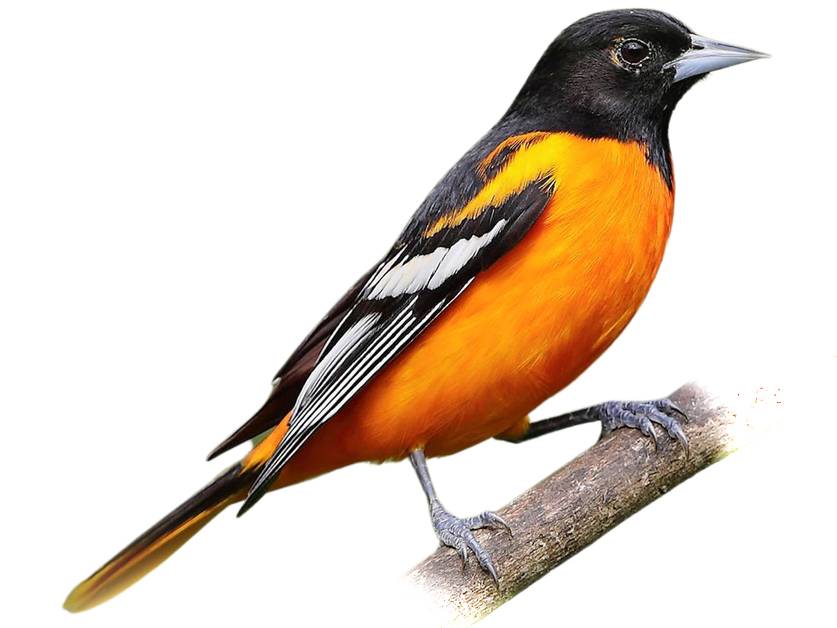
How to identify the Baltimore Oriole
Icterus galbula
Spotted a bird? Identify it instantly with the Birdby app
Open the appTo correctly identify the Baltimore Oriole (Icterus galbula), check each of these features. Birds can be tricky: habit, habitat, and call often confirm a sighting that a single photo cannot.
Size at a glance
- Length
- 17-22 cm (6.7-8.7 in)
- Wingspan
- 23-30 cm (9.1-11.8 in)
- Weight
- 30-40 g (1.1-1.4 oz)
Physical features to check
- 1
Plumage
Overall feather coloration and pattern.
Adult males are brilliant orange on the underparts, rump, and shoulder patches, contrasting with a black head, back, wings, and tail. There is a single white wing bar. Adult females are duller, typically yellowish-orange to brownish-orange on the underparts, with an olive-brown back, grayish head, and two white wing bars. Some older females can be quite bright, approaching male coloration.
- 2
Beak shape
Shape and color of the bill: a key field mark.
Conical, sharply pointed, and straight; dark gray to black.
- 3
Eye color
Iris color and any distinctive eye markings.
Dark brown.
- 4
Leg color
Leg and foot color.
Dark gray to black.
- 5
Distinguishing features
Standout features that separate this species.
Males are unmistakable with their vibrant orange and black pattern. Females and immatures are identified by their yellowish-orange underparts, two white wing bars, and pointed bill. The overall sleek body shape and active foraging behavior are also characteristic.
- 6
Juvenile appearance
How young birds differ from adults.
Juveniles resemble adult females but are even duller, with more olive-brown tones and less distinct orange or yellow. They have two prominent white wing bars. First-year males will show some black feathering on the head and back, gradually acquiring adult male plumage over their first year.
- 7
Seasonal changes
Plumage variation between breeding and non-breeding seasons.
No significant seasonal plumage changes in adults; breeding and non-breeding plumages are essentially the same. First-year males gradually molt into adult plumage.
- 8
Sexual dimorphism
How males and females differ.
Pronounced. Males are bright orange and black, while females are duller yellowish-orange and olive-brown. Some older females can develop brighter plumage, mimicking males.
Key field marks
- Plumage (Males). Look for the unmistakable combination of brilliant orange underparts, rump, and shoulder patches, contrasting with a solid black head, back, wings, and tail. Note the single white wing bar.
- Plumage (Females/Immatures). Identify by yellowish-orange to brownish-orange underparts, olive-brown back, grayish head, and two distinct white wing bars. The pointed bill is also a key feature.
- Song. Listen for the distinctive, rich, fluty, whistled song, often described as a series of clear, deliberate notes. It's a strong indicator of their presence, especially in spring.
- Nest. If you find a unique, deep, pendulous, woven pouch-like nest hanging from a slender branch, it's almost certainly a Baltimore Oriole nest.
- Feeding Behavior. Observe them actively gleaning insects from leaves in the canopy or visiting feeders for fruit and jelly. Their agility in trees is characteristic.
Explore the Baltimore Oriole
Identify birds anywhere
Free on iOS, Android, and Web. Photo & sound identification, full species database, and your personal life list.