
Spotted a bird? Identify it instantly with the Birdby app
Open the appAbout
The Red-backed Shrike is a small, Old World passerine bird known for its predatory 'shrike' behavior, impaling prey on thorns or barbed wire fences – a practice that has earned it the nickname 'butcher bird'. It is a sexually dimorphic species with distinct plumages between males, females, and juveniles. It is a long-distance migrant, breeding across much of temperate Eurasia and wintering in southern Africa.
Size & lifespan
- Length
- 16-18 cm
- Wingspan
- 24-27 cm
- Weight
- 25-35 g
- Lifespan
- Typically 2-5 years in the wild, up to 8 years recorded.
- Diet
- Primarily large insects such as beetles, grasshoppers, crickets, and bumblebees. Also consumes small mammals (voles, shrews), small birds, lizards, and frogs, especially when feeding young.
Physical characteristics
- Plumage
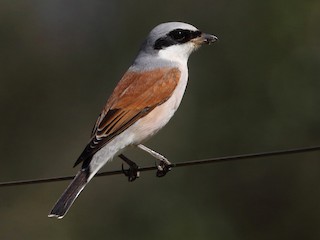
- Adult male: Pale grey crown and nape, prominent black mask through the eye. Back and scapulars are rufous-chestnut 'reddish-brown'. Rump and uppertail-coverts are grey. Tail is black with white outer feathers and white tips to central feathers. Underparts are white to pinkish-white, often with a faint peachy tinge on the flanks. Wings are dark brown to blackish with a faint pale wing panel. Adult female: Upperparts are rufous-brown, often mottled or finely barred, lacking the distinct grey head and black mask of the male. Underparts are off-white to buff, heavily barred crescent-shaped or scaled pattern on the breast and flanks. Tail is brownish with rufous bases and narrow white tips to outer feathers. Juvenile: Similar to female but with more distinct and extensive barring/scaling on both upperparts and underparts, including the back and rump. Overall a rather mottled, cryptic brown appearance. The mask is indistinct or absent.
- Beak shape
- Strong, hooked bill, dark grey to black, with a paler base to the lower mandible.
- Eye color
- Dark brown.
- Leg color
- Dark grey to black.
- Distinguishing features
- Strong sexual dimorphism, 'butcher bird' impaling behavior, grey head and mask on males contrasted with reddish-brown back, often seen perching upright on prominent vantage points.
- Juvenile appearance
- Mottled brown and heavily barred on both upperparts and underparts, resembling a duller, more uniformly patterned version of an adult female but with more extensive barring.
- Seasonal changes
- Plumage does not undergo significant seasonal changes, though colors may appear slightly brighter after a fresh molt and duller before molt due to wear and fading. Juveniles acquire adult plumage after their first complete molt in late summer/autumn.
- Sexual dimorphism
- Pronounced. Males have a grey head, black mask, and bright rufous back. Females are duller, brown-backed with barring on underparts.
How to identify
- 1
Male Plumage
Look for the distinctive combination of a grey head, black eye-mask, and rufous-chestnut 'red-back'. Underparts are usually pale pinkish-white.
- 2
Female Plumage
Identify by the brown upperparts (lacking grey head and strong mask), and prominent crescentic barring/scaling on the buffy-white underparts.
- 3
Juvenile Plumage
Heavily barred and mottled brown overall, with a scalloped appearance. The bill often has a larger pale base.
- 4
Behavior
Observe for its characteristic 'perch-and-pounce' hunting strategy from an exposed branch or wire. Look for impaled prey ('larder') on thorns in its territory.
- 5
Voice
Listen for its melodious, warbling song, often with mimicry, or its harsh 'tschak' alarm calls.
- 6
Habitat
Search in open areas with scattered thorny bushes, hedgerows, and tall vegetation, often agricultural or semi-natural landscapes.
Habitat & range
- Biomes
- Temperate grasslands, shrublands, open woodlands, agricultural areas, and forest edges.
- Geographic range
- Breeds across most of temperate Europe (eastward from France and Denmark) and Asia, extending to western Siberia. Winters primarily in eastern and southern Africa, from Kenya south to South Africa.
- Elevation range
- Typically from sea level up to 1,500-2,000 meters in breeding areas, locally higher in mountainous regions (up to 3,000m in central Asia).
- Preferred environments
- Open landscapes with scattered thorny bushes (e.g., hawthorn, blackthorn), hedgerows, tall grasses, clearings in sparse woodlands, shrubby pastures, young plantations, and orchards. Requires suitable perches for hunting and dense thorny vegetation for nesting and impaling prey.
Behavior
- Activity time
- Diurnal. Most active during daylight hours, particularly in the morning and late afternoon for hunting.
- Feeding habits
- Perch-and-pounce predator. Actively hunts from an exposed perch, swooping down to catch prey on the ground or in low vegetation. Known for its unique habit of impaling larger prey items on thorns, barbed wire, or wedging them into tight crevices for later consumption or to assist in tearing them apart. This habit is particularly prevalent during the breeding season when provisioning young with larger prey.
- Social behavior
- Generally solitary or found in breeding pairs. Migrates in loose flocks, but not highly social outside the breeding season. Can be aggressive towards other birds, especially when defending territory or cached food.
- Flight pattern
- Undulating flight, often low over vegetation, with rapid wing beats interspersed with short glides. Direct flight when migrating.
- Migration pattern
- Long-distance migratory. Entire population moves from Eurasian breeding grounds to sub-Saharan Africa for the non-breeding season. Migrates via specific routes, often encountering natural barriers like the Sahara Desert and Mediterranean Sea. Post-breeding migration starts in late July/August, and spring migration for breeding returns takes place in April/May.
- Territoriality
- Strongly territorial during the breeding season. Males establish territories and defend them vigorously against rivals. Display flights and calls are used to demarcate boundaries.
Song & calls
- Song
- A varied and pleasant, warbling song, often delivered from a prominent perch. It consists of a mixture of melodious, fluty notes, whistles, churrs, and mimicry of other bird species (e.g., swallows, chaffinches, warblers). Can be quite complex and inventive.
- Call
- Common calls include harsh, scolding 'tschak', 'tschrr', or 'kerr' notes used in alarm or agitation. A softer 'twee' or 'pwit' may be given in contact. During courtship, a purring 'prrr' is heard.
- When they vocalize
- Males sing most frequently during courtship and early breeding season to attract mates and establish territory. Alarm calls are given throughout the year as needed.
Breeding & reproduction
- Breeding season
- May to July, with slight variations depending on geographic location.
- Nesting habits
- Nests are typically well-concealed, deep cups built in thorny bushes (e.g., hawthorn, blackthorn, wild rose) or dense hedges, usually 1-3 meters above the ground. Both sexes participate in nest building. The nest is constructed from twigs, stems, roots, moss, and grass, lined with finer materials like hair, wool, and feathers.
- Clutch size
- 4-7 eggs, most commonly 5-6.
- Egg description
- Typically 5-6 eggs, occasionally 4-7. Variable in color, often greenish-white or pale buff, with reddish-brown or grey blotches, spots, and streaks, particularly concentrated at the blunt end.
- Incubation period
- 14-16 days, primarily by the female, though the male may assist briefly.
- Fledging period
- 14-15 days after hatching. The young leave the nest but remain dependent on parents for several weeks.
- Parental care
- Both parents feed the nestlings and fledglings. The male often brings the majority of food during incubation, and then both parents share feeding duties after hatching. Fledglings are taught hunting techniques.
Where to find
Breeding Grounds
Across temperate Eurasia. Best sought in areas with mosaic habitats of open grassland, scrub, and scattered trees/hedgerows. Look in meadows with hawthorn or blackthorn bushes, clearings in young plantations, and abandoned agricultural land.
Migration Stopovers
Can be seen in a wider range of habitats during migration, including gardens, parks, and coastal scrub, especially around strategic land-bridges and coastlines as they cross continents.
Wintering Grounds
Eastern and Southern Africa. Found in dry acacia savanna, bushveld, and other open woodland/shrubland habitats. Similar open, scrubby areas as their breeding grounds.
Field tips
- Locate Perches. Red-backed Shrikes prefer to hunt from prominent, exposed perches. Scan the tops of bushes, fence posts, power lines, and tall vegetation.
- Search Thorny Shrubs. Their preferred nesting and 'larder' sites are thorny shrubs. Carefully check hawthorn, blackthorn, and similar bushes for nests or impaled prey, especially during the breeding season.
- Listen for Song/Calls. Their distinctive, often mimetic, warbling song can lead you to a hidden bird. Alarm calls 'tschak-tschrr' are also good indicators of their presence.
- Patience and Observation. Shrikes can be wary. Observe from a distance with binoculars. Their hunting dives from a perch are a clear behavioral cue.
- Time of Year. Focus on late spring and summer (May-July) in breeding areas. They arrive relatively late in spring and depart early for migration.
Similar species
Woodchat Shrike
Lanius senator
Adult male Woodchat Shrike has a prominent white patch on the wing, a pure black back, and a rufous crown and nape (not grey). Both sexes lack the extensively barred underparts of female/juvenile Red-backed Shrike. Female Woodchat is paler brown-backed but still shows the rufous crown and white wing patch, often duller.
Great Grey Shrike
Lanius excubitor
Significantly larger, predominantly grey and white with black wings and tail. It has a longer tail and a more robust bill. Lacks the rufous-chestnut back of the male Red-backed Shrike and the barred underparts of the female/juvenile.
Lesser Grey Shrike
Lanius minor
Similar in size but has a black mask that extends over the forehead, a pale pinkish flush on the breast (less distinct than Red-backed Shrike), and lack of rufous on the back. It has black primary feathers with a distinct white wing speculum, which Red-backed Shrike lacks. Its forehead and crown are uniform grey.
Quick facts
- Etymology:
- The genus name 'Lanius' is Latin for 'butcher', referring to their practice of impaling prey. 'collurio' is also Latin, referring to an unidentified shrike species.
- Diet Specialization:
- Known as a 'butcher bird' due to its habit of impaling prey on thorns or barbed wire, creating a 'larder' for later consumption.
- Migration Distance:
- One of the longest-distance migrants among European passerines, covering thousands of kilometers between breeding and wintering grounds.
- Habitat Indicator:
- Its presence indicates healthy, biodiverse scrubland and mosaic habitats, often characterized by traditional agricultural practices or undeveloped marginal lands.
Fun facts
- The 'larder' created by the shrike not only stores food but also helps to tear apart larger prey items, as shrikes lack strong talons like raptors.
- Red-backed Shrikes are known to mimic other birds' songs, integrating phrases into their own complex melodies, making their song quite intriguing to listen to.
- Despite their fierce predatory nature, Red-backed Shrikes are themselves vulnerable to larger raptors during migration.
- Unlike many passerines, the Red-backed Shrike is one of the few species with both sexes participating in building the nest, though laying and incubation are primarily female roles.
Scientific classification
- Kingdom
- Animalia
- Phylum
- Chordata
- Class
- Aves
- Order
- Passeriformes
- Family
- Laniidae
- Genus
- Lanius
- Species
- Lanius collurio
Explore the Red-backed Shrike
Identify birds anywhere
Free on iOS, Android, and Web. Photo & sound identification, full species database, and your personal life list.