
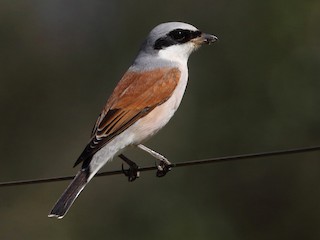
How to identify the Red-backed Shrike
Lanius collurio
Spotted a bird? Identify it instantly with the Birdby app
Open the appTo correctly identify the Red-backed Shrike (Lanius collurio), check each of these features. Birds can be tricky: habit, habitat, and call often confirm a sighting that a single photo cannot.
Size at a glance
- Length
- 16-18 cm
- Wingspan
- 24-27 cm
- Weight
- 25-35 g
Physical features to check
- 1
Plumage
Overall feather coloration and pattern.
Adult male: Pale grey crown and nape, prominent black mask through the eye. Back and scapulars are rufous-chestnut 'reddish-brown'. Rump and uppertail-coverts are grey. Tail is black with white outer feathers and white tips to central feathers. Underparts are white to pinkish-white, often with a faint peachy tinge on the flanks. Wings are dark brown to blackish with a faint pale wing panel. Adult female: Upperparts are rufous-brown, often mottled or finely barred, lacking the distinct grey head and black mask of the male. Underparts are off-white to buff, heavily barred crescent-shaped or scaled pattern on the breast and flanks. Tail is brownish with rufous bases and narrow white tips to outer feathers. Juvenile: Similar to female but with more distinct and extensive barring/scaling on both upperparts and underparts, including the back and rump. Overall a rather mottled, cryptic brown appearance. The mask is indistinct or absent.
- 2
Beak shape
Shape and color of the bill: a key field mark.
Strong, hooked bill, dark grey to black, with a paler base to the lower mandible.
- 3
Eye color
Iris color and any distinctive eye markings.
Dark brown.
- 4
Leg color
Leg and foot color.
Dark grey to black.
- 5
Distinguishing features
Standout features that separate this species.
Strong sexual dimorphism, 'butcher bird' impaling behavior, grey head and mask on males contrasted with reddish-brown back, often seen perching upright on prominent vantage points.
- 6
Juvenile appearance
How young birds differ from adults.
Mottled brown and heavily barred on both upperparts and underparts, resembling a duller, more uniformly patterned version of an adult female but with more extensive barring.
- 7
Seasonal changes
Plumage variation between breeding and non-breeding seasons.
Plumage does not undergo significant seasonal changes, though colors may appear slightly brighter after a fresh molt and duller before molt due to wear and fading. Juveniles acquire adult plumage after their first complete molt in late summer/autumn.
- 8
Sexual dimorphism
How males and females differ.
Pronounced. Males have a grey head, black mask, and bright rufous back. Females are duller, brown-backed with barring on underparts.
Key field marks
- Male Plumage. Look for the distinctive combination of a grey head, black eye-mask, and rufous-chestnut 'red-back'. Underparts are usually pale pinkish-white.
- Female Plumage. Identify by the brown upperparts (lacking grey head and strong mask), and prominent crescentic barring/scaling on the buffy-white underparts.
- Juvenile Plumage. Heavily barred and mottled brown overall, with a scalloped appearance. The bill often has a larger pale base.
- Behavior. Observe for its characteristic 'perch-and-pounce' hunting strategy from an exposed branch or wire. Look for impaled prey ('larder') on thorns in its territory.
- Voice. Listen for its melodious, warbling song, often with mimicry, or its harsh 'tschak' alarm calls.
- Habitat. Search in open areas with scattered thorny bushes, hedgerows, and tall vegetation, often agricultural or semi-natural landscapes.
Explore the Red-backed Shrike
Identify birds anywhere
Free on iOS, Android, and Web. Photo & sound identification, full species database, and your personal life list.