
Spotted a bird? Identify it instantly with the Birdby app
Open the appAbout
The European Herring Gull is a large and widespread gull species found across much of the Northern Hemisphere. It is a highly adaptable and opportunistic feeder, often associated with coastal areas, urban environments, and agricultural lands. Known for its distinctive calls and robust build, it is a familiar sight in many parts of its range.
Size & lifespan
- Length
- 55-67 cm
- Wingspan
- 138-150 cm
- Weight
- 750-1500 g
- Lifespan
- Up to 30 years in the wild, typically 10-15 years.
- Diet
- Omnivore
Physical characteristics
- Plumage
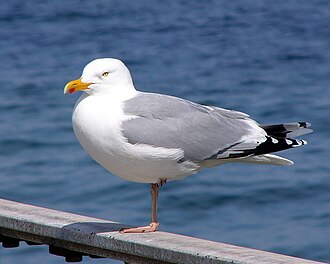
- Adults have a white head, neck, underparts, and tail. The back and upperwings are pale grey. The wingtips are black with prominent white 'mirrors' (spots).
- Beak shape
- Strong, slightly hooked yellow bill with a distinctive red spot on the lower mandible (gonys spot).
- Eye color
- Pale yellow with a red orbital ring.
- Leg color
- Pinkish-flesh colored.
- Distinguishing features
- Large size, pale grey back, yellow bill with red spot, pink legs, and black wingtips with white mirrors. The red spot on the bill is pecked by chicks to stimulate regurgitation of food.
- Juvenile appearance
- Juveniles are mottled brown and grey, with a dark bill and dark eyes. They gradually acquire adult plumage over four years, passing through several intermediate stages. First-winter birds are heavily mottled brown, second-winter birds show more grey on the back, and third-winter birds are largely grey and white but still retain some brown in the wings and tail.
- Seasonal changes
- Adults show very little seasonal plumage variation. The red orbital ring may become slightly more prominent during the breeding season.
- Sexual dimorphism
- Males are generally slightly larger and heavier than females, but plumage is identical.
How to identify
- 1
Size and Shape
Look for a large, robust gull with a powerful build and a relatively flat-topped head.
- 2
Plumage (Adult)
Note the pale grey back and upperwings contrasting with white underparts. The black wingtips with prominent white 'mirrors' are key.
- 3
Bill
Observe the strong yellow bill with a distinct red spot on the lower mandible. This is a crucial field mark.
- 4
Legs
Check for pinkish-flesh colored legs. This distinguishes it from yellow-legged gulls.
- 5
Eye
Pale yellow eye with a red orbital ring.
- 6
Vocalizations
Listen for its characteristic loud, 'laughing' calls, especially the 'kyow-kyow-kyow-kyow-kyaaaah' series.
- 7
Juvenile Plumage
Young birds are heavily mottled brown and grey. Note the dark bill and eyes, and the gradual transition to adult plumage over several years.
Habitat & range
- Biomes
- Coastal areas, estuaries, urban environments, agricultural land, landfills, inland lakes, and rivers.
- Geographic range
- Breeds across Northern Europe, Scandinavia, and parts of Russia. Winters across Western and Southern Europe, North Africa, and the Middle East. Also found in North America (though often considered a separate species, American Herring Gull, Larus smithsonianus, by some authorities).
- Elevation range
- Primarily sea level to low elevations, but can be found inland at various altitudes, especially near human settlements or large bodies of water.
- Preferred environments
- Rocky coasts, sandy beaches, cliffs, islands, harbors, fishing ports, city centers, parks, reservoirs, and cultivated fields.
Behavior
- Activity time
- Diurnal, though they may forage at night under artificial light or during full moons.
- Feeding habits
- Highly opportunistic and omnivorous. Diet includes fish, crustaceans, mollusks, insects, eggs and chicks of other birds, small mammals, carrion, offal, discarded human food, and berries. They forage by scavenging, surface-seizing, shallow-diving, and kleptoparasitism (stealing food from other birds).
- Social behavior
- Highly social, especially outside the breeding season, forming large flocks at roosts and feeding sites. Breeds in colonies, sometimes numbering thousands of pairs.
- Flight pattern
- Strong, direct flight with powerful wingbeats. Also capable of soaring and gliding, especially in coastal updrafts. Often seen hovering or circling over food sources.
- Migration pattern
- Northern populations are migratory, moving south and west for the winter. Southern populations are largely resident or undertake short-distance dispersal. Juveniles often disperse further than adults.
- Territoriality
- Highly territorial during the breeding season, defending nesting sites aggressively. Outside breeding, they are less territorial, often feeding in communal areas.
Song & calls
- Song
- Does not have a true song. Vocalizations are primarily calls.
- Call
- A wide repertoire of loud, raucous calls. The most characteristic is a long, drawn-out 'kyow-kyow-kyow-kyow-kyaaaah' or 'gull-gull-gull-ga-ga-ga'. Also produces short 'gah-gah' alarm calls, 'mewing' calls, and 'choking' calls during courtship or territorial disputes.
- When they vocalize
- Vocalizes year-round, but particularly noisy during the breeding season and when competing for food.
Breeding & reproduction
- Breeding season
- April to July, with peak egg-laying in May.
- Nesting habits
- Nests are typically built on cliffs, rocky outcrops, islands, sand dunes, or increasingly, on rooftops and other urban structures. The nest is a bulky scrape lined with vegetation, feathers, and debris.
- Clutch size
- 2-4 eggs
- Egg description
- Typically 2-4 (usually 3) eggs, olive-brown to greenish-blue, heavily blotched and spotted with dark brown or black. Average size is about 70 x 50 mm.
- Incubation period
- 28-30 days, incubated by both parents.
- Fledging period
- 35-40 days after hatching. Young are semi-precocial, leaving the nest shortly after hatching but remaining dependent on parents for food.
- Parental care
- Both parents share incubation duties and care for the chicks, feeding them regurgitated food until they fledge and for some time thereafter.
Where to find
Coastal Areas
Look along beaches, cliffs, estuaries, harbors, and fishing ports. They are abundant in these environments.
Urban Environments
Common in cities, especially those near the coast, where they scavenge for food in parks, streets, and landfills.
Agricultural Land
Often follow plows or gather in fields to feed on invertebrates and discarded crops.
Inland Water Bodies
Can be found around large lakes, reservoirs, and rivers, particularly during migration or winter.
Field tips
- Observe Feeding Behavior. Watch for their opportunistic feeding habits – scavenging, following fishing boats, or even snatching food from unwary picnickers.
- Listen for Calls. Their loud and distinctive calls are often the first indication of their presence, especially in coastal or urban settings.
- Study Age Plumages. Pay attention to the different plumages of juveniles and subadults, as they can look quite different from adults and from each other.
- Check Leg Color. Leg color is a crucial distinguishing feature from similar species like the Yellow-legged Gull or Lesser Black-backed Gull.
Similar species
Lesser Black-backed Gull
Larus fuscus
The Lesser Black-backed Gull has a darker grey (slate-grey to blackish) back and upperwings, and yellow legs (not pink). Its call is also generally deeper and more guttural.
Great Black-backed Gull
Larus marinus
The Great Black-backed Gull is significantly larger, with a much darker, almost black, back and upperwings. It also has pink legs, but its bill is much heavier and its call is deeper and more resonant.
Yellow-legged Gull
Larus michahellis
The Yellow-legged Gull has yellow legs (not pink), a slightly darker grey back, and often a more angular head shape. Its red orbital ring is typically more prominent, and its calls are often described as harsher.
American Herring Gull
Larus smithsonianus
Often considered a separate species, the American Herring Gull is very similar but typically has a slightly darker grey mantle, a more pronounced streaking on the head in winter, and a slightly different call. Identification in the field can be challenging where ranges overlap or vagrants occur.
Quick facts
- Scientific Name:
- Larus argentatus
- Family:
- Laridae
- Diet:
- Omnivore
- Conservation Status:
- Least Concern
- Average Lifespan:
- 10-15 years
- Wingspan:
- 138-150 cm
Fun facts
- The red spot on the bill of adult European Herring Gulls acts as a target for chicks, which peck at it to stimulate the parents to regurgitate food.
- European Herring Gulls are highly intelligent and adaptable, capable of learning complex behaviors, such as dropping shellfish onto hard surfaces to break them open.
- Despite their commonality, the taxonomy of 'Herring Gulls' is complex, with various subspecies and closely related species (like the American Herring Gull) often being re-evaluated and split by ornithologists.
- They are known for their bold and sometimes aggressive behavior, especially when competing for food, and have successfully adapted to living alongside humans in urban environments.
Scientific classification
- Kingdom
- Animalia
- Phylum
- Chordata
- Class
- Aves
- Order
- Charadriiformes
- Family
- Laridae
- Genus
- Larus
- Species
- Larus argentatus
Explore the European Herring Gull
Identify birds anywhere
Free on iOS, Android, and Web. Photo & sound identification, full species database, and your personal life list.