
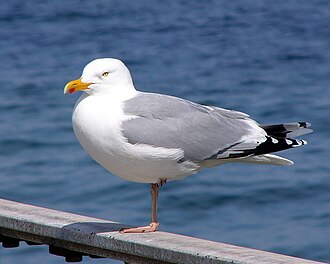
How to identify the European Herring Gull
Larus argentatus
Spotted a bird? Identify it instantly with the Birdby app
Open the appTo correctly identify the European Herring Gull (Larus argentatus), check each of these features. Birds can be tricky: habit, habitat, and call often confirm a sighting that a single photo cannot.
Size at a glance
- Length
- 55-67 cm
- Wingspan
- 138-150 cm
- Weight
- 750-1500 g
Physical features to check
- 1
Plumage
Overall feather coloration and pattern.
Adults have a white head, neck, underparts, and tail. The back and upperwings are pale grey. The wingtips are black with prominent white 'mirrors' (spots).
- 2
Beak shape
Shape and color of the bill: a key field mark.
Strong, slightly hooked yellow bill with a distinctive red spot on the lower mandible (gonys spot).
- 3
Eye color
Iris color and any distinctive eye markings.
Pale yellow with a red orbital ring.
- 4
Leg color
Leg and foot color.
Pinkish-flesh colored.
- 5
Distinguishing features
Standout features that separate this species.
Large size, pale grey back, yellow bill with red spot, pink legs, and black wingtips with white mirrors. The red spot on the bill is pecked by chicks to stimulate regurgitation of food.
- 6
Juvenile appearance
How young birds differ from adults.
Juveniles are mottled brown and grey, with a dark bill and dark eyes. They gradually acquire adult plumage over four years, passing through several intermediate stages. First-winter birds are heavily mottled brown, second-winter birds show more grey on the back, and third-winter birds are largely grey and white but still retain some brown in the wings and tail.
- 7
Seasonal changes
Plumage variation between breeding and non-breeding seasons.
Adults show very little seasonal plumage variation. The red orbital ring may become slightly more prominent during the breeding season.
- 8
Sexual dimorphism
How males and females differ.
Males are generally slightly larger and heavier than females, but plumage is identical.
Key field marks
- Size and Shape. Look for a large, robust gull with a powerful build and a relatively flat-topped head.
- Plumage (Adult). Note the pale grey back and upperwings contrasting with white underparts. The black wingtips with prominent white 'mirrors' are key.
- Bill. Observe the strong yellow bill with a distinct red spot on the lower mandible. This is a crucial field mark.
- Legs. Check for pinkish-flesh colored legs. This distinguishes it from yellow-legged gulls.
- Eye. Pale yellow eye with a red orbital ring.
- Vocalizations. Listen for its characteristic loud, 'laughing' calls, especially the 'kyow-kyow-kyow-kyow-kyaaaah' series.
- Juvenile Plumage. Young birds are heavily mottled brown and grey. Note the dark bill and eyes, and the gradual transition to adult plumage over several years.
Explore the European Herring Gull
Identify birds anywhere
Free on iOS, Android, and Web. Photo & sound identification, full species database, and your personal life list.