
Spotted a bird? Identify it instantly with the Birdby app
Open the appAbout
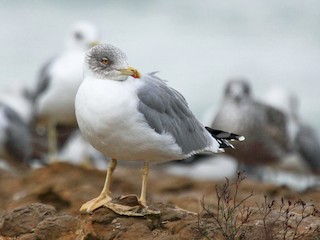
The Yellow-legged Gull is a large gull species closely related to the Herring Gull and often considered a Mediterranean representative of the 'Larus argentatus' complex. It is characterized by its robust build, powerful bill, and distinctive yellow legs and a red orbital ring in adults. It's an opportunistic feeder, highly adaptable to various environments, including urban settings.
Size & lifespan
- Length
- 52-68 cm (20-27 in)
- Wingspan
- 120-155 cm (47-61 in)
- Weight
- 760-1600 g (1.7-3.5 lbs)
- Lifespan
- Typically 10-25 years, with some individuals reaching over 30 years in the wild.
- Diet
- Highly omnivorous and opportunistic. Diet includes fish, crustaceans, mollusks, insects, small mammals, birds, eggs, carrion, offal, refuse, and plant material. They frequently exploit human discarded food sources.
Physical characteristics
- Plumage
- Adults in breeding plumage have a white head, neck, underparts, and tail. The back and upperwings are medium to dark grey. The wingtips are black with prominent white 'mirrors' (spots). Non-breeding adults show fine streaking on the head and nape, which is less extensive than in Atlantic Herring Gulls.
- Beak shape
- Strong, heavy, and conical, yellow with a prominent red spot (gonys spot) on the lower mandible.
- Eye color
- Pale yellow, surrounded by a distinct red orbital ring.
- Leg color
- Bright yellow, becoming duller, more yellowish-orange, or even greyish-yellow outside the breeding season, especially in younger adults.
- Distinguishing features
- Combination of yellow legs (especially bright in breeding season), red orbital ring, relatively dark grey mantle, and heavy yellow bill with a red spot. Juveniles and immatures are complex and variable but generally feature dark streaking/mottling on a pale ground, dark bills, and dark eyes.
- Juvenile appearance
- First-year birds are heavily mottled brown and grey, with a dark bill, dark eyes, and pinkish-grey legs. The rump and tail base are whiter than in first-year Herring Gulls. Second-year birds show an intermediate plumage, with a greyer mantle developing, often a paler bill base, and legs starting to turn yellowish-pink. The plumage develops gradually, becoming more adult-like over 3-4 years.
- Seasonal changes
- Adults show subtle seasonal changes, mainly a slight streaking on the head and nape in non-breeding plumage and a dulling of leg and bill coloration. The red orbital ring is most prominent during the breeding season. Juveniles undergo significant plumage changes over several years before reaching adult plumage.
- Sexual dimorphism
- Minimal in plumage or coloration. Males are generally slightly larger and heavier than females, but this difference is not consistently discernible in the field.
How to identify
- 1
Leg Color
Look for bright, rich yellow legs in adults, especially during the breeding season. Duller yellow or yellowish-orange can occur at other times or in younger adults.
- 2
Mantle Color
Observe the grey saddle (back and upperwings); it's typically a medium to dark grey, darker than Herring Gull but lighter than Lesser Black-backed Gull.
- 3
Bill Characteristics
Identify the heavy yellow bill with a prominent red spot on the lower mandible (gonys spot). The bill often appears proportionally larger and more powerful than a Herring Gull's.
- 4
Red Orbital Ring
A distinct red ring around the eye in adults is a key field mark, especially prominent in breeding birds.
- 5
Head Streaking (Non-breeding)
Note the relatively clean white head in non-breeding plumage, with minimal or only fine streaking on the nape and hindneck, less extensive than seen in Herring Gulls.
- 6
Juvenile Plumage
In juveniles, look for a generally paler, washed-out brownish appearance with a whiter rump and tail base compared to the more uniformly dark first-year Herring Gulls. The primaries are often darker, appearing almost black, and the bill dark.
Habitat & range
- Biomes
- Coastal areas, marine environments, wetlands, agricultural land, urban and suburban areas, estuaries, large rivers.
- Geographic range
- Predominantly the Mediterranean Sea basin and Atlantic coasts of Europe and North Africa, extending north to parts of Western Europe (e.g., France, UK, Netherlands, Germany, Switzerland) and east into the Black Sea, Red Sea, and Arabian Peninsula.
- Elevation range
- Primarily found at sea level along coasts, but can range inland to significant elevations when foraging or using inland water bodies, especially near urban and agricultural areas.
- Preferred environments
- Rocky coasts, islands, cliffs for nesting, but also increasingly artificial structures in urban areas. Also found around ports, fishing boats, landfills, sewage outfalls, and agricultural fields. Requires access to open water for bathing and drinking.
Behavior
- Activity time
- Primarily diurnal, with peak activity during daylight hours for foraging. They may also forage at night, particularly in areas with artificial lighting or near fishing boats.
- Feeding habits
- Highly opportunistic and adaptable. They scavenge widely, forage on marine creatures along the coast, prey on small vertebrates, and readily exploit anthropogenic food sources from landfills, fishing vessels, and urban refuse. They often drop hard-shelled prey (e.g., mollusks) from height onto rocks to open them.
- Social behavior
- Highly social, especially outside the breeding season. They form large flocks for roosting and foraging, often associating with other gull species. During breeding, they nest in colonies, sometimes very dense.
- Flight pattern
- Strong, buoyant, and graceful flight, often soaring on updrafts or thermals. When actively foraging, flight is typically direct with powerful wing beats. They glide effortlessly over water.
- Migration pattern
- Partially migratory or dispersive. Northern populations undertake short to medium-distance migrations or dispersal movements, often moving south-west from breeding areas. Mediterranean populations are largely resident or undertake short-distance dispersal movements. Juveniles and immature birds tend to be more dispersive than adults.
- Territoriality
- Territorial during the breeding season, defending a small area around the nest site within a colony. Outside the breeding season, they are gregarious and generally non-territorial, forming communal roosts and feeding aggregations.
Song & calls
- Song
- Gulls generally do not have a complex 'song' in the conventional sense. However, they perform specific vocalizations during courtship and territorial displays, which can be elaborate. The 'long call' is an upward-trending series of deep 'ow-ow-ow...' notes, often ending with a head-tossing posture, indicating territorial assertion or excitement.
- Call
- A variety of calls, including a harsh, deep 'kyaow' or 'kyarr' used in alarm or mild aggression. A common 'gabbling' or 'chattering' call is heard in flocks. Begging calls from chicks are high-pitched peeping or 'chee-chee' notes. The 'alarm call' is a rapid series of 'kek-kek-kek' notes, escalating in intensity.
- When they vocalize
- Most vocal during the breeding season at colonies, when establishing territories, courting, and defending nests/chicks. Also vocal when competing for food or during social interactions in flocks throughout the year.
Breeding & reproduction
- Breeding season
- Typically starts from March to April in southern areas, extending through May and June further north.
- Nesting habits
- Colonial nesters, often forming large and dense colonies on rocky cliffs, islands, coastal islets, and increasingly on rooftops or urban structures. The nest is a simple scrape on the ground, lined with grass, seaweed, feathers, and other debris. Both parents participate in nest building.
- Clutch size
- Usually 2-3 eggs, sometimes 1 or rarely 4.
- Egg description
- 2-3 eggs, typically olive to brownish-buff, variably marked with dark spots and blotches. Dimensions average around 68 x 48 mm.
- Incubation period
- 27-31 days, incubated by both parents.
- Fledging period
- Chicks fledge (become capable of sustained flight) at approximately 35-45 days old.
- Parental care
- Both parents share incubation duties and care for the chicks. They provide food, protect them from predators and adverse weather, and guide them to foraging grounds once they are more mobile. Chicks remain dependent on parents for several weeks after fledging.
Where to find
Coastal areas
Look along rocky coastlines, sandy beaches, estuaries, and harbors. They are common around fishing ports, scavenging for discards.
Urban environments
Often found in cities and towns, especially near landfills, parks, rooftops (for nesting), and anywhere human food waste is available.
Inland wetlands and lakes
While primarily coastal, they venture inland to large rivers, lakes, and reservoirs, particularly outside the breeding season or for foraging.
Agricultural fields
They exploit agricultural foraging opportunities, feeding on invertebrates or carrion disturbed by farming practices.
Field tips
- Observe Leg Color Carefully. Even if the yellow is dull, it's typically still yellowish-tinged and not pinkish-grey like many Herring Gulls. Good lighting is crucial.
- Compare Mantle Shades. If possible, compare the grey of the back with known Herring Gulls or Lesser Black-backed Gulls in the same area. Yellow-legged Gulls fall in between in terms of darkness.
- Look for Red Eye-ring. This can be a very helpful and often overlooked feature for adults, distinguishing them from Herring and Caspian Gulls.
- Study Juveniles and Immatures. While complex, pay attention to the contrasting paler rump and tail base, and the overall 'cleaner' or more washed-out brownish-grey appearance compared to other large gulls of similar age.
- Listen to Vocalizations. Their calls, especially the long call, can be slightly deeper and more guttural than Herring Gulls, although this requires experience to distinguish reliably.
Similar species
Herring Gull
Larus argentatus
Yellow-legged Gulls (Larus michahellis) typically have brighter yellow legs (though these can dull), a more distinct red orbital ring, and a slightly darker grey mantle than Herring Gulls. The head streaking in non-breeding plumage is less extensive in Yellow-legged Gulls. Juvenile Yellow-legged Gulls tend to be paler overall with a whiter rump compared to the more uniformly brownish Herring Gull juveniles.
Caspian Gull
Larus cachinnans
Caspian Gulls typically have duller, flesh-colored to pale yellow legs (never bright yellow), a paler mantle, and a longer, more elegant neck. Their head shape is often flatter, and the bill is often longer and thinner. The orbital ring is usually dark or less prominent than in Yellow-legged Gulls. Juveniles distinguish by their overall paler appearance, especially on the underparts, and different feather patterns on the tertials.
Lesser Black-backed Gull
Larus fuscus
Lesser Black-backed Gulls have much darker, slate-grey to black mantles and upperwings, contrasting strongly with the white head and underparts. Their legs are also yellow, but the mantle color is the primary distinction. Juveniles and immatures of Lesser Black-backed Gulls are also generally darker and more uniformly brown than Yellow-legged Gulls.
Quick facts
- Taxonomic Status:
- Formerly considered a subspecies of Herring Gull (Larus argentatus michahellis), now generally recognized as a full species.
- Adaptability:
- One of the most adaptable gull species, rapidly colonizing new habitats, including urban areas, and exploiting diverse food sources.
- Population Trend:
- Generally increasing and expanding its range, particularly northwards in Europe.
- Nesting Sites:
- Increasingly utilizes rooftops and other human-made structures for nesting, particularly in coastal cities.
Fun facts
- Yellow-legged Gulls are notorious for 'kleptoparasitism,' meaning they steal food directly from other birds or even snatched from unwary humans.
- Their adaptability has led to significant population increases in many regions, sometimes bringing them into conflict with human interests due to noise, mess, and predation on other bird species.
- The species' scientific name 'michahellis' honors Karl Michahelles, a German physician and ornithologist.
- They are thought to be extending their range northward into regions previously dominated by Herring Gulls, potentially impacting native populations.
Scientific classification
- Kingdom
- Animalia
- Phylum
- Chordata
- Class
- Aves
- Order
- Charadriiformes
- Family
- Laridae
- Genus
- Larus
- Species
- Larus michahellis
Explore the Yellow-legged Gull
Identify birds anywhere
Free on iOS, Android, and Web. Photo & sound identification, full species database, and your personal life list.