
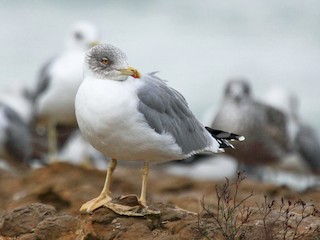
Where does the Yellow-legged Gull live?
Larus michahellis
Spotted a bird? Identify it instantly with the Birdby app
Open the appThe Yellow-legged Gull lives in specific habitats and regions. Knowing where, and when, to look improves your chances of a successful sighting.
Biomes
Coastal areas, marine environments, wetlands, agricultural land, urban and suburban areas, estuaries, large rivers.
Geographic range
Predominantly the Mediterranean Sea basin and Atlantic coasts of Europe and North Africa, extending north to parts of Western Europe (e.g., France, UK, Netherlands, Germany, Switzerland) and east into the Black Sea, Red Sea, and Arabian Peninsula.
Preferred environments
Rocky coasts, islands, cliffs for nesting, but also increasingly artificial structures in urban areas. Also found around ports, fishing boats, landfills, sewage outfalls, and agricultural fields. Requires access to open water for bathing and drinking.
Elevation range
Primarily found at sea level along coasts, but can range inland to significant elevations when foraging or using inland water bodies, especially near urban and agricultural areas.
Where to look
Coastal areas
Look along rocky coastlines, sandy beaches, estuaries, and harbors. They are common around fishing ports, scavenging for discards.
Urban environments
Often found in cities and towns, especially near landfills, parks, rooftops (for nesting), and anywhere human food waste is available.
Inland wetlands and lakes
While primarily coastal, they venture inland to large rivers, lakes, and reservoirs, particularly outside the breeding season or for foraging.
Agricultural fields
They exploit agricultural foraging opportunities, feeding on invertebrates or carrion disturbed by farming practices.
Field tips
- Observe Leg Color Carefully. Even if the yellow is dull, it's typically still yellowish-tinged and not pinkish-grey like many Herring Gulls. Good lighting is crucial.
- Compare Mantle Shades. If possible, compare the grey of the back with known Herring Gulls or Lesser Black-backed Gulls in the same area. Yellow-legged Gulls fall in between in terms of darkness.
- Look for Red Eye-ring. This can be a very helpful and often overlooked feature for adults, distinguishing them from Herring and Caspian Gulls.
- Study Juveniles and Immatures. While complex, pay attention to the contrasting paler rump and tail base, and the overall 'cleaner' or more washed-out brownish-grey appearance compared to other large gulls of similar age.
- Listen to Vocalizations. Their calls, especially the long call, can be slightly deeper and more guttural than Herring Gulls, although this requires experience to distinguish reliably.
Migration
Partially migratory or dispersive. Northern populations undertake short to medium-distance migrations or dispersal movements, often moving south-west from breeding areas. Mediterranean populations are largely resident or undertake short-distance dispersal movements. Juveniles and immature birds tend to be more dispersive than adults.
Explore the Yellow-legged Gull
Identify birds anywhere
Free on iOS, Android, and Web. Photo & sound identification, full species database, and your personal life list.