
Spotted a bird? Identify it instantly with the Birdby app
Open the appAbout
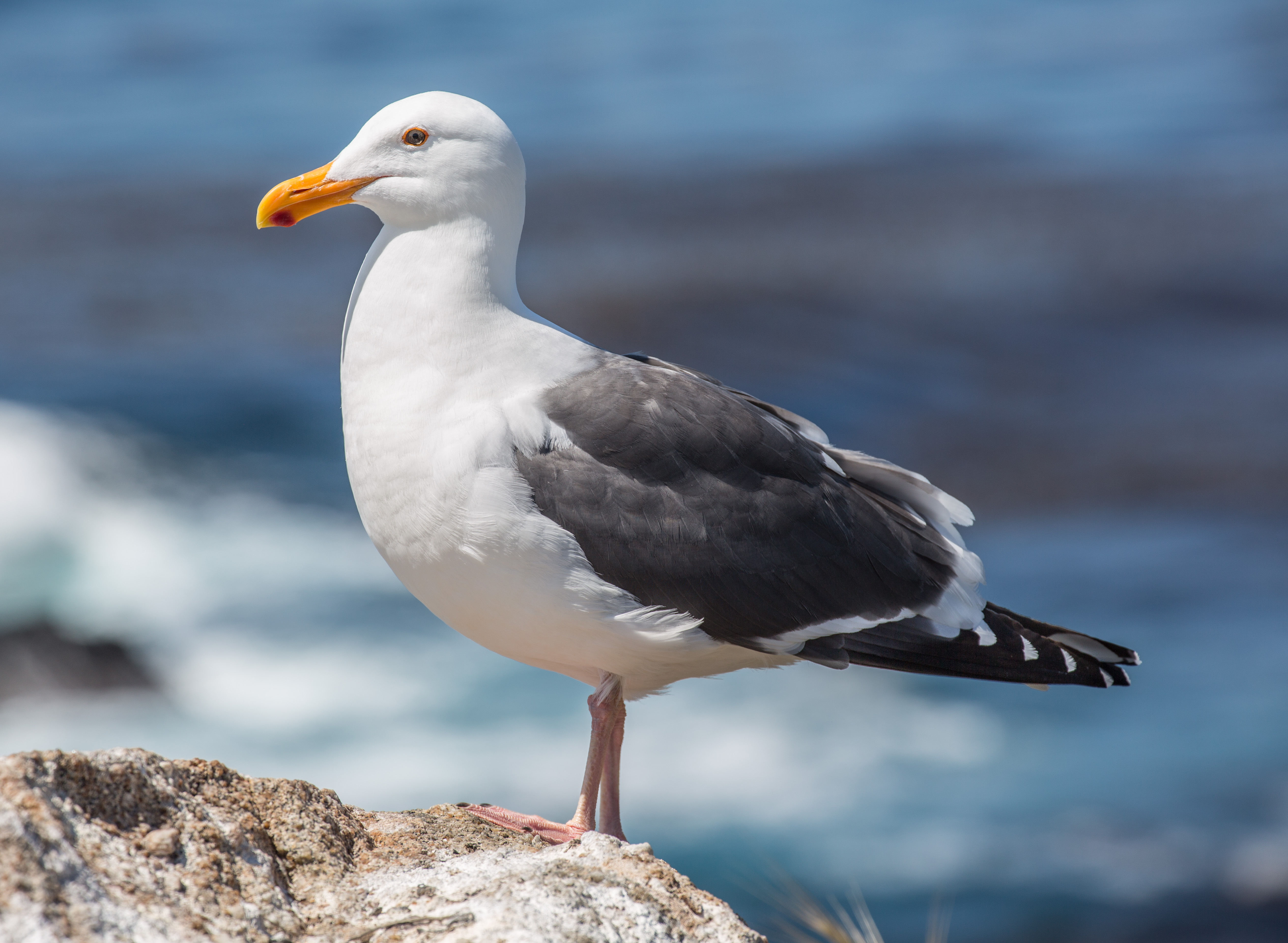
The Western Gull is a large, robust gull species endemic to the Pacific coast of North America. It is characterized by its dark mantle, pink legs, and heavy bill, and is a dominant scavenger and predator in its coastal environment.
Size & lifespan
- Length
- 58-66 cm (23-26 in)
- Wingspan
- 130-144 cm (51-57 in)
- Weight
- 800-1400 g (1.8-3.1 lbs)
- Lifespan
- Up to 25 years in the wild
- Diet
- Omnivore, primarily carnivorous and scavenging
Physical characteristics
- Plumage
- Adults have a dark slate-gray to blackish mantle and wings, contrasting with white head, neck, underparts, and tail. The wingtips are black with small white mirrors. Juveniles are mottled brown, gradually acquiring adult plumage over 3-4 years.
- Beak shape
- Large, heavy, yellow bill with a prominent red spot on the gonys (lower mandible).
- Eye color
- Pale yellow with a dark orbital ring.
- Leg color
- Pink.
- Distinguishing features
- Large size, dark mantle (darker than most other large gulls in its range), pink legs, and heavy yellow bill with a red spot. The dark orbital ring around the pale eye is also a good field mark.
- Juvenile appearance
- First-year birds are dark brown overall, heavily mottled, with a dark bill and dark legs. They gradually lighten and acquire adult features over several molts, becoming paler brown in their second year, and showing more gray in their third year.
- Seasonal changes
- No significant seasonal plumage changes in adults, though non-breeding adults may have faint streaking on the head and nape. Breeding adults have a clean white head.
- Sexual dimorphism
- Males are typically slightly larger and heavier than females, but plumage is identical.
How to identify
- 1
Mantle Color
Look for the very dark slate-gray to blackish mantle (back and upper wings). This is a key distinguishing feature from most other large gulls in its range.
- 2
Leg Color
Observe the legs, which are consistently pink in adults. This helps differentiate from species with yellow or greenish legs.
- 3
Bill
Note the large, heavy yellow bill with a prominent red spot on the lower mandible (gonys). The size and color are distinctive.
- 4
Eye Color
Adults have a pale yellow eye surrounded by a dark orbital ring, which contrasts with the dark eye of many other gull species.
- 5
Wingtips
The wingtips are black with small white 'mirrors' (spots). This contrasts with the pale gray wingtips of Glaucous-winged Gulls.
- 6
Size and Build
Western Gulls are large and robust, giving them a powerful appearance compared to smaller gull species.
Habitat & range
- Biomes
- Coastal marine, rocky shores, sandy beaches, estuaries, harbors, offshore islands.
- Geographic range
- Pacific coast of North America, from British Columbia, Canada, south to Baja California, Mexico. Breeding colonies are primarily on offshore islands and isolated coastal cliffs.
- Elevation range
- Sea level to low coastal elevations.
- Preferred environments
- Rocky islets, offshore islands, and remote coastal cliffs for breeding; foraging occurs along beaches, tide pools, harbors, fishing docks, and open ocean near the coast.
Behavior
- Activity time
- Diurnal, active during daylight hours for foraging and social interactions.
- Feeding habits
- Highly opportunistic and omnivorous. Primarily scavenges carrion, fish offal, and human refuse. Also preys on fish, marine invertebrates (crabs, mussels, sea urchins), eggs and chicks of other seabirds, small mammals, and insects. Known to drop shellfish from heights to break them open.
- Social behavior
- Highly colonial, especially during breeding season, forming large, dense colonies. Outside of breeding, they are often seen in flocks, sometimes mixed with other gull species, at foraging sites or roosts.
- Flight pattern
- Strong, steady flight with powerful wingbeats. Glides frequently on updrafts along cliffs or over water. Often soars high, especially when searching for food or during migration.
- Migration pattern
- Generally resident throughout much of its range, particularly in the southern parts. Northern populations (e.g., British Columbia) may undertake short-distance southward movements in winter. Juveniles disperse more widely than adults.
- Territoriality
- Highly territorial during the breeding season, defending nesting sites aggressively against conspecifics and other species. Outside of breeding, they are less territorial at foraging sites but may defend individual food items.
Song & calls
- Song
- Western Gulls do not have a complex song. Their vocalizations are primarily calls.
- Call
- A variety of harsh, guttural calls. The most common is a loud, deep 'kyow-kyow-kyow' or 'kya-kya-kya' series, often given in alarm or territorial display. Also produces a long, wailing 'mew' call and short 'chup' notes. The 'long call' is a series of loud, rising and falling notes, often given with the head thrown back.
- When they vocalize
- Vocalizes year-round, but most frequently and intensely during the breeding season for territorial defense, pair bonding, and alarm.
Breeding & reproduction
- Breeding season
- Typically April to July, with peak egg-laying in May.
- Nesting habits
- Nests colonially on offshore islands, rocky cliffs, and sometimes on man-made structures. Nests are typically scrapes on the ground, lined with vegetation (grasses, seaweed, feathers, debris). Both parents participate in nest building.
- Clutch size
- 2-3 eggs, most commonly 3.
- Egg description
- 2-3 eggs, typically olive-buff to brownish, heavily spotted and blotched with dark brown or black. Eggs are pyriform (pear-shaped).
- Incubation period
- 27-30 days, shared by both parents.
- Fledging period
- Chicks fledge at approximately 45-55 days after hatching. They remain dependent on parents for several weeks post-fledging.
- Parental care
- Both parents share incubation duties and care for the chicks, providing food and protection until they are independent.
Where to find
Coastal Areas
Look along sandy beaches, rocky shores, and tide pools throughout its Pacific coast range.
Harbors and Docks
Often found congregating around fishing boats, docks, and marinas, scavenging for fish scraps.
Offshore Islands and Cliffs
Breeding colonies are typically found on remote, predator-free offshore islands and steep coastal cliffs.
Urban Coastal Environments
Common in coastal cities and towns, often seen in parking lots, landfills, and parks near the ocean.
Field tips
- Scan for large gulls. Western Gulls are among the largest gulls on the Pacific coast, so look for their imposing size.
- Observe mantle color. Pay close attention to the dark slate-gray back and upper wings, which is a primary identification feature.
- Check leg and bill color. Confirm pink legs and the heavy yellow bill with a red spot. These are consistent adult features.
- Listen for calls. Their loud, deep 'kyow' calls are distinctive and can help locate them, especially in noisy coastal environments.
- Look for foraging behavior. Watch for them scavenging along the waterline, diving for fish, or dropping shellfish to break them open.
Similar species
Glaucous-winged Gull
Larus glaucescens
The Glaucous-winged Gull has a paler gray mantle, often appearing silvery-gray, and lacks the distinct black wingtips of the Western Gull. Its wingtips are pale gray, blending with the rest of the wing. It also has a flesh-colored bill with a red spot, rather than yellow, and often has a darker eye. Hybrids (known as 'Olympic Gulls') are common where their ranges overlap.
Herring Gull
Larus argentatus
Herring Gulls have a lighter gray mantle than Western Gulls and typically have pinker legs (though Western Gulls also have pink legs). The key difference is the mantle color and the extent of black on the wingtips. Herring Gulls have more extensive black on the wingtips with larger white mirrors. Herring Gulls are primarily found on the Atlantic coast and inland, with limited overlap on the Pacific.
California Gull
Larus californicus
California Gulls are smaller and more slender than Western Gulls. They have a darker gray mantle, but not as dark as the Western Gull. Their legs are typically yellowish-green (though can sometimes appear pinkish), and their bill is smaller, yellow with a red and black spot near the tip. Their eye is dark, unlike the pale eye of the Western Gull.
Quick facts
- Primary Habitat:
- Pacific Coastline
- Diet:
- Omnivorous scavenger and predator
- Leg Color:
- Pink
- Mantle Color:
- Dark slate-gray to blackish
- Conservation Status:
- Least Concern
Fun facts
- Western Gulls are known for their aggressive and opportunistic feeding habits, often stealing food from other birds and even humans.
- They are one of the few gull species that regularly prey on the eggs and chicks of other seabirds, including murres and cormorants, especially in dense breeding colonies.
- Where their range overlaps with the Glaucous-winged Gull, hybridization is common, leading to a variety of intermediate plumages often referred to as 'Olympic Gulls'.
- Western Gulls play an important ecological role as scavengers, helping to clean up coastal environments.
Scientific classification
- Kingdom
- Animalia
- Phylum
- Chordata
- Class
- Aves
- Order
- Charadriiformes
- Family
- Laridae
- Genus
- Larus
- Species
- Larus occidentalis
Explore the Western Gull
Identify birds anywhere
Free on iOS, Android, and Web. Photo & sound identification, full species database, and your personal life list.