
Spotted a bird? Identify it instantly with the Birdby app
Open the appAbout
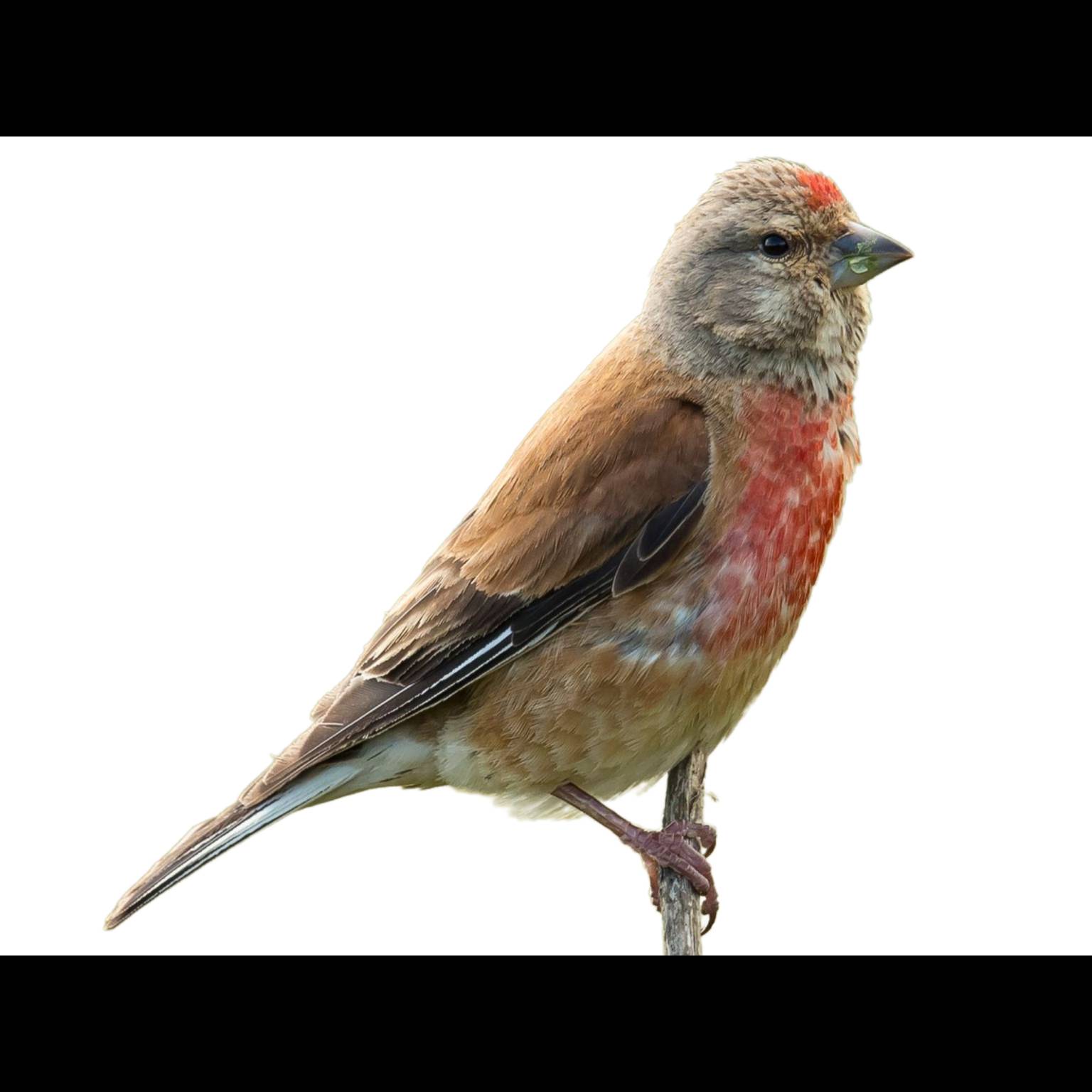
The Common Linnet (Linaria cannabina) is a small passerine bird in the finch family Fringillidae. It is a widespread and common species across Europe, North Africa, and parts of Asia, known for its distinctive song and preference for open, scrubby habitats. Males in breeding plumage display striking red patches on the forehead and breast, which are absent in females and non-breeding males.
Size & lifespan
- Length
- 12.5-14 cm
- Wingspan
- 21-25 cm
- Weight
- 15-22 g
- Lifespan
- 2-5 years (up to 8 years recorded)
- Diet
- Granivore (primarily seeds), occasionally insects
Physical characteristics
- Plumage
- Adult males in breeding plumage have a grey nape and hindneck, a bright crimson forehead patch, and a rosy-red breast. The back is chestnut-brown, and the underparts are buffy-white with streaked flanks. The wings and tail are dark with prominent white edges, especially visible in flight. Non-breeding males and females lack the crimson and rosy-red coloration; they are generally duller, with streaked brown upperparts and buffy-white, heavily streaked underparts. The rump is typically unstreaked brown.
- Beak shape
- Conical, relatively short and stout, adapted for seed-eating. Greyish-horn colored, darker on the culmen.
- Eye color
- Dark brown
- Leg color
- Dark brown to blackish-brown
- Distinguishing features
- White wing-bars (especially prominent on primaries), white outer tail feathers, and the male's breeding plumage with red forehead and breast. The unstreaked brown rump is a good field mark for both sexes.
- Juvenile appearance
- Juveniles are similar to females but are more heavily streaked on the head, back, and underparts, giving them a scruffier appearance. They lack any red coloration.
- Seasonal changes
- Males transition from a duller, streaked plumage in winter to the vibrant breeding plumage with red forehead and breast through a partial pre-breeding molt and feather wear revealing underlying pigments.
- Sexual dimorphism
- Pronounced in breeding season: males develop crimson forehead and rosy-red breast. Females and non-breeding males are duller, lacking these red pigments, and are more heavily streaked overall.
How to identify
- 1
Size and Shape
Small, slender finch with a relatively long tail and a conical bill.
- 2
Male Breeding Plumage
Look for the distinctive crimson forehead and rosy-red breast, grey nape, and chestnut-brown back. White edges on dark wings and tail are key.
- 3
Female/Non-breeding Male Plumage
Overall streaky brown appearance, buffy-white underparts with streaking, and a plain brown (unstreaked) rump. White wing-bars and outer tail feathers are still present.
- 4
Flight
Undulating flight pattern, often in flocks, with flashes of white on the wings and outer tail feathers.
- 5
Call
Listen for the characteristic dry 'chitt-itt-itt-itt' or 'churr-churr-churr' call, often given in flight.
- 6
Habitat
Check open, scrubby areas, heathlands, gorse bushes, and hedgerows, especially near agricultural fields or coasts.
Habitat & range
- Biomes
- Temperate grasslands, shrublands, agricultural lands, coastal areas, heathlands, open woodlands.
- Geographic range
- Widespread across Europe, North Africa (including the Canary Islands), and parts of western and central Asia. Its range extends from the Atlantic coast eastwards to western Siberia and south to the Middle East.
- Elevation range
- Sea level up to 2,000 meters, occasionally higher in mountainous regions.
- Preferred environments
- Prefers open country with scattered bushes, hedges, gorse, and thorny scrub, often near cultivated land or coastal dunes. Avoids dense forests and urban centers, though can be found in large gardens or parks with suitable scrub.
Behavior
- Activity time
- Diurnal.
- Feeding habits
- Primarily a ground feeder, foraging for small seeds, especially those of weeds and agricultural crops like thistles, dandelions, chickweed, and brassicas. Occasionally consumes small invertebrates, particularly when feeding young. They often feed in flocks outside the breeding season.
- Social behavior
- Highly gregarious outside the breeding season, forming large flocks, sometimes mixed with other finch species. During breeding, pairs are territorial but may nest in loose colonies.
- Flight pattern
- Undulating flight, typical of finches, with rapid wing beats followed by a short glide. Often flies in loose flocks, especially when migrating or foraging.
- Migration pattern
- Partially migratory. Northern and eastern populations are largely migratory, moving south and west for the winter. Southern and western populations are often resident or undertake short-distance movements. Migrates in flocks.
- Territoriality
- Males establish and defend small breeding territories, primarily through song and display. Outside the breeding season, they are not territorial.
Song & calls
- Song
- A rapid, varied, and melodious jumble of trills, twitters, and whistles, often incorporating mimicry of other birds. It's a pleasant, rambling song, often delivered from a prominent perch or in a display flight. Described as 'twee-twee-twee, churr-churr-churr, tit-tit-tit'.
- Call
- Common calls include a distinctive, dry 'chitt-itt-itt-itt' or 'churr-churr-churr', often given in flight or when disturbed. Also a softer 'tsooeet' contact call.
- When they vocalize
- Most vocal during the breeding season (spring and early summer), but calls can be heard year-round, especially when flocks are foraging.
Breeding & reproduction
- Breeding season
- April to August, typically two or three broods per year.
- Nesting habits
- The nest is a neat, cup-shaped structure built by the female, usually low down in dense scrub, gorse, hawthorn, or other thorny bushes, often well-concealed. It's constructed from twigs, roots, moss, and grass, lined with wool, hair, and feathers.
- Clutch size
- 3-7 eggs
- Egg description
- 3-7 eggs (typically 4-6), pale bluish-white or greenish-white, sparsely spotted and streaked with reddish-brown or purplish-grey, mainly at the broad end. Approximately 18 x 13 mm.
- Incubation period
- 11-14 days, primarily by the female.
- Fledging period
- 10-15 days after hatching. Young are fed by both parents.
- Parental care
- Both parents feed the nestlings, primarily with regurgitated seeds and some insects. The female often continues to brood the young while the male brings food.
Where to find
Heathlands and Moorlands
Excellent places to find Linnets, especially where gorse and heather provide cover and food.
Coastal Dunes and Shingle Beaches
Often found foraging among marram grass and other coastal vegetation.
Agricultural Margins and Fallow Fields
Areas with abundant weed seeds are prime feeding grounds.
Hedgerows and Scrubland
Dense bushes and thorny scrub provide ideal nesting and roosting sites.
Field tips
- Look for Flocks. Outside the breeding season, Linnets are highly gregarious. Look for groups foraging on the ground or perched in bushes.
- Listen for Calls. Their distinctive 'churr' call is often the first indication of their presence, especially when they fly up from cover.
- Check for White Wing/Tail Flashes. In flight, the white edges on the wings and outer tail feathers are very noticeable and a key identification feature.
- Observe Feeding Behavior. Watch for them feeding on the ground, often clinging to seed heads of thistles or other weeds.
- Breeding Season Males. During spring and summer, look for males singing from prominent perches or performing display flights, showcasing their red plumage.
Similar species
Twite
Linaria flavirostris
The Twite lacks the white in the wings and tail of the Linnet. It has a yellowish bill (especially in winter) and a more streaked rump. Males do not develop red on the head or breast. Its call is a distinctive 'twa-eet'.
Redpoll species (e.g., Common Redpoll)
Acanthis flammea
Redpolls are generally smaller, have a smaller, pointed bill, and a distinctive red forehead patch in both sexes (though more prominent in males). They also have two prominent white wing-bars and a streaked rump. Linnets have a larger, stouter bill and a plain brown rump.
Serin
Serinus serinus
The Serin is smaller and more compact, with a shorter tail. Males are bright yellow on the face, breast, and rump. Females are duller but still show yellowish tones. Linnets lack the extensive yellow plumage.
Quick facts
- Diet:
- Mainly seeds, especially weed seeds
- Habitat:
- Open country with scrub, heathland, coastal areas
- Sociality:
- Highly gregarious outside breeding season
- Migration:
- Partial migrant
- Conservation Status:
- Least Concern
- Key ID Feature:
- White wing/tail flashes, male's red forehead/breast
Fun facts
- The name 'Linnet' comes from the bird's fondness for flax seeds (Linum usitatissimum), which was historically a common crop.
- Male Linnets perform a 'butterfly flight' display during courtship, flying with slow, exaggerated wing beats while singing.
- They are known to consume a wide variety of small seeds, playing an important role in seed dispersal in their habitats.
- In some cultures, the Linnet was kept as a cage bird due to its pleasant song.
Scientific classification
- Kingdom
- Animalia
- Phylum
- Chordata
- Class
- Aves
- Order
- Passeriformes
- Family
- Fringillidae
- Genus
- Linaria
- Species
- Linaria cannabina
Explore the Common Linnet
Identify birds anywhere
Free on iOS, Android, and Web. Photo & sound identification, full species database, and your personal life list.