
Spotted a bird? Identify it instantly with the Birdby app
Open the appAbout
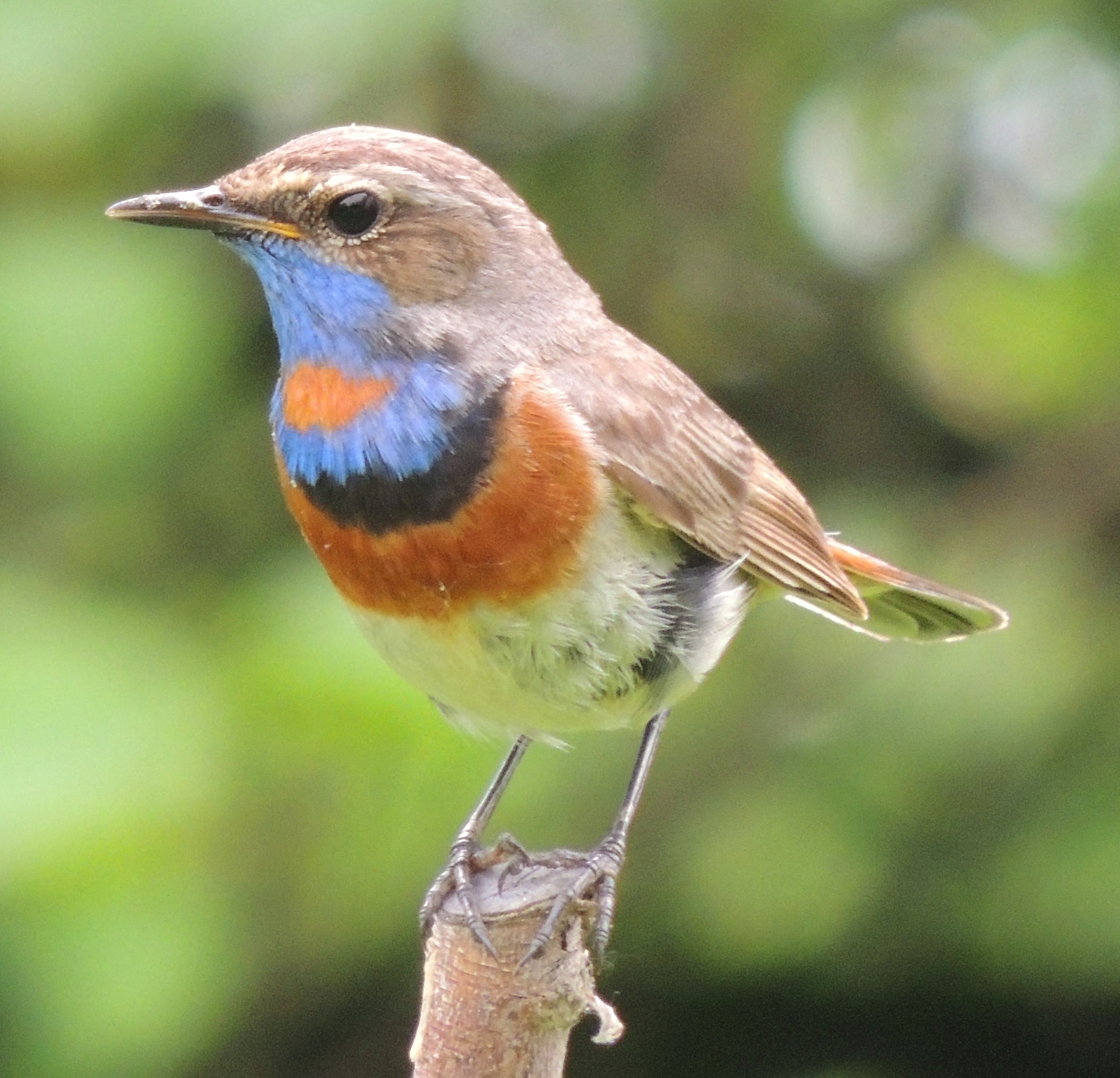
The Bluethroat is a small, migratory passerine bird known for the striking blue and rufous throat patch of the breeding male. It is a member of the Old World flycatcher family, Muscicapidae, though it was formerly classified as a thrush (Turdidae). It is a shy bird, often found in dense vegetation near water, and is renowned for its complex and varied song.
Size & lifespan
- Length
- 13-14 cm
- Wingspan
- 21-23 cm
- Weight
- 12-23 g
- Lifespan
- Typically 2-5 years in the wild, with records up to 8 years.
- Diet
- Insectivore, primarily feeding on insects and other small invertebrates, supplemented with berries in autumn.
Physical characteristics
- Plumage
- Adult males in breeding plumage have a brilliant blue throat and upper breast, typically bordered below by a narrow black band, a white band, and a broad rufous-chestnut band. The extent and pattern of the blue and rufous vary significantly between subspecies. A small white or rufous spot is often present in the center of the blue throat. The upperparts are plain brown, and the underparts are whitish with buff flanks. The tail is dark brown with rufous-orange sides at the base, a key field mark. Females and non-breeding males have a duller plumage, with the blue on the throat reduced or absent, often replaced by streaky brown or a pale throat with dark malar stripes. Juveniles are mottled dark brown above and below.
- Beak shape
- Slender, pointed, and dark (blackish-brown), typical of an insectivorous passerine.
- Eye color
- Dark brown.
- Leg color
- Dark brown to blackish.
- Distinguishing features
- The male's vibrant blue throat with a central white or rufous spot (depending on subspecies) is unmistakable. The rufous-orange patches at the base of the tail, visible in flight or when the tail is fanned, are a crucial identification feature for all plumages and sexes. Often cocks its tail and flicks its wings.
- Juvenile appearance
- Juveniles are heavily mottled and spotted dark brown on the head, back, and underparts, giving a scaly appearance. They lack any blue on the throat and the rufous tail patches are less distinct than in adults.
- Seasonal changes
- Males acquire their vibrant breeding plumage in spring through a pre-nuptial molt. After breeding, a post-nuptial molt results in a duller, eclipse plumage where the blue throat is largely obscured by pale feather tips, making them resemble females more closely. Females show less dramatic seasonal changes, but their plumage can appear fresher and slightly brighter in spring.
- Sexual dimorphism
- Pronounced in breeding plumage, with males displaying the characteristic blue throat. Females have a much duller throat, often whitish or buff with dark streaking on the sides, sometimes with a faint blue wash or a few blue feathers. Non-breeding males resemble females but may retain some blue.
How to identify
- 1
Male Breeding Plumage
Look for the unmistakable bright blue throat and upper breast, bordered by black, white, and rufous bands. Note the central white or rufous spot within the blue, which varies by subspecies.
- 2
Tail Pattern
Observe the tail, especially when fanned or in flight. The rufous-orange patches at the base of the outer tail feathers are a key identification mark for all ages and sexes.
- 3
Habitat and Behavior
Search in dense, damp scrub near water. Watch for a shy bird that often hops on the ground or in low vegetation, frequently cocking its tail and flicking its wings.
- 4
Song
Listen for the rich, varied, and often mimetic song, delivered from a prominent perch or during a short song-flight, especially at dawn and dusk during the breeding season.
- 5
Female/Non-breeding Male
These are duller. Look for a pale throat with dark malar stripes, sometimes with a faint blue wash or a few blue feathers, combined with the characteristic rufous tail patches.
Habitat & range
- Biomes
- Tundra, taiga, boreal forests, temperate grasslands, wetlands, scrublands.
- Geographic range
- Breeds across a wide range of Eurasia, from Scandinavia and Eastern Europe eastward through Siberia to Alaska. Winters in southern Europe, North Africa, the Middle East, and South Asia.
- Elevation range
- Typically breeds from sea level up to 2,000 meters, occasionally higher in mountainous regions.
- Preferred environments
- Prefers damp, bushy habitats with dense low vegetation, often near water. This includes willow and birch scrub along rivers and lakes, marshy areas, wet meadows with scattered bushes, clearings in boreal forests, and subalpine scrub. Requires dense cover for nesting and foraging.
Behavior
- Activity time
- Diurnal, most active during the early morning and late afternoon.
- Feeding habits
- Forages primarily on the ground or in low vegetation, gleaning insects and spiders. It often hops actively through dense cover, occasionally making short flights to catch flying insects. In autumn, it supplements its diet with berries (e.g., Vaccinium, Empetrum).
- Social behavior
- Generally solitary or found in pairs during the breeding season. Outside of breeding, they can be seen singly or in small, loose groups during migration. Not typically a flocking species.
- Flight pattern
- Flight is typically short, low, and undulating, often between patches of dense cover. When disturbed, it will often fly a short distance and quickly disappear into vegetation. Displays a characteristic tail-cocking and wing-flicking behavior.
- Migration pattern
- A long-distance migratory species. Northern populations migrate south to wintering grounds in North Africa, the Middle East, and South Asia. Migration occurs primarily at night. Spring migration is from March to May, and autumn migration from August to October.
- Territoriality
- Males are highly territorial during the breeding season, defending their nesting area with song and occasional aggressive displays against rivals.
Song & calls
- Song
- The male's song is rich, varied, and melodious, often incorporating mimicry of other bird species. It is a complex mix of whistles, trills, clicks, and buzzing notes, delivered from a prominent perch or during a short song-flight. It can be quite loud and far-carrying, especially at dawn and dusk.
- Call
- Common calls include a soft 'hweet' or 'tack' contact call, a sharp 'chack' alarm call, and a harsh 'churr' when agitated.
- When they vocalize
- Males sing most frequently during the breeding season, from April to July, particularly at dawn and dusk. They may also sing during migration. Calls are given year-round.
Breeding & reproduction
- Breeding season
- May to July, with peak activity in June.
- Nesting habits
- Nests are typically built on or very close to the ground, well-hidden in dense vegetation such as tussocks of grass, under bushes, or among roots. The nest is a cup-shaped structure made of moss, grass, leaves, and roots, lined with finer materials like hair and feathers. Only the female builds the nest.
- Clutch size
- Typically 4-7 eggs, usually 5-6.
- Egg description
- 4-7 eggs, typically pale blue or greenish-blue, sometimes with fine reddish-brown speckles, especially at the broader end. Dimensions average 19 x 14 mm.
- Incubation period
- 13-15 days, primarily by the female.
- Fledging period
- 12-14 days after hatching. Young leave the nest before they can fly well.
- Parental care
- Both parents feed the nestlings and fledglings. The female incubates, but the male often brings food to her on the nest. After fledging, the young are cared for by both parents for several weeks.
Where to find
Wetlands and Marshes
Look in areas with dense reedbeds, sedges, and willow scrub along the edges of lakes, rivers, and ponds.
Boreal Forests and Tundra
In northern breeding grounds, they inhabit scrubby clearings, dwarf birch and willow thickets, and boggy areas.
Subalpine Scrub
In mountainous regions, they can be found in dense low-growing vegetation above the treeline.
Migration Stopovers
During migration, they may be found in a wider variety of bushy habitats, including gardens and parks, especially if dense cover and water are present.
Field tips
- Be Patient and Quiet. Bluethroats are shy and often stay hidden in dense cover. Sit quietly near suitable habitat and wait for them to emerge or sing.
- Listen for the Song. Their distinctive and varied song is often the first indication of their presence. Learn to recognize it, as they can be hard to spot visually.
- Look for Movement in Dense Cover. Scan the lower parts of bushes and reeds for subtle movements, as they forage close to the ground.
- Early Morning and Late Evening. These are the best times to hear males singing and to observe them when they are most active.
- Check Tail Flashes. When a bird flies into cover, try to catch a glimpse of the rufous tail patches, which are diagnostic.
Similar species
Robin
Erithacus rubecula
While both have rufous coloration, the Robin has a distinct orange-red breast and face, lacking the Bluethroat's blue throat and rufous tail patches. Robins are also generally more confiding and found in more open habitats.
Red-flanked Bluetail
Tarsiger cyanurus
The Red-flanked Bluetail male has a blue back and head, and orange flanks, but lacks the prominent blue throat patch of the Bluethroat. Its tail is also blue, not rufous at the base. Females are duller brown with blue rump and tail.
Common Nightingale
Luscinia megarhynchos
The Nightingale is uniformly brown above and buffy-white below, lacking any blue or prominent rufous markings on the throat or tail. Its song is also distinct, though equally complex and melodious.
Quick facts
- Distinctive Feature:
- Male's blue throat with central white or rufous spot.
- Habitat Preference:
- Dense, damp scrub near water.
- Diet:
- Insects and small invertebrates, berries in autumn.
- Migration:
- Long-distance migrant.
- Song:
- Rich, varied, and often mimetic.
Fun facts
- The Bluethroat is known for its remarkable ability to mimic the songs of other bird species, often incorporating them into its own complex vocalizations.
- There are several recognized subspecies of Bluethroat, primarily distinguished by the color of the central spot on the male's blue throat (white-spotted, red-spotted, or spotless).
- Despite its vibrant plumage, the Bluethroat is notoriously shy and often remains hidden, making its beautiful song a primary means of detection for birdwatchers.
- The species name 'svecica' refers to Sweden, where the white-spotted subspecies (L. s. svecica) was first described.
Scientific classification
- Kingdom
- Animalia
- Phylum
- Chordata
- Class
- Aves
- Order
- Passeriformes
- Family
- Muscicapidae
- Genus
- Luscinia
- Species
- Luscinia svecica
Explore the Bluethroat
Identify birds anywhere
Free on iOS, Android, and Web. Photo & sound identification, full species database, and your personal life list.