
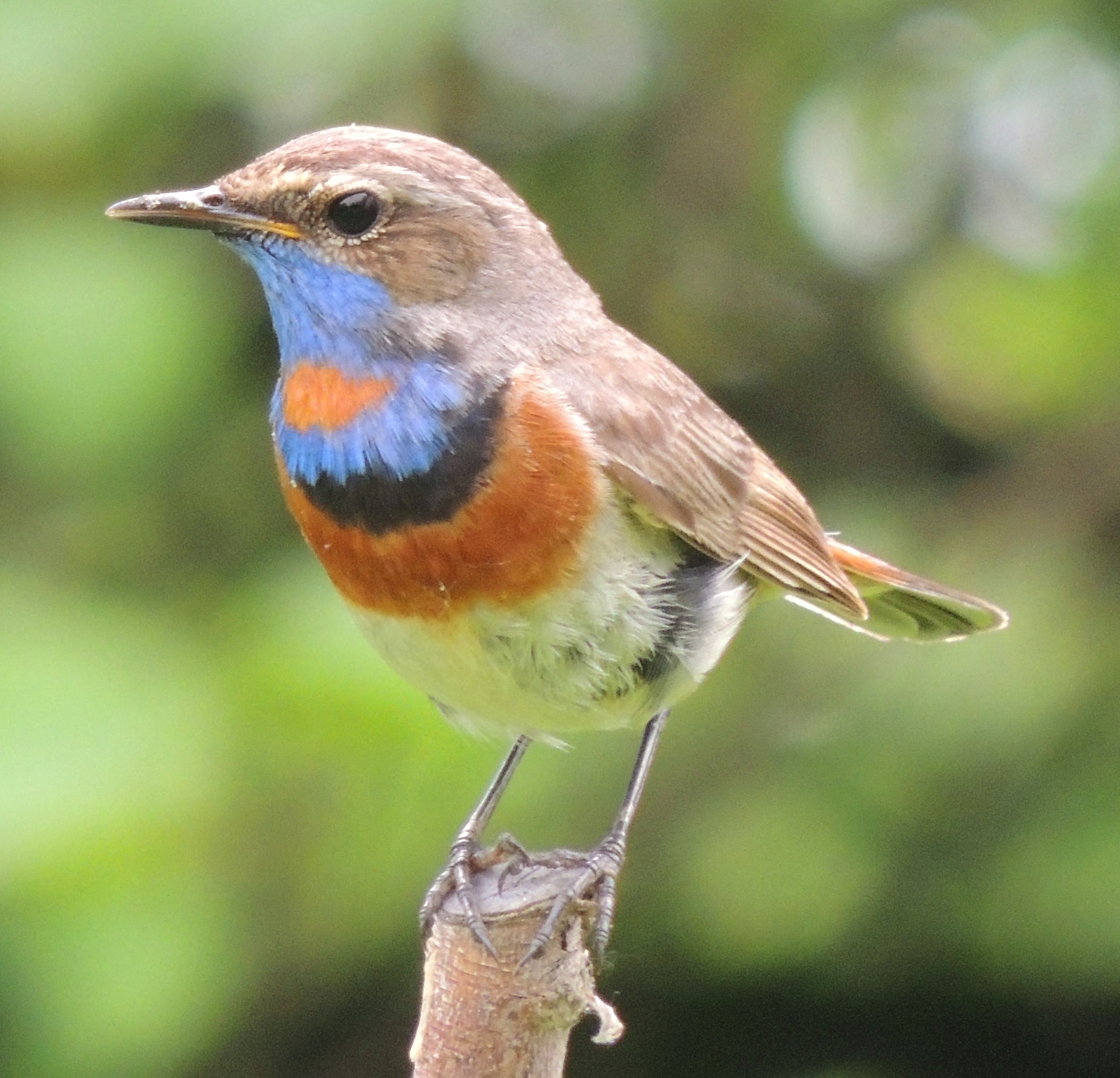
How to identify the Bluethroat
Luscinia svecica
Spotted a bird? Identify it instantly with the Birdby app
Open the appTo correctly identify the Bluethroat (Luscinia svecica), check each of these features. Birds can be tricky: habit, habitat, and call often confirm a sighting that a single photo cannot.
Size at a glance
- Length
- 13-14 cm
- Wingspan
- 21-23 cm
- Weight
- 12-23 g
Physical features to check
- 1
Plumage
Overall feather coloration and pattern.
Adult males in breeding plumage have a brilliant blue throat and upper breast, typically bordered below by a narrow black band, a white band, and a broad rufous-chestnut band. The extent and pattern of the blue and rufous vary significantly between subspecies. A small white or rufous spot is often present in the center of the blue throat. The upperparts are plain brown, and the underparts are whitish with buff flanks. The tail is dark brown with rufous-orange sides at the base, a key field mark. Females and non-breeding males have a duller plumage, with the blue on the throat reduced or absent, often replaced by streaky brown or a pale throat with dark malar stripes. Juveniles are mottled dark brown above and below.
- 2
Beak shape
Shape and color of the bill: a key field mark.
Slender, pointed, and dark (blackish-brown), typical of an insectivorous passerine.
- 3
Eye color
Iris color and any distinctive eye markings.
Dark brown.
- 4
Leg color
Leg and foot color.
Dark brown to blackish.
- 5
Distinguishing features
Standout features that separate this species.
The male's vibrant blue throat with a central white or rufous spot (depending on subspecies) is unmistakable. The rufous-orange patches at the base of the tail, visible in flight or when the tail is fanned, are a crucial identification feature for all plumages and sexes. Often cocks its tail and flicks its wings.
- 6
Juvenile appearance
How young birds differ from adults.
Juveniles are heavily mottled and spotted dark brown on the head, back, and underparts, giving a scaly appearance. They lack any blue on the throat and the rufous tail patches are less distinct than in adults.
- 7
Seasonal changes
Plumage variation between breeding and non-breeding seasons.
Males acquire their vibrant breeding plumage in spring through a pre-nuptial molt. After breeding, a post-nuptial molt results in a duller, eclipse plumage where the blue throat is largely obscured by pale feather tips, making them resemble females more closely. Females show less dramatic seasonal changes, but their plumage can appear fresher and slightly brighter in spring.
- 8
Sexual dimorphism
How males and females differ.
Pronounced in breeding plumage, with males displaying the characteristic blue throat. Females have a much duller throat, often whitish or buff with dark streaking on the sides, sometimes with a faint blue wash or a few blue feathers. Non-breeding males resemble females but may retain some blue.
Key field marks
- Male Breeding Plumage. Look for the unmistakable bright blue throat and upper breast, bordered by black, white, and rufous bands. Note the central white or rufous spot within the blue, which varies by subspecies.
- Tail Pattern. Observe the tail, especially when fanned or in flight. The rufous-orange patches at the base of the outer tail feathers are a key identification mark for all ages and sexes.
- Habitat and Behavior. Search in dense, damp scrub near water. Watch for a shy bird that often hops on the ground or in low vegetation, frequently cocking its tail and flicking its wings.
- Song. Listen for the rich, varied, and often mimetic song, delivered from a prominent perch or during a short song-flight, especially at dawn and dusk during the breeding season.
- Female/Non-breeding Male. These are duller. Look for a pale throat with dark malar stripes, sometimes with a faint blue wash or a few blue feathers, combined with the characteristic rufous tail patches.
Explore the Bluethroat
Identify birds anywhere
Free on iOS, Android, and Web. Photo & sound identification, full species database, and your personal life list.