
Spotted a bird? Identify it instantly with the Birdby app
Open the appAbout
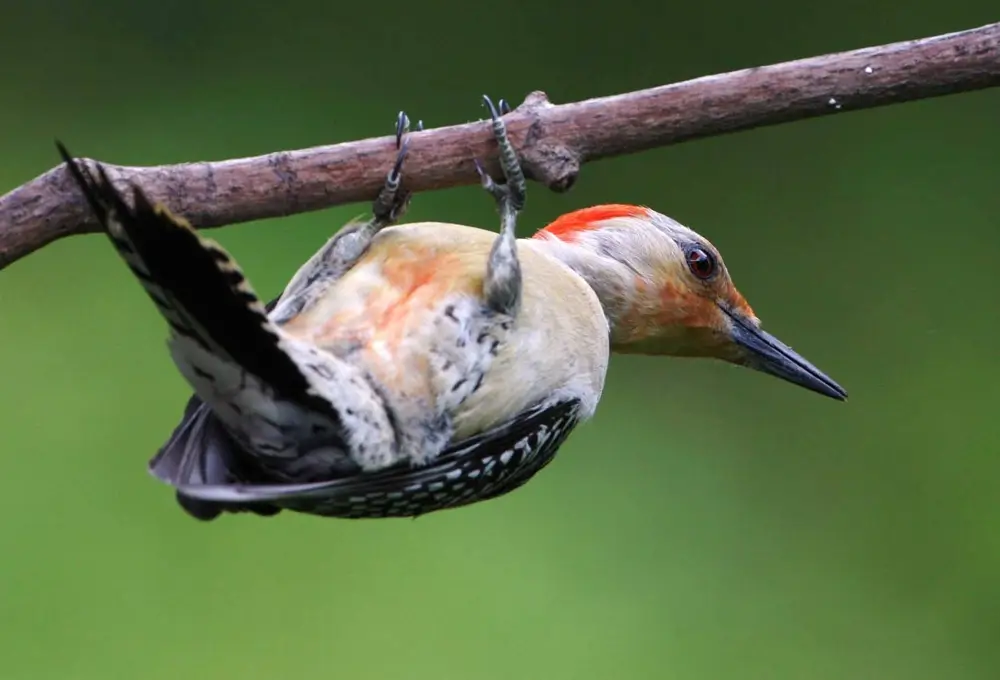
The Red-bellied Woodpecker is a medium-sized woodpecker native to the eastern United States. Despite its name, the red on its belly is often difficult to see in the field, appearing as a faint wash. Its most striking features are the black-and-white barred back and the extensive red on the head of the male.
Size & lifespan
- Length
- 22-27 cm (8.7-10.6 in)
- Wingspan
- 38-46 cm (15-18 in)
- Weight
- 56-91 g (2.0-3.2 oz)
- Lifespan
- Up to 12 years in the wild
- Diet
- Omnivore, primarily insects, nuts, seeds, and fruits
Physical characteristics
- Plumage
- Adults have a black-and-white barred (zebra-like) pattern on their back and wings. The underparts are pale gray to buffy white, with a faint reddish wash on the lower belly, which is often hard to discern. The rump is white. The tail is black with white barring on the outer tail feathers.
- Beak shape
- Strong, chisel-like, black bill.
- Eye color
- Dark brown
- Leg color
- Grayish-black
- Distinguishing features
- Black-and-white barred back, pale underparts, and red on the head (extent varies by sex). The faint red belly patch is often not visible.
- Juvenile appearance
- Juveniles resemble adult females but have duller plumage, less distinct barring, and a brownish wash on the head and underparts. The red on the head is often absent or very limited, appearing as a faint orange-red on the nape.
- Seasonal changes
- No significant seasonal plumage changes.
- Sexual dimorphism
- Males have a full red crown extending from the forehead to the nape. Females have red only on the nape and a patch at the base of the bill, with a gray crown. Both sexes have the faint red belly wash.
How to identify
- 1
Back Pattern
Look for the distinctive black-and-white barring across the entire back, resembling a zebra pattern. This is a key field mark that distinguishes it from most other woodpeckers in its range.
- 2
Head Coloration (Sex-specific)
Males have a full red cap from the forehead to the nape. Females have red only on the nape and a small patch above the bill, with a gray crown in between. This is the most reliable way to sex them.
- 3
Underparts and Belly
The underparts are pale gray to buffy white. While named 'Red-bellied', the reddish wash on the lower belly is often very faint and difficult to see in the field, so do not rely on this feature alone.
- 4
Vocalizations
Listen for its characteristic rolling 'churr-churr-churr' or 'kwirr-kwirr-kwirr' call, and sharp 'kip' notes. These calls are quite distinctive and often heard before the bird is seen.
- 5
Size and Shape
It's a medium-sized woodpecker with a relatively long, chisel-like bill. Its overall size is larger than a Downy but smaller than a Pileated.
Habitat & range
- Biomes
- Deciduous forests, mixed forests, suburban areas, parks, orchards, and riparian woodlands.
- Geographic range
- Eastern United States, from southern Canada south to Florida and the Gulf Coast, and west to the Great Plains. Its range has been expanding northward in recent decades.
- Elevation range
- Typically found from sea level up to approximately 600 meters (2,000 feet).
- Preferred environments
- Mature woodlands with large, dead or decaying trees for nesting and foraging. They adapt well to human-modified landscapes with sufficient tree cover.
Behavior
- Activity time
- Diurnal.
- Feeding habits
- Forages by gleaning insects from bark, probing crevices, and excavating wood. Also consumes a significant amount of plant material, including acorns, nuts, seeds, and fruits. Known to store food in crevices. Will visit bird feeders for suet, peanuts, and sunflower seeds.
- Social behavior
- Generally solitary or found in pairs, especially during the breeding season. May gather in small groups at abundant food sources or feeders.
- Flight pattern
- Undulating flight pattern, typical of woodpeckers, with several rapid wing beats followed by a short glide on closed wings.
- Migration pattern
- Primarily a year-round resident throughout most of its range. Northern populations may exhibit some short-distance, irruptive movements in response to food availability, but generally not considered migratory.
- Territoriality
- Territorial, especially during the breeding season, defending nesting and foraging areas. Both sexes participate in territorial displays and vocalizations.
Song & calls
- Song
- Does not have a complex song. Its primary vocalizations are calls.
- Call
- Most common call is a rolling, churring 'churr-churr-churr' or 'kwirr-kwirr-kwirr'. Also gives a sharp, loud 'kip' or 'kik' call, often repeated. Produces drumming sounds on resonant surfaces, typically a rapid, accelerating series of taps.
- When they vocalize
- Vocalizes year-round, with increased activity during the breeding season. Drumming is most frequent in spring as part of territorial and courtship displays.
Breeding & reproduction
- Breeding season
- Typically April to July, with peak activity in May and June.
- Nesting habits
- Nests in cavities excavated in dead or decaying trees, stumps, or large branches. Both sexes participate in excavating the nest hole, which is usually 6-30 meters (20-100 feet) above the ground. They may reuse old cavities or excavate new ones each year.
- Clutch size
- 3-8 eggs, usually 4-5.
- Egg description
- 3-8 (typically 4-5) pure white, smooth, glossy eggs, oval to elliptical in shape, measuring about 24 x 18 mm.
- Incubation period
- 12-14 days, shared by both parents.
- Fledging period
- 24-27 days after hatching. Young are fed by both parents.
- Parental care
- Both male and female incubate eggs and feed the nestlings. Males often roost in the nest cavity overnight during incubation and brooding.
Where to find
Deciduous and Mixed Forests
Look in mature woodlands with a good mix of deciduous trees, especially those with dead snags or decaying wood.
Suburban Parks and Yards
They are increasingly common in suburban and urban areas with mature trees, often visiting bird feeders.
Orchards and Riparian Areas
Can be found in fruit orchards and along riverbanks where suitable trees are present.
Field tips
- Listen for Calls. Their loud, rolling calls are often the first indication of their presence. Learn to recognize the 'churr-churr-churr' or 'kwirr-kwirr-kwirr' and sharp 'kip' calls.
- Watch Bird Feeders. They are frequent visitors to suet feeders, especially in winter. Placing suet out can attract them to your yard.
- Scan Tree Trunks. Look for them climbing up tree trunks, probing bark crevices, or excavating holes. They often work their way up a tree before flying to the base of another.
- Look for Drumming. In spring, listen for their drumming, which is a rapid, accelerating series of taps on resonant branches or utility poles.
Similar species
Downy Woodpecker
Dryobates pubescens
Much smaller size (14-17 cm). Downy has a smaller bill, a white stripe down its back, and lacks the extensive red on the head (male has a small red patch on the nape). Red-bellied has a barred back.
Hairy Woodpecker
Dryobates villosus
Similar in size to Red-bellied, but has a much larger bill relative to its head. Hairy also has a white stripe down its back and lacks the barred back and red crown of the Red-bellied. Male Hairy has a red patch on the nape only.
Pileated Woodpecker
Dryocopus pileatus
Much larger (40-49 cm). Pileated has a prominent red crest, a mostly black body with white stripes on the face and neck, and a distinctive undulating flight. Red-bellied is smaller with a barred back.
Northern Flicker
Colaptes auratus
Similar size, but flickers are brown overall with black barring on the back, a black crescent on the chest, and a white rump visible in flight. They often forage on the ground. Red-bellied has a distinct black-and-white barred back.
Quick facts
- Primary Diet:
- Insects, nuts, seeds, fruits
- Habitat:
- Deciduous and mixed forests, suburban areas
- Status:
- Year-round resident in most of its range
- Distinguishing Mark:
- Black-and-white barred back
- Vocalization:
- Rolling 'churr-churr-churr' call
Fun facts
- The 'red belly' is often so faint that it's rarely seen in the field, leading many birdwatchers to wonder about the origin of its name.
- Red-bellied Woodpeckers are known for storing food, especially acorns and nuts, in crevices in bark or fence posts for later consumption.
- They are one of the few woodpecker species that can catch insects in flight, though this is not their primary foraging method.
- Their range has been expanding northward in recent decades, likely due to climate change and increased availability of bird feeders.
- Like many woodpeckers, they have a long, barbed tongue that can extend far beyond the tip of their bill to extract insects from deep crevices.
Scientific classification
- Kingdom
- Animalia
- Phylum
- Chordata
- Class
- Aves
- Order
- Piciformes
- Family
- Picidae
- Genus
- Melanerpes
- Species
- Melanerpes carolinus
Explore the Red-bellied Woodpecker
Identify birds anywhere
Free on iOS, Android, and Web. Photo & sound identification, full species database, and your personal life list.