
Spotted a bird? Identify it instantly with the Birdby app
Open the appAbout
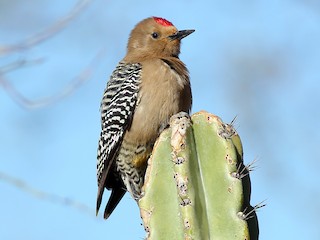
The Gila Woodpecker is a medium-sized woodpecker native to the southwestern United States and parts of Mexico. It is well-adapted to arid environments, particularly desert riparian areas and saguaro cactus forests. Known for its distinctive barred back and pale underparts, it plays a crucial ecological role as a primary cavity nester, creating homes for many other desert species.
Size & lifespan
- Length
- 20-25 cm (8-10 in)
- Wingspan
- 40-43 cm (15.5-17 in)
- Weight
- 50-70 g (1.8-2.5 oz)
- Lifespan
- Up to 7 years in the wild
- Diet
- Omnivore, primarily insects, fruits, berries, and cactus pulp/nectar
Physical characteristics
- Plumage
- Adults have a pale brown head and underparts, with a distinctive barred black and white pattern on the back, wings, and tail. A small, round, yellow patch is present on the lower belly, often difficult to see in the field. The rump is white.
- Beak shape
- Strong, chisel-shaped, dark gray to black bill, typical of woodpeckers for excavating wood.
- Eye color
- Dark brown.
- Leg color
- Dark gray to black.
- Distinguishing features
- The combination of pale brown head/underparts, barred black and white back, and the small yellow belly patch are key. The white rump is also a good field mark, especially in flight.
- Juvenile appearance
- Juveniles resemble adults but have duller plumage, less distinct barring, and often show a faint reddish wash on the crown in both sexes, which is more pronounced in young males. The yellow belly patch may be less vivid.
- Seasonal changes
- No significant seasonal plumage changes. Plumage may appear slightly worn or faded towards the end of the breeding season before molting.
- Sexual dimorphism
- Males possess a small, circular red cap on the crown, which is absent in females. Otherwise, plumage is similar.
How to identify
- 1
Head and Underparts Color
Look for the distinctive pale brown (tan/buff) coloration on the head, face, and underparts. This is a key identifier that separates it from most other woodpeckers in its range.
- 2
Back Pattern
Observe the finely barred black and white pattern on the back and wings. This 'zebra-striped' appearance is characteristic.
- 3
Male's Red Cap
If it's a male, look for a small, circular red patch on the very top of the crown. Females lack this red patch.
- 4
Yellow Belly Patch
Try to spot the small, round yellow patch on the lower belly. This can be difficult to see unless the bird is in good light or stretching.
- 5
White Rump
In flight, a prominent white rump is often visible, contrasting with the barred back and tail.
- 6
Habitat
Consider the habitat. If you're in a desert environment with saguaro cacti or riparian woodlands in the southwestern US or Mexico, it's highly likely to be a Gila Woodpecker.
- 7
Vocalizations
Listen for its characteristic rolling 'churr' calls or the sharp 'kip' notes. These are often heard before the bird is seen.
Habitat & range
- Biomes
- Deserts, arid scrublands, riparian woodlands.
- Geographic range
- Southwestern United States (primarily Arizona, southeastern California, southern Nevada, extreme southwestern Utah, and New Mexico) and western Mexico (Baja California, Sonora, Sinaloa).
- Elevation range
- Typically from sea level up to 1,500 meters (5,000 feet), occasionally higher in some areas.
- Preferred environments
- Saguaro cactus forests, mesquite bosques, cottonwood-willow riparian corridors, urban and suburban areas with mature trees and palms, especially where large cacti are present for nesting.
Behavior
- Activity time
- Diurnal.
- Feeding habits
- Forages on tree trunks, branches, and cacti for insects, including ants, beetles, and grasshoppers. Also consumes a significant amount of fruit (especially cactus fruits like saguaro and organ pipe), berries, seeds, and nectar. Will visit hummingbird feeders and eat pet food. Known to 'sapsuck' from trees, though less frequently than true sapsuckers.
- Social behavior
- Generally solitary or found in pairs, especially during the breeding season. May gather in small groups at abundant food sources or water. Highly vocal.
- Flight pattern
- Undulating flight pattern, typical of woodpeckers, with several rapid wing beats followed by a short glide on closed wings.
- Migration pattern
- Non-migratory; a permanent resident throughout its range.
- Territoriality
- Territorial, especially around nesting and foraging sites. Pairs defend their territory with vocalizations and aggressive displays.
Song & calls
- Song
- Does not have a complex song. Its primary vocalizations are calls.
- Call
- A variety of calls, including a rolling 'churr' or 'churrr-churrr-churrr' often given in series, a sharp 'kip' or 'whit' call, and a more excited 'wicka-wicka-wicka' similar to other Melanerpes woodpeckers. Also produces drumming sounds on resonant surfaces, though less frequently than some other woodpeckers.
- When they vocalize
- Vocalizes year-round, with increased activity during the breeding season for territorial defense and pair communication.
Breeding & reproduction
- Breeding season
- Typically March to July, with peak activity in April and May.
- Nesting habits
- Primary cavity nesters, excavating holes in saguaro cacti (often called 'saguaro boots' after the woodpeckers abandon them), cottonwoods, mesquites, and utility poles. Both sexes participate in excavation. Nests are typically 2-10 meters (6-33 feet) above ground.
- Clutch size
- 3-5 eggs.
- Egg description
- 3-5 (occasionally 2-7) pure white, unmarked, oval eggs. Approximately 24 x 18 mm.
- Incubation period
- 11-14 days, incubated by both parents.
- Fledging period
- 28-33 days after hatching. Young remain with parents for some time after fledging.
- Parental care
- Both parents share incubation duties, brooding, and feeding of the nestlings and fledglings.
Where to find
Saguaro Cactus Forests
Prime habitat, especially in Arizona. Look for them nesting in saguaro cavities.
Desert Riparian Areas
Areas with cottonwoods, willows, and mesquites along rivers and washes are excellent places to find them.
Urban and Suburban Parks/Gardens
They are quite adaptable and can be found in developed areas with mature trees, palms, and even feeders.
Orchards and Agricultural Areas
May forage in these areas if suitable trees are present.
Field tips
- Look for Cavities. Scan saguaro cacti and large trees for excavated holes, which are often created by Gila Woodpeckers. Even if the woodpecker isn't present, other birds or owls might be using the 'saguaro boot'.
- Listen for Calls. Their distinctive 'churr' calls are often the first indication of their presence. Learn their vocalizations to locate them.
- Check Fruit-bearing Plants. During seasons when cactus fruits or other berries are ripe, check these plants as Gila Woodpeckers are avid fruit-eaters.
- Visit Feeders. They are known to visit suet feeders, hummingbird feeders (for nectar), and even eat pet food left outdoors. Setting up a feeder can attract them.
- Observe Behavior. Watch for their characteristic foraging behavior, pecking at bark or cactus flesh, or gleaning insects from surfaces.
Similar species
Ladder-backed Woodpecker
Dryobates scalaris
The Ladder-backed Woodpecker is smaller, has a more finely barred back (like a ladder), and lacks the Gila Woodpecker's pale brown head and underparts. Its head is also barred, not plain brown. Males have a red crown patch, but it's typically more extensive and often streaked with black.
Golden-fronted Woodpecker
Melanerpes aurifrons
The Golden-fronted Woodpecker has a similar barred back but differs significantly in head pattern. It has a yellow or orange nape and a yellow or red patch at the base of the bill (forehead), which the Gila Woodpecker lacks. Its underparts are also typically grayer, not pale brown.
Red-bellied Woodpecker
Melanerpes carolinus
Found further east, the Red-bellied Woodpecker has a similar barred back but a much paler, often whitish, head and underparts. Males have a full red crown and nape, while females have red only on the nape. The red belly patch is often very faint and hard to see, similar to the Gila's yellow patch.
Quick facts
- Primary Cavity Nester:
- Creates nesting cavities in saguaro cacti and trees, which are then used by many other desert species.
- Desert Specialist:
- Highly adapted to arid environments, utilizing desert plants for food and shelter.
- Omnivorous Diet:
- Eats a wide variety of insects, fruits, berries, and even nectar.
- Non-migratory:
- Resides in its range year-round.
- Sexual Dimorphism:
- Males have a red crown patch, females do not.
Fun facts
- Gila Woodpeckers are crucial 'ecosystem engineers' in the Sonoran Desert. Their abandoned nest cavities in saguaro cacti, known as 'saguaro boots,' provide essential nesting and roosting sites for a wide array of other desert birds, including Elf Owls, American Kestrels, and various flycatchers, as well as small mammals and reptiles.
- They have a remarkable ability to excavate nests in the fleshy saguaro cactus without harming the plant. The cactus forms a hard, woody lining around the cavity, protecting both the nest and the cactus itself.
- Gila Woodpeckers are one of the few bird species that regularly consume cactus fruit and nectar, playing a role in the pollination and seed dispersal of these desert plants.
- Despite their name, the Gila Woodpecker is not restricted to the Gila River region; its range extends across much of the Sonoran and Mojave Deserts.
- They are known to cache food, particularly fruits and seeds, in crevices or holes for later consumption.
Scientific classification
- Kingdom
- Animalia
- Phylum
- Chordata
- Class
- Aves
- Order
- Piciformes
- Family
- Picidae
- Genus
- Melanerpes
- Species
- Melanerpes uropygialis
Explore the Gila Woodpecker
Identify birds anywhere
Free on iOS, Android, and Web. Photo & sound identification, full species database, and your personal life list.