
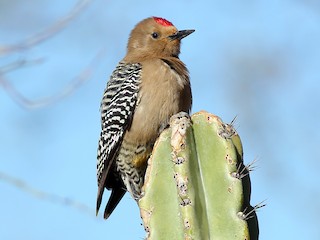
How to identify the Gila Woodpecker
Melanerpes uropygialis
Spotted a bird? Identify it instantly with the Birdby app
Open the appTo correctly identify the Gila Woodpecker (Melanerpes uropygialis), check each of these features. Birds can be tricky: habit, habitat, and call often confirm a sighting that a single photo cannot.
Size at a glance
- Length
- 20-25 cm (8-10 in)
- Wingspan
- 40-43 cm (15.5-17 in)
- Weight
- 50-70 g (1.8-2.5 oz)
Physical features to check
- 1
Plumage
Overall feather coloration and pattern.
Adults have a pale brown head and underparts, with a distinctive barred black and white pattern on the back, wings, and tail. A small, round, yellow patch is present on the lower belly, often difficult to see in the field. The rump is white.
- 2
Beak shape
Shape and color of the bill: a key field mark.
Strong, chisel-shaped, dark gray to black bill, typical of woodpeckers for excavating wood.
- 3
Eye color
Iris color and any distinctive eye markings.
Dark brown.
- 4
Leg color
Leg and foot color.
Dark gray to black.
- 5
Distinguishing features
Standout features that separate this species.
The combination of pale brown head/underparts, barred black and white back, and the small yellow belly patch are key. The white rump is also a good field mark, especially in flight.
- 6
Juvenile appearance
How young birds differ from adults.
Juveniles resemble adults but have duller plumage, less distinct barring, and often show a faint reddish wash on the crown in both sexes, which is more pronounced in young males. The yellow belly patch may be less vivid.
- 7
Seasonal changes
Plumage variation between breeding and non-breeding seasons.
No significant seasonal plumage changes. Plumage may appear slightly worn or faded towards the end of the breeding season before molting.
- 8
Sexual dimorphism
How males and females differ.
Males possess a small, circular red cap on the crown, which is absent in females. Otherwise, plumage is similar.
Key field marks
- Head and Underparts Color. Look for the distinctive pale brown (tan/buff) coloration on the head, face, and underparts. This is a key identifier that separates it from most other woodpeckers in its range.
- Back Pattern. Observe the finely barred black and white pattern on the back and wings. This 'zebra-striped' appearance is characteristic.
- Male's Red Cap. If it's a male, look for a small, circular red patch on the very top of the crown. Females lack this red patch.
- Yellow Belly Patch. Try to spot the small, round yellow patch on the lower belly. This can be difficult to see unless the bird is in good light or stretching.
- White Rump. In flight, a prominent white rump is often visible, contrasting with the barred back and tail.
- Habitat. Consider the habitat. If you're in a desert environment with saguaro cacti or riparian woodlands in the southwestern US or Mexico, it's highly likely to be a Gila Woodpecker.
- Vocalizations. Listen for its characteristic rolling 'churr' calls or the sharp 'kip' notes. These are often heard before the bird is seen.
Explore the Gila Woodpecker
Identify birds anywhere
Free on iOS, Android, and Web. Photo & sound identification, full species database, and your personal life list.