
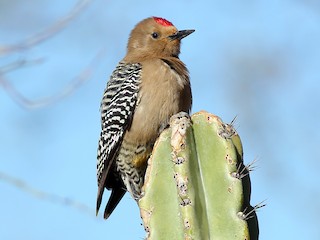
Where does the Gila Woodpecker live?
Melanerpes uropygialis
Spotted a bird? Identify it instantly with the Birdby app
Open the appThe Gila Woodpecker lives in specific habitats and regions. Knowing where, and when, to look improves your chances of a successful sighting.
Biomes
Deserts, arid scrublands, riparian woodlands.
Geographic range
Southwestern United States (primarily Arizona, southeastern California, southern Nevada, extreme southwestern Utah, and New Mexico) and western Mexico (Baja California, Sonora, Sinaloa).
Preferred environments
Saguaro cactus forests, mesquite bosques, cottonwood-willow riparian corridors, urban and suburban areas with mature trees and palms, especially where large cacti are present for nesting.
Elevation range
Typically from sea level up to 1,500 meters (5,000 feet), occasionally higher in some areas.
Where to look
Saguaro Cactus Forests
Prime habitat, especially in Arizona. Look for them nesting in saguaro cavities.
Desert Riparian Areas
Areas with cottonwoods, willows, and mesquites along rivers and washes are excellent places to find them.
Urban and Suburban Parks/Gardens
They are quite adaptable and can be found in developed areas with mature trees, palms, and even feeders.
Orchards and Agricultural Areas
May forage in these areas if suitable trees are present.
Field tips
- Look for Cavities. Scan saguaro cacti and large trees for excavated holes, which are often created by Gila Woodpeckers. Even if the woodpecker isn't present, other birds or owls might be using the 'saguaro boot'.
- Listen for Calls. Their distinctive 'churr' calls are often the first indication of their presence. Learn their vocalizations to locate them.
- Check Fruit-bearing Plants. During seasons when cactus fruits or other berries are ripe, check these plants as Gila Woodpeckers are avid fruit-eaters.
- Visit Feeders. They are known to visit suet feeders, hummingbird feeders (for nectar), and even eat pet food left outdoors. Setting up a feeder can attract them.
- Observe Behavior. Watch for their characteristic foraging behavior, pecking at bark or cactus flesh, or gleaning insects from surfaces.
Migration
Non-migratory; a permanent resident throughout its range.
Explore the Gila Woodpecker
Identify birds anywhere
Free on iOS, Android, and Web. Photo & sound identification, full species database, and your personal life list.