
Spotted a bird? Identify it instantly with the Birdby app
Open the appAbout
The Brown-headed Cowbird is a small, obligate brood parasitic passerine bird native to temperate and subtropical North America. It is known for laying its eggs in the nests of other bird species, relying on the host parents to raise its young. This species has expanded its range significantly with human-induced habitat changes.
Size & lifespan
- Length
- 16-22 cm (6.3-8.7 in)
- Wingspan
- 32-38 cm (12.6-15.0 in)
- Weight
- 30-60 g (1.1-2.1 oz)
- Lifespan
- 2-8 years in the wild, up to 12 years recorded
- Diet
- Omnivore (primarily seeds and insects)
Physical characteristics
- Plumage
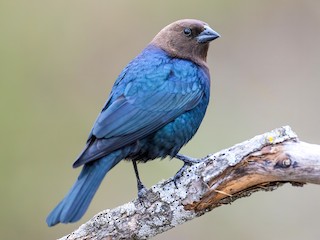
- Adult males are iridescent black with a distinctive brown head and neck. Adult females are duller, grayish-brown overall, slightly paler on the underparts, with faint streaking on the breast. Juveniles are streaky brown, resembling a large sparrow, with a pale eyebrow and a slightly streaked breast.
- Beak shape
- Conical, finch-like bill, relatively short and stout. Males have a dark gray to black bill; females have a dark gray bill.
- Eye color
- Dark brown
- Leg color
- Dark gray to black
- Distinguishing features
- Males are easily identified by their glossy black body and contrasting brown head. Females are more challenging but are uniformly grayish-brown without strong markings, unlike many sparrows or finches. The overall stocky build and short tail are also characteristic.
- Juvenile appearance
- Juveniles are streaky brown, particularly on the underparts, with a pale throat and a noticeable pale eyebrow. They lack the distinct brown head of the adult male and the uniform gray-brown of the adult female.
- Seasonal changes
- No significant seasonal plumage changes in adults. Plumage remains consistent year-round.
- Sexual dimorphism
- Pronounced. Males are glossy black with a brown head; females are dull grayish-brown.
How to identify
- 1
Male Plumage
Look for the distinctive combination of a glossy, iridescent black body and a contrasting rich brown head and neck. This is unique among North American blackbirds.
- 2
Female Plumage
Identify by the overall plain, uniform grayish-brown plumage, slightly paler below, with very faint or no streaking. Note the stocky build and short tail. Absence of strong markings is key.
- 3
Bill Shape
Observe the short, stout, conical bill, typical of a seed-eater, which is dark gray to black in both sexes.
- 4
Behavior (Brood Parasitism)
While not a direct field mark, observing a cowbird near a nest of another species, or finding a disproportionately large, streaky chick in a small host nest, is a strong indicator.
- 5
Calls and Songs
Listen for the male's gurgling, bubbly song ('glug-glug-glee') and the sharp, metallic 'chink' call, which is a common contact note.
Habitat & range
- Biomes
- Grasslands, open woodlands, forest edges, agricultural fields, suburban areas, parks, and riparian zones.
- Geographic range
- Breeds across most of North America, from southern Canada through the United States and into northern Mexico. Winters in the southern parts of its breeding range and further south into Mexico and the southeastern U.S.
- Elevation range
- Sea level up to approximately 2,500 meters (8,200 feet), primarily in lower elevations.
- Preferred environments
- Prefers open or semi-open habitats with scattered trees, often associated with livestock or human disturbance. Avoids dense, unbroken forests.
Behavior
- Activity time
- Diurnal
- Feeding habits
- Forages on the ground, often near grazing animals, eating seeds (especially grass seeds), grains, and insects (grasshoppers, beetles, caterpillars). They will also visit bird feeders. They often follow livestock, feeding on insects stirred up by their hooves.
- Social behavior
- Highly social, especially outside the breeding season, forming large mixed-species flocks with other blackbirds, grackles, and starlings. During the breeding season, males display to females, but pairs do not form strong bonds.
- Flight pattern
- Strong, direct flight, often in loose flocks. Undulating flight pattern when traveling longer distances.
- Migration pattern
- Northern populations are migratory, moving south for the winter. Southern populations are resident. Migration occurs in flocks, typically at night.
- Territoriality
- Males are not territorial in the traditional sense, but they do defend a small area around a displaying female. Females do not defend territories but may have overlapping home ranges.
Song & calls
- Song
- The male's song is a gurgling, bubbly series of notes, often described as 'glug-glug-glee' or 'bubble-bubble-zee,' sometimes preceded by a high-pitched whistle. It is not particularly musical.
- Call
- Common calls include a sharp, metallic 'chink' or 'check' call, often given in flight or when disturbed. Females also give a harsh 'rattle' call, especially when approaching a host nest.
- When they vocalize
- Males sing primarily during the breeding season (spring and early summer) to attract females. Calls are given year-round, particularly when foraging or in flocks.
Breeding & reproduction
- Breeding season
- Typically from April to July, varying by latitude.
- Nesting habits
- Obligate brood parasite. Does not build its own nest. Females lay eggs in the nests of over 220 documented host species, most commonly small passerines like warblers, vireos, sparrows, and finches. The female cowbird observes host nests and lays her egg quickly, often removing a host egg in the process.
- Clutch size
- A female cowbird can lay 30-40 eggs in a single breeding season, one egg per host nest, over a period of several weeks.
- Egg description
- Brown-headed Cowbird eggs are typically off-white, grayish-white, or pale bluish-white, heavily speckled and spotted with various shades of brown, gray, and sometimes purple. The markings are often concentrated at the larger end. They are generally larger than the eggs of most host species. Average size: 21 x 16 mm.
- Incubation period
- 10-13 days, typically shorter than most host species, allowing the cowbird chick to hatch first.
- Fledging period
- 8-13 days after hatching. Cowbird chicks often outcompete host chicks for food and grow rapidly.
- Parental care
- None by the biological parents. The eggs and young are entirely cared for by the host parents.
Where to find
Open Woodlands and Edges
Look in areas where forests meet open fields, clearings, or suburban developments. They thrive in fragmented landscapes.
Agricultural Areas
Common in pastures, farmlands, and areas with livestock, where they feed on insects stirred up by grazing animals.
Suburban Parks and Gardens
Often found in urban and suburban environments, especially where bird feeders are present or open grassy areas are abundant.
Bird Feeders
They are frequent visitors to feeders, particularly those offering sunflower seeds or mixed grain.
Field tips
- Listen for Calls. Their distinctive 'chink' call is often heard before the bird is seen, especially in flocks.
- Observe Mixed Flocks. Outside the breeding season, look for them foraging in large mixed-species flocks with other blackbirds, grackles, and starlings.
- Check Host Nests. During the breeding season, if you observe small songbirds acting agitated around their nest, it might be a cowbird attempting to parasitize it. Finding a cowbird egg or chick in a host nest is definitive identification of their presence.
- Look Near Livestock. In rural areas, check fields with cattle or horses, as cowbirds often follow them to feed on disturbed insects.
Similar species
Bronzed Cowbird
Molothrus aeneus
Bronzed Cowbirds are larger, males have red eyes and a shaggy neck ruff, and their plumage has a bronze sheen rather than iridescent black. Females are darker than Brown-headed Cowbird females. Their range is more southerly.
Rusty Blackbird
Euphagus carolinus
Rusty Blackbirds are larger with a longer, thinner bill and pale yellow eyes. Males are glossy black with a greenish sheen, and in winter, they show rusty feather edgings. Females are duller gray. They prefer wet, forested habitats.
Brewer's Blackbird
Euphagus cyanocephalus
Brewer's Blackbirds are larger with pale yellow eyes. Males are glossy black with a purplish sheen on the head and greenish on the body. Females are duller gray-brown. They have a longer tail and a more upright posture than cowbirds.
Female Red-winged Blackbird
Agelaius phoeniceus
Female Red-winged Blackbirds are heavily streaked brown and white, especially on the underparts, and often show a yellowish wash on the face and throat, sometimes with a hint of red on the shoulder. Brown-headed Cowbird females are more uniformly grayish-brown with faint streaking.
Quick facts
- Brood Parasite:
- Does not build its own nest; lays eggs in other species' nests.
- Diet:
- Omnivorous, primarily seeds and insects.
- Habitat:
- Open and semi-open habitats, forest edges, agricultural lands.
- Male Appearance:
- Glossy black body with a brown head.
- Female Appearance:
- Plain grayish-brown.
Fun facts
- Brown-headed Cowbirds are obligate brood parasites, meaning they *must* lay their eggs in the nests of other species to reproduce. They are one of only a few such species in North America.
- A single female Brown-headed Cowbird can lay up to 40 eggs in a breeding season, distributing them among many different host nests.
- The expansion of the Brown-headed Cowbird's range across North America is largely attributed to deforestation and the spread of agriculture, which created more open habitats suitable for them and their host species.
- Cowbird chicks often hatch earlier and grow faster than their host siblings, sometimes outcompeting them for food and even pushing them out of the nest.
- Despite their parasitic nature, some host species have developed defenses, such as recognizing and ejecting cowbird eggs from their nests.
Scientific classification
- Kingdom
- Animalia
- Phylum
- Chordata
- Class
- Aves
- Order
- Passeriformes
- Family
- Icteridae
- Genus
- Molothrus
- Species
- Molothrus ater
Explore the Brown-headed Cowbird
Identify birds anywhere
Free on iOS, Android, and Web. Photo & sound identification, full species database, and your personal life list.