
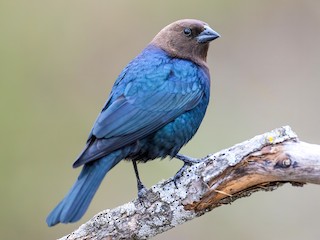
How to identify the Brown-headed Cowbird
Molothrus ater
Spotted a bird? Identify it instantly with the Birdby app
Open the appTo correctly identify the Brown-headed Cowbird (Molothrus ater), check each of these features. Birds can be tricky: habit, habitat, and call often confirm a sighting that a single photo cannot.
Size at a glance
- Length
- 16-22 cm (6.3-8.7 in)
- Wingspan
- 32-38 cm (12.6-15.0 in)
- Weight
- 30-60 g (1.1-2.1 oz)
Physical features to check
- 1
Plumage
Overall feather coloration and pattern.
Adult males are iridescent black with a distinctive brown head and neck. Adult females are duller, grayish-brown overall, slightly paler on the underparts, with faint streaking on the breast. Juveniles are streaky brown, resembling a large sparrow, with a pale eyebrow and a slightly streaked breast.
- 2
Beak shape
Shape and color of the bill: a key field mark.
Conical, finch-like bill, relatively short and stout. Males have a dark gray to black bill; females have a dark gray bill.
- 3
Eye color
Iris color and any distinctive eye markings.
Dark brown
- 4
Leg color
Leg and foot color.
Dark gray to black
- 5
Distinguishing features
Standout features that separate this species.
Males are easily identified by their glossy black body and contrasting brown head. Females are more challenging but are uniformly grayish-brown without strong markings, unlike many sparrows or finches. The overall stocky build and short tail are also characteristic.
- 6
Juvenile appearance
How young birds differ from adults.
Juveniles are streaky brown, particularly on the underparts, with a pale throat and a noticeable pale eyebrow. They lack the distinct brown head of the adult male and the uniform gray-brown of the adult female.
- 7
Seasonal changes
Plumage variation between breeding and non-breeding seasons.
No significant seasonal plumage changes in adults. Plumage remains consistent year-round.
- 8
Sexual dimorphism
How males and females differ.
Pronounced. Males are glossy black with a brown head; females are dull grayish-brown.
Key field marks
- Male Plumage. Look for the distinctive combination of a glossy, iridescent black body and a contrasting rich brown head and neck. This is unique among North American blackbirds.
- Female Plumage. Identify by the overall plain, uniform grayish-brown plumage, slightly paler below, with very faint or no streaking. Note the stocky build and short tail. Absence of strong markings is key.
- Bill Shape. Observe the short, stout, conical bill, typical of a seed-eater, which is dark gray to black in both sexes.
- Behavior (Brood Parasitism). While not a direct field mark, observing a cowbird near a nest of another species, or finding a disproportionately large, streaky chick in a small host nest, is a strong indicator.
- Calls and Songs. Listen for the male's gurgling, bubbly song ('glug-glug-glee') and the sharp, metallic 'chink' call, which is a common contact note.
Explore the Brown-headed Cowbird
Identify birds anywhere
Free on iOS, Android, and Web. Photo & sound identification, full species database, and your personal life list.