
Spotted a bird? Identify it instantly with the Birdby app
Open the appAbout
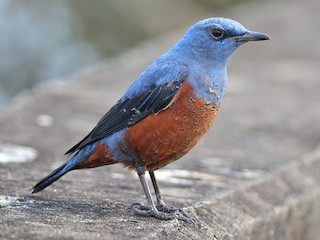
The Blue Rock Thrush is a medium-sized, thrush-like passerine bird, known for its striking blue-grey plumage in males. It is typically found in mountainous and rocky coastal areas across a wide range from southern Europe, northwest Africa, and central Asia to Southeast Asia. It is an insectivorous and omnivorous species, often seen perched on prominent rocks or buildings. Its melodious song is a characteristic sound of its rocky habitats.
Size & lifespan
- Length
- 19-23 cm
- Wingspan
- 33-38 cm
- Weight
- 42-65 g
- Lifespan
- Typically 5-8 years in the wild, up to 10-12 years recorded
- Diet
- Primarily insects (beetles, grasshoppers, caterpillars, ants, flies), spiders, molluscs, worms. During autumn and winter, it supplements its diet with berries and fruits.
Physical characteristics
- Plumage
- Adult breeding male: Entirely dark blue-grey, appearing almost black in poor light, with blackish flight feathers and tail. The plumage has a slightly scaly appearance on the back, and the underside can appear mottled with darker blue-grey markings. Adult female: Much duller, with brownish-grey upperparts and heavily barred or scalloped dull white to pale buff underparts. The barring is more prominent on the flanks and belly, while the breast is paler. Non-breeding male: Similar to breeding male but often with some pale fringes to feathers, giving a slightly scaly appearance. Juvenile: Resembles the female but with more distinct pale spotting on the upperparts and more extensive barring on the underparts, giving a more strongly mottled appearance. The first-year male often shows a mix of juvenile and adult male plumage, with some blue feathers starting to appear.
- Beak shape
- Slender, straight, and pointed, adapted for insect foraging.
- Eye color
- Dark brown.
- Leg color
- Dark grey to blackish.
- Distinguishing features
- Males are unmistakable with their deep blue-grey plumage. Females and juveniles are recognized by their thrush-like shape, rocky habitat preference, and distinctive flight. The female's barred underparts are a key identification feature. White patch at the base of the primary feathers is visible in flight on both sexes.
- Juvenile appearance
- Dull brownish-grey upperparts with pale spots, and heavily barred or scalloped pale underparts, resembling a heavily marked adult female.
- Seasonal changes
- Males are brightest during the breeding season. Slight dulling and feather wear can occur outside the breeding season, but the overall coloration remains largely consistent for both sexes.
- Sexual dimorphism
- Strongly sexually dimorphic, with males being vivid blue-grey and females being brownish with barred underparts.
How to identify
- 1
Male Plumage
Look for the uniform deep blue-grey body, appearing almost black in dull light. No contrasting colors like orange or white.
- 2
Female Plumage
Observe brownish-grey upperparts combined with distinct dark barring or scalloping on the pale buffy-white underparts.
- 3
Habitat
Primarily found in rocky, mountainous, or coastal cliff areas, often near human structures like old buildings and ruins.
- 4
Song
Listen for its distinctive, rich, fluty, and melodious song delivered from a prominent perch.
- 5
Behavior
Watch for it perching prominently on rocks or buildings, flying actively between perches, or foraging on the ground with quick hops.
- 6
Flight Identification
Note the white patch at the base of the primaries visible in flight, though this can be subtle.
Habitat & range
- Biomes
- Temperate, Subtropical, and Tropical Dry Terrestrial Biomes (especially rocky areas, cliffs, gorges), also coastal areas.
- Geographic range
- Southern Europe (Iberian Peninsula, France, Italy, Balkans, Greece), Northwest Africa (Morocco, Algeria, Tunisia), Turkey, Middle East, Central Asia (Caucasus, Himalayas, Tibet, China), and Southeast Asia (Myanmar, Thailand, Vietnam, Malaysia, Indonesia). Migratory in northern and eastern parts of its range, residential in southern and western parts.
- Elevation range
- Sea level up to 4500 meters in some parts of its Asian range, typically found at lower to mid-altitudes in Europe.
- Preferred environments
- Steep rocky slopes, cliffs, gorges, rock outcrops, old quarries, ruins, castles, ancient buildings, fortified walls, and sometimes coastal areas with sea cliffs. Requires crevices or cavities for nesting.
Behavior
- Activity time
- Diurnal. Most active during the early morning and late afternoon.
- Feeding habits
- Forages mainly on the ground, hopping along rocks and crevices. It also makes short flights to catch insects in the air (sallying) or pounces on prey from an elevated perch. It probes in leaf litter and under stones. Occasionally consumes berries and small fruits.
- Social behavior
- Generally solitary or found in pairs during the breeding season. Can be seen in small, loose flocks during migration or in areas with abundant food during winter, but usually maintains individual territories.
- Flight pattern
- Strong, undulating flight with rapid wing beats, often punctuated by glides. Displays a characteristic white patch at the base of the primaries during flight. Often flies from one prominent perch to another.
- Migration pattern
- Partially migratory. Northern and eastern populations migrate south to warmer regions for winter, particularly to northern Africa, the Middle East, and parts of Southeast Asia. Southern and western populations are largely resident. Migrates singly or in small groups.
- Territoriality
- Highly territorial during the breeding season. Males defend their breeding territory with songs and occasional chases. Territories are typically centered around suitable nesting sites and foraging grounds.
Song & calls
- Song
- A beautiful, rich, fluting, and melodious song, often delivered from a prominent perch (rock, tree, building). It consists of clear, whistling phrases, sometimes with mimicked elements from other birds, varying in tempo and pitch. It can be quite loud and far-carrying.
- Call
- A sharp, clicking or 'chick-tuc' call; also a 'teek-teek-teek' alarm call which can become more agitated and rapid when disturbed.
- When they vocalize
- Sings most frequently during the breeding season, from early morning to late evening, and sometimes at night. Calls are given year-round, especially in alarm or during territorial interactions.
Breeding & reproduction
- Breeding season
- Typically April to July, with slight variations depending on the geographic location.
- Nesting habits
- Nests in rock crevices, caves, old walls, ruins, or under eaves of buildings. The nest is a loose cup made of moss, roots, grass, and thin stems, lined with fine grass, hair, or feathers. Both parents participate in nest building.
- Clutch size
- Typically 3-6 eggs, often 4-5.
- Egg description
- 3-6 eggs, usually 4-5. Pale blue to greenish-blue, often unmarked or with faint reddish-brown speckles, particularly at the larger end.
- Incubation period
- Approximately 12-15 days, primarily by the female.
- Fledging period
- Chicks fledge around 14-18 days after hatching. Both parents feed the young.
- Parental care
- Both parents care for the young, feeding them and defending the nest. Often raises one or two broods per season.
Where to find
Mountainous regions
Scan rocky outcrops, cliff faces, and steep slopes.
Coastal cliffs
Look for birds perched on sea cliffs, especially in the Mediterranean and parts of Asia.
Historical sites and ruins
Check old castles, fortified towns, ancient ruins, and quarry sites as they provide suitable nesting and perching spots.
Field tips
- Listen for the song. The male's loud and clear song is often the first indication of its presence, especially during breeding season. It often sings from a high, exposed perch.
- Scan prominent perches. Blue Rock Thrushes frequently perch on the highest points of rocks, cliffs, or buildings, providing good vantage points for observation.
- Observe foraging behavior. Watch for birds hopping on the ground or making short, agile flights to catch insects.
- Visit appropriate habitats. Focus on rocky areas, especially those with some vegetation, and ancient man-made structures.
- Seasonal timing. Visit during the breeding season for the best chance of hearing singing males and observing nesting activity. In migratory regions, spring and autumn can yield sightings during migration.
Similar species
Rufous-tailed Rock Thrush
Monticola saxatilis
The male Rufous-tailed Rock Thrush has a prominent blue head, orange underparts, and an orange rump/tail, making it distinctly different from the all-blue male Blue Rock Thrush. Females are also browner and have a rufous tail, lacking the heavy barring of the female Blue Rock Thrush.
Common Rock Thrush
Monticola saxatilis (alternative common name for Rufous-tailed Rock Thrush)
See Rufous-tailed Rock Thrush. The males are very different in plumage (blue head, orange belly vs. all blue-grey). Females are more similar but the female Common Rock Thrush typically shows a warm rufous wash to the tail and usually has less prominent barring on the underparts.
Eastern Bluebird
Sialia sialis
Only superficially similar due to blue plumage. Eastern Bluebirds are considerably smaller, have a rusty breast, and are found in North America in open woodlands and suburban areas, not in rocky habitats. The blue is also a brighter azure, not the deep slate-blue of the Blue Rock Thrush.
Quick facts
- Distinctive Feature (Male):
- Uniform deep blue-grey plumage.
- Habitat Preference:
- Rocky cliffs, mountainsides, and ancient buildings.
- Song Type:
- Melodious, fluting whistles often with mimicry.
- Diet:
- Mainly insects, supplemented by berries.
- Nesting Site:
- Rock crevices and building cavities.
Fun facts
- The Blue Rock Thrush is the national bird of Malta.
- Despite its thrush-like appearance and common name, it is more closely related to Old World flycatchers due to recent taxonomic revisions.
- Its scientific name 'solitarius' refers to its often solitary nature outside of the breeding season.
- In many cultures, its song is considered one of the most beautiful among European birds.
Scientific classification
- Kingdom
- Animalia
- Phylum
- Chordata
- Class
- Aves
- Order
- Passeriformes
- Family
- Muscicapidae
- Genus
- Monticola
- Species
- solitarius
Explore the Blue Rock Thrush
Identify birds anywhere
Free on iOS, Android, and Web. Photo & sound identification, full species database, and your personal life list.