
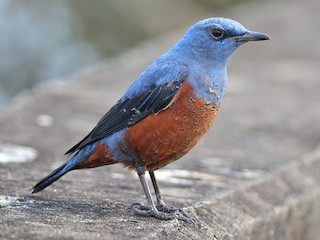
Where does the Blue Rock Thrush live?
Monticola solitarius
Spotted a bird? Identify it instantly with the Birdby app
Open the appThe Blue Rock Thrush lives in specific habitats and regions. Knowing where, and when, to look improves your chances of a successful sighting.
Biomes
Temperate, Subtropical, and Tropical Dry Terrestrial Biomes (especially rocky areas, cliffs, gorges), also coastal areas.
Geographic range
Southern Europe (Iberian Peninsula, France, Italy, Balkans, Greece), Northwest Africa (Morocco, Algeria, Tunisia), Turkey, Middle East, Central Asia (Caucasus, Himalayas, Tibet, China), and Southeast Asia (Myanmar, Thailand, Vietnam, Malaysia, Indonesia). Migratory in northern and eastern parts of its range, residential in southern and western parts.
Preferred environments
Steep rocky slopes, cliffs, gorges, rock outcrops, old quarries, ruins, castles, ancient buildings, fortified walls, and sometimes coastal areas with sea cliffs. Requires crevices or cavities for nesting.
Elevation range
Sea level up to 4500 meters in some parts of its Asian range, typically found at lower to mid-altitudes in Europe.
Where to look
Mountainous regions
Scan rocky outcrops, cliff faces, and steep slopes.
Coastal cliffs
Look for birds perched on sea cliffs, especially in the Mediterranean and parts of Asia.
Historical sites and ruins
Check old castles, fortified towns, ancient ruins, and quarry sites as they provide suitable nesting and perching spots.
Field tips
- Listen for the song. The male's loud and clear song is often the first indication of its presence, especially during breeding season. It often sings from a high, exposed perch.
- Scan prominent perches. Blue Rock Thrushes frequently perch on the highest points of rocks, cliffs, or buildings, providing good vantage points for observation.
- Observe foraging behavior. Watch for birds hopping on the ground or making short, agile flights to catch insects.
- Visit appropriate habitats. Focus on rocky areas, especially those with some vegetation, and ancient man-made structures.
- Seasonal timing. Visit during the breeding season for the best chance of hearing singing males and observing nesting activity. In migratory regions, spring and autumn can yield sightings during migration.
Migration
Partially migratory. Northern and eastern populations migrate south to warmer regions for winter, particularly to northern Africa, the Middle East, and parts of Southeast Asia. Southern and western populations are largely resident. Migrates singly or in small groups.
Explore the Blue Rock Thrush
Identify birds anywhere
Free on iOS, Android, and Web. Photo & sound identification, full species database, and your personal life list.