
How to identify the Blue Rock Thrush
Monticola solitarius
Spotted a bird? Identify it instantly with the Birdby app
Open the appTo correctly identify the Blue Rock Thrush (Monticola solitarius), check each of these features. Birds can be tricky: habit, habitat, and call often confirm a sighting that a single photo cannot.
Size at a glance
- Length
- 19-23 cm
- Wingspan
- 33-38 cm
- Weight
- 42-65 g
Physical features to check
- 1
Plumage
Overall feather coloration and pattern.
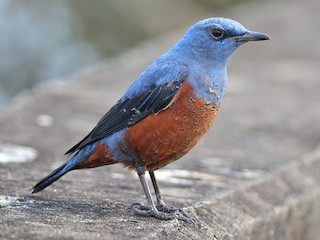
Adult breeding male: Entirely dark blue-grey, appearing almost black in poor light, with blackish flight feathers and tail. The plumage has a slightly scaly appearance on the back, and the underside can appear mottled with darker blue-grey markings. Adult female: Much duller, with brownish-grey upperparts and heavily barred or scalloped dull white to pale buff underparts. The barring is more prominent on the flanks and belly, while the breast is paler. Non-breeding male: Similar to breeding male but often with some pale fringes to feathers, giving a slightly scaly appearance. Juvenile: Resembles the female but with more distinct pale spotting on the upperparts and more extensive barring on the underparts, giving a more strongly mottled appearance. The first-year male often shows a mix of juvenile and adult male plumage, with some blue feathers starting to appear.
- 2
Beak shape
Shape and color of the bill: a key field mark.
Slender, straight, and pointed, adapted for insect foraging.
- 3
Eye color
Iris color and any distinctive eye markings.
Dark brown.
- 4
Leg color
Leg and foot color.
Dark grey to blackish.
- 5
Distinguishing features
Standout features that separate this species.
Males are unmistakable with their deep blue-grey plumage. Females and juveniles are recognized by their thrush-like shape, rocky habitat preference, and distinctive flight. The female's barred underparts are a key identification feature. White patch at the base of the primary feathers is visible in flight on both sexes.
- 6
Juvenile appearance
How young birds differ from adults.
Dull brownish-grey upperparts with pale spots, and heavily barred or scalloped pale underparts, resembling a heavily marked adult female.
- 7
Seasonal changes
Plumage variation between breeding and non-breeding seasons.
Males are brightest during the breeding season. Slight dulling and feather wear can occur outside the breeding season, but the overall coloration remains largely consistent for both sexes.
- 8
Sexual dimorphism
How males and females differ.
Strongly sexually dimorphic, with males being vivid blue-grey and females being brownish with barred underparts.
Key field marks
- Male Plumage. Look for the uniform deep blue-grey body, appearing almost black in dull light. No contrasting colors like orange or white.
- Female Plumage. Observe brownish-grey upperparts combined with distinct dark barring or scalloping on the pale buffy-white underparts.
- Habitat. Primarily found in rocky, mountainous, or coastal cliff areas, often near human structures like old buildings and ruins.
- Song. Listen for its distinctive, rich, fluty, and melodious song delivered from a prominent perch.
- Behavior. Watch for it perching prominently on rocks or buildings, flying actively between perches, or foraging on the ground with quick hops.
- Flight Identification. Note the white patch at the base of the primaries visible in flight, though this can be subtle.
Explore the Blue Rock Thrush
Identify birds anywhere
Free on iOS, Android, and Web. Photo & sound identification, full species database, and your personal life list.