
Spotted a bird? Identify it instantly with the Birdby app
Open the appAbout
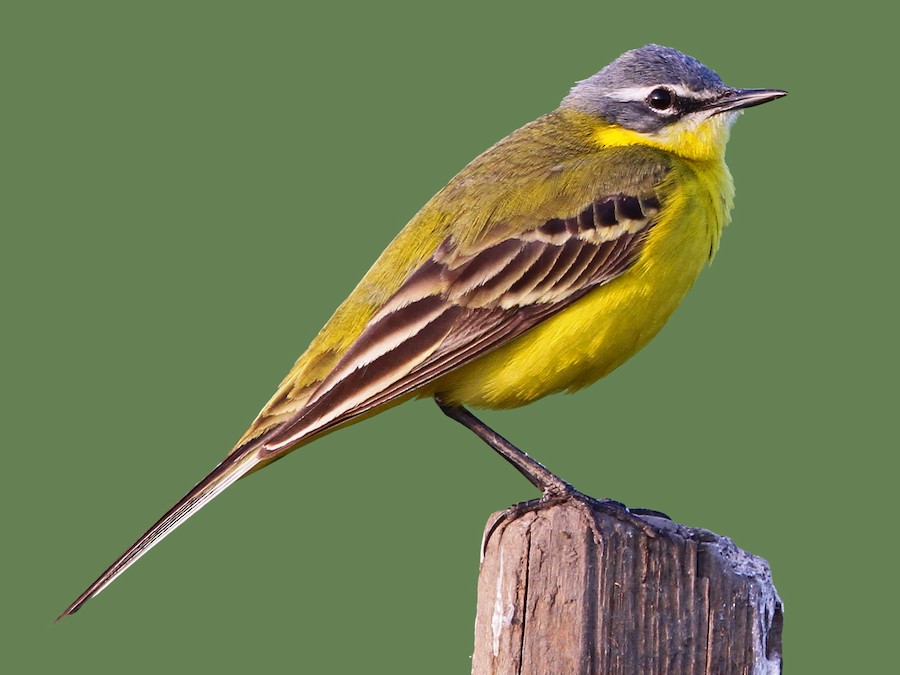
The Western Yellow Wagtail (Motacilla flava) is a small, slender passerine bird in the wagtail family Motacillidae. It is characterized by its long tail, which it constantly wags up and down, and its bright yellow underparts, especially in breeding males. This species is highly migratory, breeding across a vast Palaearctic range and wintering in Africa and southern Asia. It is known for its remarkable subspecies diversity, with many forms differing primarily in head plumage patterns, which can make identification challenging in the field.
Size & lifespan
- Length
- 15-18 cm (5.9-7.1 in)
- Wingspan
- 23-27 cm (9.1-10.6 in)
- Weight
- 11-22 g (0.4-0.8 oz)
- Lifespan
- Typically 2-5 years, with some individuals reaching up to 8 years in the wild.
- Diet
- Primarily insectivorous, feeding on a wide range of small invertebrates.
Physical characteristics
- Plumage
- Adult breeding males typically exhibit bright yellow underparts, olive-green upperparts, and distinct head patterns varying significantly among subspecies. Many forms have grey, blue-grey, or blackish crowns and hindnecks, with contrasting white supercilia and submoustachial stripes. Adult breeding females are generally duller, with paler yellow underparts, more olive-brown upperparts, and less striking head patterns. Non-breeding adults (both sexes) resemble breeding females, with duller yellow or whitish underparts and browner upperparts.
- Beak shape
- Slender, pointed, and dark, adapted for catching insects.
- Eye color
- Dark brown.
- Leg color
- Dark grayish-brown to black.
- Distinguishing features
- Constantly bobbing and wagging tail; bright yellow underparts (especially males); slender body with a long tail; distinct head patterns varying by subspecies; undulating flight.
- Juvenile appearance
- Juveniles are largely brownish-grey above, with a buffy wash on the underparts, often streaked on the breast. They lack the strong yellow coloration of adults and typically have pale lore and a pale eye-ring, with a dark ear-covert contrasting with the pale throat. The tail is shorter than adults. As they mature through their first winter, they acquire more adult-like plumage, often similar to non-breeding females.
- Seasonal changes
- Plumage becomes brighter and more intense in breeding season (spring and summer), particularly for males. Non-breeding (winter) plumage is duller, with reduced yellow tones, browner upperparts, and less distinct head markings. First-winter birds resemble non-breeding adults but may retain some juvenile feathering.
- Sexual dimorphism
- Pronounced during the breeding season, with males being much brighter and having more distinct head patterns. Females are duller overall. In non-breeding plumage, sexes are more similar, though males may retain some yellow tones.
How to identify
- 1
Plumage
Look for bright yellow underparts (especially in males), olive-green upperparts. Pay close attention to the head pattern (crown color, presence/absence of supercilium, lore color) which is key for subspecies identification.
- 2
Tail Wagging
The constant 'wagging' of the tail up and down is a distinctive behavioral trait of all wagtails and a primary identification clue.
- 3
Habitat
Search in open, wet grassy areas, meadows, and pastures. They are often found near livestock or standing water.
- 4
Vocalization
Listen for their characteristic sharp 'tseep' call in flight or their simple, high-pitched song from a perch.
Habitat & range
- Biomes
- Grasslands, wetlands, agricultural areas, tundra.
- Geographic range
- Breeds across most of temperate Europe, Asia, and northwestern Africa. Winters in sub-Saharan Africa, the Arabian Peninsula, and parts of southern Asia.
- Elevation range
- Sea level up to approximately 2000 meters (6500 ft), occasionally higher during migration.
- Preferred environments
- Open, wet habitats with short vegetation, such as damp meadows, pastures, marshes, riverbanks, cultivated fields, and floodplains. They favor areas with access to insects and bare ground for foraging.
Behavior
- Activity time
- Diurnal. Most active during daylight hours, particularly in the morning and late afternoon, foraging for food and tending to nests.
- Feeding habits
- Forages primarily on the ground or in low vegetation, actively running and walking to catch insects. They also make short, agile flights to snatch flying insects (hawking) and may glean insects from foliage. Their diet includes flies, beetles, aphids, caterpillars, and other small arthropods. Often seen near livestock, feeding on insects attracted to or disturbed by the animals.
- Social behavior
- Generally solitary or in pairs during the breeding season. Outside of breeding, they can be highly gregarious, forming large flocks, sometimes mixed with other wagtail species, especially during migration and at wintering sites. They roost communally in reedbeds or bushes.
- Flight pattern
- Undulating flight pattern, characterized by a series of shallow dips and rises. Flaps its wings rapidly between glides. Often flies low over the ground.
- Migration pattern
- Long-distance migrant. Northern populations migrate south to Africa and parts of southern Asia for the non-breeding season. Migration typically occurs in broad fronts, both by day and night, often in flocks. Spring migration is from March-April, and autumn migration from August-October.
- Territoriality
- Males establish and defend breeding territories through song and display. Territories are typically near water or open, grassy areas where food is abundant. Defensive actions include chases and vocalizations.
Song & calls
- Song
- The song is a rather simple, sustained series of high-pitched, often trilling or buzzing notes, typically rendered as 'tswee-tswee-tswee' or 'srit-srit-srit'. It is relatively soft and melodic, delivered from a perch or in display flight. Subspecies may show slight variations.
- Call
- The most common call is a sharp, often metallic 'tseep' or 'tsip', which can be uttered singly or in a series. This contact call is frequently heard in flight, during alarm, or when foraging. A softer 'chup' or 'wit' may also be given.
- When they vocalize
- Most vocal during the breeding season, from spring to early summer, when males sing to attract mates and defend territories. Calls are given year-round, especially during migration and when disturbed.
Breeding & reproduction
- Breeding season
- Typically May to July, varying with geographic location.
- Nesting habits
- Nests are usually built on the ground, often hidden under a tussock of grass, a shrub, or in a shallow depression. The female constructs a cup-shaped nest from grass, moss, roots, and leaves, lined with finer materials like hair or feathers.
- Clutch size
- Typically 3-7 eggs, most commonly 5-6 eggs.
- Egg description
- Eggs are typically off-white, yellowish-white, or pale buff, often finely speckled or blotched with grey, brown, or olive markings, which can be denser at the wider end. Usually dull in sheen.
- Incubation period
- Approximately 11-14 days, primarily by the female.
- Fledging period
- Chicks fledge around 11-15 days after hatching, though they may remain dependent on parents for a short period thereafter.
- Parental care
- Both parents participate in feeding the chicks. The female primarily incubates, while the male often feeds her during incubation. After hatching, both parents actively forage and bring insects to the nestlings.
Where to find
Wet meadows and pastures
These are prime habitats during the breeding season where they feed on insects disturbed by grazing animals or found in damp soil.
Marshes and floodplains
Areas with low, sparse vegetation and abundant insect life are ideal for foraging and nesting.
Agricultural fields
Cultivated lands, especially those near water sources, can attract them due to insect availability.
Lakeshores and riverbanks
Open edges of water bodies provide foraging opportunities.
Migration stopovers
During migration, they can be found in a wider range of open habitats, including coastal areas and open fields, often in flocks.
Field tips
- Scan open ground. Look for small, active birds running or walking with their characteristic tail-wagging motion.
- Listen for calls. Their 'tseep' call is often the first indication of their presence, especially when they are flushed from tall grass.
- Observe head patterns carefully. If you encounter a yellow wagtail, take detailed notes or photos of the head plumage to aid in subspecies identification, as this is the most variable trait.
- Visit during migration. Migration periods (spring and autumn) can offer opportunities to see various subspecies outside their typical breeding ranges, often in larger flocks.
- Check near livestock. Cattle and other grazing animals disturb insects, making them easier prey for wagtails.
Similar species
Yellow Wagtail (eastern subspecies)
Motacilla flava (various subspecies)
The main challenge is distinguishing between various subspecies of Motacilla flava as their head patterns are the primary differentiating feature. Field identification requires careful observation of crown, supercilium, and ear-covert color. For example, 'Grey-headed Wagtail' (M. f. thunbergi) has a dark grey crown extending to the eye, lacks a supercilium, and often has a dark loral stripe, while 'Blue-headed Wagtail' (M. f. flava) has a blue-grey crown, white supercilium, and dark lores.
Citrine Wagtail
Motacilla citreola
Citrine Wagtail males in breeding plumage have a bright yellow head and underparts with a black nape and mantle, contrasting with a broader white wing-bar. Western Yellow Wagtails (M. flava) never have an entirely yellow head; their head patterns are more complexly grey, blue, or black with white markings. Females and immatures of Citrine Wagtail can be trickier, but often show a clearer pale supercilium that continues behind the eye and a more prominent white double wing bar on the covert. The lack of an 'eye-stripe' through the lores is also a good indicator for Citrine.
Grey Wagtail
Motacilla cinerea
Grey Wagtail is overall grey above and yellow below, but has a longer tail than Western Yellow Wagtail, and notably a distinct white supercilium, blackish lores, and a white chin/throat (often with a black throat patch in breeding males). The yellow is typically restricted to the belly and undertail coverts, whereas Western Yellow Wagtails have more extensive yellow across the entire underside. Grey Wagtails also prefer faster-flowing water habitats.
Quick facts
- Order:
- Passeriformes
- Family:
- Motacillidae
- Diet:
- Insects and small invertebrates
- Migration:
- Long-distance migrant
- Conservation Status:
- Least Concern
Fun facts
- The Western Yellow Wagtail has one of the most complex subspecies distributions of any bird, with up to 15 recognized subspecies, each with distinct head patterns.
- Due to the extensive variation among subspecies, some ornithologists consider it a 'species complex' rather than a single species, making its taxonomy a subject of ongoing debate.
- The constant tail-wagging behavior is thought to help flush out insects or perhaps signal to predators that the bird is alert and difficult to catch.
- During migration, large flocks can gather at favorable stopover sites, sometimes exceeding several thousand individuals.
Scientific classification
- Kingdom
- Animalia
- Phylum
- Chordata
- Class
- Aves
- Order
- Passeriformes
- Family
- Motacillidae
- Genus
- Motacilla
- Species
- M. flava
Explore the Western Yellow Wagtail
Identify birds anywhere
Free on iOS, Android, and Web. Photo & sound identification, full species database, and your personal life list.