
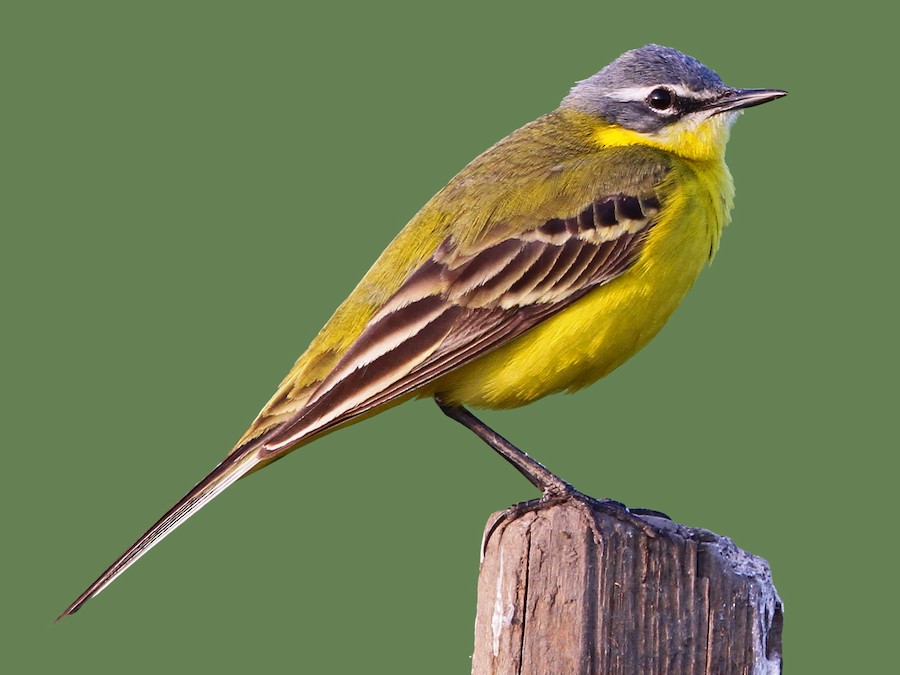
How to identify the Western Yellow Wagtail
Motacilla flava
Spotted a bird? Identify it instantly with the Birdby app
Open the appTo correctly identify the Western Yellow Wagtail (Motacilla flava), check each of these features. Birds can be tricky: habit, habitat, and call often confirm a sighting that a single photo cannot.
Size at a glance
- Length
- 15-18 cm (5.9-7.1 in)
- Wingspan
- 23-27 cm (9.1-10.6 in)
- Weight
- 11-22 g (0.4-0.8 oz)
Physical features to check
- 1
Plumage
Overall feather coloration and pattern.
Adult breeding males typically exhibit bright yellow underparts, olive-green upperparts, and distinct head patterns varying significantly among subspecies. Many forms have grey, blue-grey, or blackish crowns and hindnecks, with contrasting white supercilia and submoustachial stripes. Adult breeding females are generally duller, with paler yellow underparts, more olive-brown upperparts, and less striking head patterns. Non-breeding adults (both sexes) resemble breeding females, with duller yellow or whitish underparts and browner upperparts.
- 2
Beak shape
Shape and color of the bill: a key field mark.
Slender, pointed, and dark, adapted for catching insects.
- 3
Eye color
Iris color and any distinctive eye markings.
Dark brown.
- 4
Leg color
Leg and foot color.
Dark grayish-brown to black.
- 5
Distinguishing features
Standout features that separate this species.
Constantly bobbing and wagging tail; bright yellow underparts (especially males); slender body with a long tail; distinct head patterns varying by subspecies; undulating flight.
- 6
Juvenile appearance
How young birds differ from adults.
Juveniles are largely brownish-grey above, with a buffy wash on the underparts, often streaked on the breast. They lack the strong yellow coloration of adults and typically have pale lore and a pale eye-ring, with a dark ear-covert contrasting with the pale throat. The tail is shorter than adults. As they mature through their first winter, they acquire more adult-like plumage, often similar to non-breeding females.
- 7
Seasonal changes
Plumage variation between breeding and non-breeding seasons.
Plumage becomes brighter and more intense in breeding season (spring and summer), particularly for males. Non-breeding (winter) plumage is duller, with reduced yellow tones, browner upperparts, and less distinct head markings. First-winter birds resemble non-breeding adults but may retain some juvenile feathering.
- 8
Sexual dimorphism
How males and females differ.
Pronounced during the breeding season, with males being much brighter and having more distinct head patterns. Females are duller overall. In non-breeding plumage, sexes are more similar, though males may retain some yellow tones.
Key field marks
- Plumage. Look for bright yellow underparts (especially in males), olive-green upperparts. Pay close attention to the head pattern (crown color, presence/absence of supercilium, lore color) which is key for subspecies identification.
- Tail Wagging. The constant 'wagging' of the tail up and down is a distinctive behavioral trait of all wagtails and a primary identification clue.
- Habitat. Search in open, wet grassy areas, meadows, and pastures. They are often found near livestock or standing water.
- Vocalization. Listen for their characteristic sharp 'tseep' call in flight or their simple, high-pitched song from a perch.
Explore the Western Yellow Wagtail
Identify birds anywhere
Free on iOS, Android, and Web. Photo & sound identification, full species database, and your personal life list.