
Spotted a bird? Identify it instantly with the Birdby app
Open the appAbout
The Yellow-crowned Night-Heron is a medium-sized heron characterized by its stocky build, relatively short legs, and thick neck. It is primarily nocturnal or crepuscular, feeding mainly on crustaceans in coastal and freshwater wetlands. Its distinctive head pattern, especially in adults, makes it relatively easy to identify.
Size & lifespan
- Length
- 55-70 cm (22-28 in)
- Wingspan
- 101-112 cm (40-44 in)
- Weight
- 500-800 g (1.1-1.8 lbs)
- Lifespan
- Up to 17 years in the wild
- Diet
- Carnivore (primarily crustaceans, especially crabs and crayfish)
Physical characteristics
- Plumage
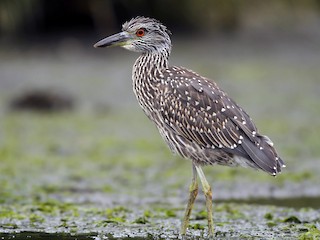
- Adults have a slate-gray body with fine black vermiculations on the back and wings. The head is striking, with a black face, a prominent white stripe below the eye, and a pale yellow to white crown and plume extending from the back of the head. Juveniles are mottled brown with fine white streaks and spots, lacking the distinct adult head pattern.
- Beak shape
- Stout, black, and relatively short compared to other herons, adapted for crushing crustacean shells.
- Eye color
- Bright orange-red in adults, duller in juveniles.
- Leg color
- Dull greenish-yellow, becoming brighter yellow or orange-red during breeding season.
- Distinguishing features
- Adults are distinguished by their slate-gray body, black face with a white cheek stripe, and pale yellow crown. Juveniles are heavily streaked brown with a dark bill and dull legs.
- Juvenile appearance
- Juveniles are entirely different from adults, being mottled brown with fine white streaks and spots over the entire body, including the head. Their bill is dark, and legs are dull greenish. They gradually acquire adult plumage over 2-3 years.
- Seasonal changes
- Leg color becomes brighter (yellow to orange-red) during the breeding season. The yellow crown and white plumes are more prominent and vibrant during courtship and nesting.
- Sexual dimorphism
- Males and females are generally similar in plumage, though males may be slightly larger. During breeding season, both sexes develop long, white occipital plumes.
How to identify
- 1
Adult Head Pattern
Look for the striking black face with a prominent white stripe extending from behind the eye, and a pale yellow to white crown. This is the most definitive field mark for adults.
- 2
Body Plumage
Observe the overall slate-gray body with fine black vermiculations on the back and wings. This uniform gray contrasts with the head pattern.
- 3
Leg Color
Note the dull greenish-yellow legs, which become brighter yellow or orange-red during the breeding season. They are relatively short for a heron.
- 4
Bill Shape
Identify the stout, black, and relatively short bill, which is adapted for crushing hard-shelled prey.
- 5
Juvenile Plumage
For juveniles, look for a heavily mottled brown body with fine white streaks and spots. The bill will be dark, and legs dull greenish. They lack the adult head pattern entirely.
- 6
Behavior and Activity Time
Observe its activity primarily at dusk, night, or dawn, often foraging slowly in shallow water. Its preference for crustaceans is also a strong indicator.
- 7
Call
Listen for its distinctive, harsh 'kwok' or 'squawk' call, especially when in flight or disturbed.
Habitat & range
- Biomes
- Coastal wetlands, freshwater marshes, swamps, mangroves, estuaries, riparian forests.
- Geographic range
- Breeds across the southeastern United States, extending north along the Atlantic coast to New England, and west through the Mississippi River basin. Also found in Mexico, Central America, the Caribbean, and northern South America. Northern populations are migratory, while southern populations are resident.
- Elevation range
- Primarily lowlands, typically below 500 meters (1,640 feet), often at sea level.
- Preferred environments
- Prefers shallow water habitats with dense vegetation for cover, such as tidal creeks, mangrove swamps, cypress swamps, and flooded woodlands. Often found near human habitation in urban parks and suburban areas if suitable foraging and nesting sites are available.
Behavior
- Activity time
- Nocturnal and crepuscular (active at dawn and dusk), but will forage during the day, especially during breeding season or when food is scarce.
- Feeding habits
- Primarily a nocturnal or crepuscular feeder, though it may forage during the day, especially when feeding young. It hunts by standing motionless or walking slowly in shallow water, waiting for prey to come within striking distance. Its diet consists almost exclusively of crustaceans, particularly crabs (fiddler crabs, blue crabs) and crayfish, but also includes insects, small fish, frogs, and mollusks.
- Social behavior
- Generally solitary when foraging, but often nests in colonies (rookeries) with other herons and egrets. Outside of the breeding season, they are less social.
- Flight pattern
- Flight is strong and direct, with slow, deliberate wingbeats. Legs trail behind the body, and the neck is typically retracted into an S-shape, characteristic of herons.
- Migration pattern
- Northern populations are migratory, moving south to the Gulf Coast, Florida, Mexico, and the Caribbean for the winter. Southern populations in Florida, the Gulf Coast, and tropical regions are largely resident.
- Territoriality
- Defends a small foraging territory, especially during the breeding season. Nesting territories within colonies are also defended.
Song & calls
- Song
- Not known for a complex song. Vocalizations are generally harsh calls.
- Call
- The most common call is a distinctive, harsh, guttural 'kwok' or 'squawk', often given in flight or when disturbed. Also produces a softer 'woc-woc' call at the nest.
- When they vocalize
- Most vocal during the breeding season, especially at dusk and dawn, and when disturbed or in flight.
Breeding & reproduction
- Breeding season
- Varies geographically, typically from March to July in North America, peaking in April-May.
- Nesting habits
- Nests solitarily or in small to large colonies (rookeries), often with other wading birds. Nests are typically platforms of sticks, built in trees or shrubs over water or on dry land, usually 3-15 meters (10-50 feet) above the ground. Both parents participate in nest building.
- Clutch size
- 2-6 eggs
- Egg description
- 2-6 (typically 3-5) pale bluish-green eggs, unmarked. Oval to elliptical in shape.
- Incubation period
- 21-25 days
- Fledging period
- 25-30 days, but young may leave the nest and climb in nearby branches before they can fly. They become independent around 40-50 days.
- Parental care
- Both parents incubate the eggs and feed the young. Chicks are altricial (helpless at birth) and require extensive parental care.
Where to find
Coastal Wetlands
Look in mangrove swamps, tidal creeks, salt marshes, and estuaries, particularly where fiddler crabs are abundant.
Freshwater Wetlands
Check cypress swamps, flooded woodlands, and slow-moving rivers or streams with dense vegetation.
Urban/Suburban Areas
They can be found in parks, golf courses, and residential areas with ponds, canals, or ditches, especially if there are trees for nesting and crustaceans for food.
Field tips
- Look at Dusk/Dawn. As a 'night-heron,' they are most active and visible during twilight hours. Arrive at your chosen location before sunset or at sunrise.
- Scan Shorelines and Shallow Water. They often stand motionless at the edge of water bodies, waiting for prey. Look for them near roots of mangroves, cypress knees, or along muddy banks.
- Listen for Calls. Their distinctive 'kwok' call can often alert you to their presence, especially in dense vegetation or low light.
- Check Nesting Colonies. During breeding season, locate rookeries, often shared with other wading birds, in tall trees near water. They can be quite vocal and visible around nests.
- Patience is Key. Their cryptic plumage and nocturnal habits mean they can be elusive. Spend time observing suitable habitats quietly.
Similar species
Black-crowned Night-Heron
Nycticorax nycticorax
Adult Black-crowned Night-Herons have a black crown and back, gray wings, and a white belly, lacking the Yellow-crowned's distinctive white facial stripe and yellow crown. Juveniles of both species are mottled brown, but juvenile Black-crowned Night-Herons have larger white spots on their wings and a heavier, more pointed bill. Yellow-crowned Night-Herons have longer legs and a more slender build than Black-crowned Night-Herons.
Green Heron
Butorides virescens
Green Herons are smaller, have a dark greenish-blue back, chestnut neck, and a shorter, thicker neck. They lack the distinct head pattern of the Yellow-crowned Night-Heron. Green Herons are typically diurnal or crepuscular and often hunt fish, while Yellow-crowned Night-Herons are more nocturnal and specialize in crustaceans.
Quick facts
- Primary Diet:
- Crabs and crayfish
- Activity Pattern:
- Nocturnal/Crepuscular
- Distinctive Feature (Adult):
- Yellow crown and white facial stripe
- Nesting Habit:
- Colonial or solitary in trees
- Conservation Status:
- Least Concern
Fun facts
- The Yellow-crowned Night-Heron is a specialist predator of crustaceans, using its stout bill to crack open shells.
- Unlike many herons, it often forages by walking slowly and deliberately, rather than standing still for long periods.
- Juvenile Yellow-crowned Night-Herons look so different from adults that they were once thought to be a separate species.
- They are known to use tools, such as bait, to lure fish, though this behavior is more commonly associated with Green Herons.
- Despite being primarily nocturnal, they will readily forage during the day, especially when feeding hungry chicks.
Scientific classification
- Kingdom
- Animalia
- Phylum
- Chordata
- Class
- Aves
- Order
- Pelecaniformes
- Family
- Ardeidae
- Genus
- Nyctanassa
- Species
- Nyctanassa violacea
Explore the Yellow-crowned Night-Heron
Identify birds anywhere
Free on iOS, Android, and Web. Photo & sound identification, full species database, and your personal life list.