
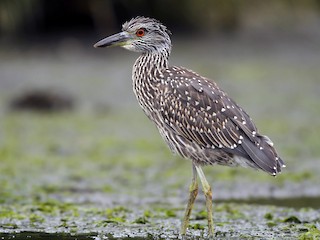
Where does the Yellow-crowned Night-Heron live?
Nyctanassa violacea
Spotted a bird? Identify it instantly with the Birdby app
Open the appThe Yellow-crowned Night-Heron lives in specific habitats and regions. Knowing where, and when, to look improves your chances of a successful sighting.
Biomes
Coastal wetlands, freshwater marshes, swamps, mangroves, estuaries, riparian forests.
Geographic range
Breeds across the southeastern United States, extending north along the Atlantic coast to New England, and west through the Mississippi River basin. Also found in Mexico, Central America, the Caribbean, and northern South America. Northern populations are migratory, while southern populations are resident.
Preferred environments
Prefers shallow water habitats with dense vegetation for cover, such as tidal creeks, mangrove swamps, cypress swamps, and flooded woodlands. Often found near human habitation in urban parks and suburban areas if suitable foraging and nesting sites are available.
Elevation range
Primarily lowlands, typically below 500 meters (1,640 feet), often at sea level.
Where to look
Coastal Wetlands
Look in mangrove swamps, tidal creeks, salt marshes, and estuaries, particularly where fiddler crabs are abundant.
Freshwater Wetlands
Check cypress swamps, flooded woodlands, and slow-moving rivers or streams with dense vegetation.
Urban/Suburban Areas
They can be found in parks, golf courses, and residential areas with ponds, canals, or ditches, especially if there are trees for nesting and crustaceans for food.
Field tips
- Look at Dusk/Dawn. As a 'night-heron,' they are most active and visible during twilight hours. Arrive at your chosen location before sunset or at sunrise.
- Scan Shorelines and Shallow Water. They often stand motionless at the edge of water bodies, waiting for prey. Look for them near roots of mangroves, cypress knees, or along muddy banks.
- Listen for Calls. Their distinctive 'kwok' call can often alert you to their presence, especially in dense vegetation or low light.
- Check Nesting Colonies. During breeding season, locate rookeries, often shared with other wading birds, in tall trees near water. They can be quite vocal and visible around nests.
- Patience is Key. Their cryptic plumage and nocturnal habits mean they can be elusive. Spend time observing suitable habitats quietly.
Migration
Northern populations are migratory, moving south to the Gulf Coast, Florida, Mexico, and the Caribbean for the winter. Southern populations in Florida, the Gulf Coast, and tropical regions are largely resident.
Explore the Yellow-crowned Night-Heron
Identify birds anywhere
Free on iOS, Android, and Web. Photo & sound identification, full species database, and your personal life list.