
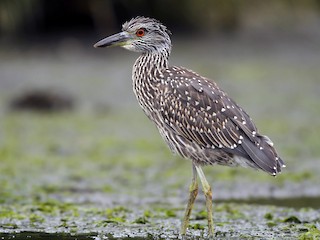
How to identify the Yellow-crowned Night-Heron
Nyctanassa violacea
Spotted a bird? Identify it instantly with the Birdby app
Open the appTo correctly identify the Yellow-crowned Night-Heron (Nyctanassa violacea), check each of these features. Birds can be tricky: habit, habitat, and call often confirm a sighting that a single photo cannot.
Size at a glance
- Length
- 55-70 cm (22-28 in)
- Wingspan
- 101-112 cm (40-44 in)
- Weight
- 500-800 g (1.1-1.8 lbs)
Physical features to check
- 1
Plumage
Overall feather coloration and pattern.
Adults have a slate-gray body with fine black vermiculations on the back and wings. The head is striking, with a black face, a prominent white stripe below the eye, and a pale yellow to white crown and plume extending from the back of the head. Juveniles are mottled brown with fine white streaks and spots, lacking the distinct adult head pattern.
- 2
Beak shape
Shape and color of the bill: a key field mark.
Stout, black, and relatively short compared to other herons, adapted for crushing crustacean shells.
- 3
Eye color
Iris color and any distinctive eye markings.
Bright orange-red in adults, duller in juveniles.
- 4
Leg color
Leg and foot color.
Dull greenish-yellow, becoming brighter yellow or orange-red during breeding season.
- 5
Distinguishing features
Standout features that separate this species.
Adults are distinguished by their slate-gray body, black face with a white cheek stripe, and pale yellow crown. Juveniles are heavily streaked brown with a dark bill and dull legs.
- 6
Juvenile appearance
How young birds differ from adults.
Juveniles are entirely different from adults, being mottled brown with fine white streaks and spots over the entire body, including the head. Their bill is dark, and legs are dull greenish. They gradually acquire adult plumage over 2-3 years.
- 7
Seasonal changes
Plumage variation between breeding and non-breeding seasons.
Leg color becomes brighter (yellow to orange-red) during the breeding season. The yellow crown and white plumes are more prominent and vibrant during courtship and nesting.
- 8
Sexual dimorphism
How males and females differ.
Males and females are generally similar in plumage, though males may be slightly larger. During breeding season, both sexes develop long, white occipital plumes.
Key field marks
- Adult Head Pattern. Look for the striking black face with a prominent white stripe extending from behind the eye, and a pale yellow to white crown. This is the most definitive field mark for adults.
- Body Plumage. Observe the overall slate-gray body with fine black vermiculations on the back and wings. This uniform gray contrasts with the head pattern.
- Leg Color. Note the dull greenish-yellow legs, which become brighter yellow or orange-red during the breeding season. They are relatively short for a heron.
- Bill Shape. Identify the stout, black, and relatively short bill, which is adapted for crushing hard-shelled prey.
- Juvenile Plumage. For juveniles, look for a heavily mottled brown body with fine white streaks and spots. The bill will be dark, and legs dull greenish. They lack the adult head pattern entirely.
- Behavior and Activity Time. Observe its activity primarily at dusk, night, or dawn, often foraging slowly in shallow water. Its preference for crustaceans is also a strong indicator.
- Call. Listen for its distinctive, harsh 'kwok' or 'squawk' call, especially when in flight or disturbed.
Explore the Yellow-crowned Night-Heron
Identify birds anywhere
Free on iOS, Android, and Web. Photo & sound identification, full species database, and your personal life list.