
Spotted a bird? Identify it instantly with the Birdby app
Open the appAbout
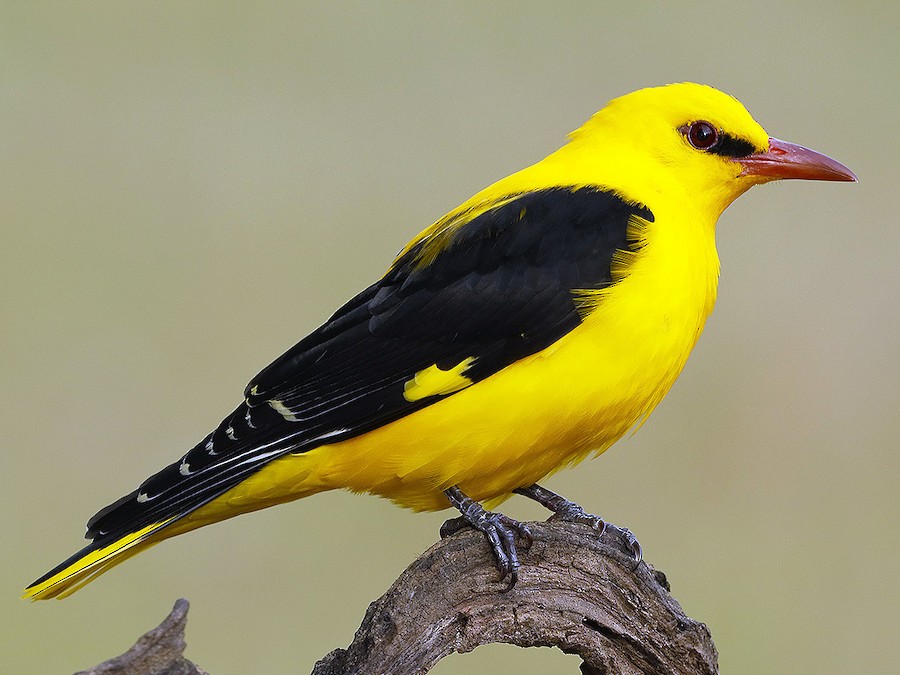
The Eurasian Golden Oriole is a medium-sized passerine bird, renowned for the striking golden-yellow plumage of the male. It is a shy and elusive species, often heard before it is seen, inhabiting deciduous woodlands across much of Europe and Asia during the breeding season.
Size & lifespan
- Length
- 22-25 cm
- Wingspan
- 44-47 cm
- Weight
- 60-90 g
- Lifespan
- Up to 10 years in the wild
- Diet
- Insectivore, Frugivore
Physical characteristics
- Plumage
- Adult males are unmistakable with brilliant golden-yellow body plumage, contrasting with black wings and a black tail with yellow tips. A black stripe extends from the lores through the eye. Females are duller, with yellowish-green upperparts, whitish underparts streaked with dusky markings, and dusky wings. Juveniles resemble females but are even duller and more streaked.
- Beak shape
- Conical and relatively stout, reddish-pink in adults, darker in juveniles.
- Eye color
- Red in adults, dark in juveniles.
- Leg color
- Greyish-blue
- Distinguishing features
- The male's vibrant golden-yellow and black plumage is unique. The female's yellowish-green back and streaked underparts, combined with its size and habitat, are key. The distinctive flute-like song is often the first clue to its presence.
- Juvenile appearance
- Resembles a duller female, with more extensive dusky streaking on the underparts and a darker bill. The eyes are dark brown, not red.
- Seasonal changes
- No significant seasonal plumage changes beyond post-breeding molt. Breeding and non-breeding plumages are essentially the same for adults.
- Sexual dimorphism
- Pronounced. Males are bright golden-yellow and black; females are duller, yellowish-green and whitish with streaking.
How to identify
- 1
Plumage (Male)
Look for the brilliant golden-yellow body, contrasting black wings, and black tail with yellow tips. The black eye-stripe is also a key feature.
- 2
Plumage (Female/Juvenile)
Observe the yellowish-green upperparts, whitish underparts with dusky streaking, and dusky wings. The reddish bill and eye (in adults) are helpful.
- 3
Song
Listen for the unmistakable, rich, flute-like 'weela-wee-oh' song. This is often the most reliable way to detect its presence.
- 4
Habitat
Search in open deciduous or mixed woodlands with tall trees, especially near water. They prefer the canopy.
- 5
Behavior
They are shy and often remain hidden in the foliage, making visual identification challenging. Look for movement high in the canopy as they forage.
Habitat & range
- Biomes
- Temperate forests, broadleaf forests, riparian woodlands, parks, orchards.
- Geographic range
- Breeds across most of Europe (excluding the far north) and temperate Asia, extending east to western China. Winters in tropical Africa and parts of India.
- Elevation range
- Typically found from sea level up to 1,000 meters, occasionally higher in some parts of its range.
- Preferred environments
- Prefers open deciduous or mixed woodlands with tall trees, especially poplars, oaks, and elms, often near water. Also found in large parks, avenues, and orchards, provided there is sufficient tree cover and undergrowth.
Behavior
- Activity time
- Diurnal.
- Feeding habits
- Primarily insectivorous during the breeding season, feeding on caterpillars, moths, beetles, and other invertebrates. During migration and in wintering grounds, they consume a significant amount of fruit, including berries and figs. They forage high in the canopy, often gleaning insects from leaves and branches.
- Social behavior
- Generally solitary or found in pairs during the breeding season. Can form small, loose flocks during migration and in wintering grounds.
- Flight pattern
- Strong, undulating flight over long distances during migration. Within its breeding territory, flight is often direct and swift between trees, but can be rather inconspicuous.
- Migration pattern
- Long-distance migratory. European populations migrate south to sub-Saharan Africa, while Asian populations winter in India and Southeast Asia. They typically arrive in breeding grounds in late April/early May and depart in August/September.
- Territoriality
- Males are highly territorial during the breeding season, defending their nesting area with song and occasional aggressive displays.
Song & calls
- Song
- A distinctive, rich, flute-like, mellow whistle, often transcribed as 'weela-wee-oh' or 'oriole-oriole'. It is a beautiful and far-carrying song, often given from high in the canopy.
- Call
- A harsh, scolding 'kweee-oh' or 'kweeah', often given when disturbed or agitated. Also a softer 'churr' call.
- When they vocalize
- Most vocal during the breeding season, particularly in the early morning and late afternoon. Calls can be heard throughout the day, especially when disturbed.
Breeding & reproduction
- Breeding season
- May to July in Europe.
- Nesting habits
- Nests are typically built high in the fork of a horizontal branch, often in deciduous trees like oak, poplar, or birch. The nest is a deep, cup-shaped structure, meticulously woven from grass, bark strips, wool, and spider silk, often decorated with lichen, making it well-camouflaged.
- Clutch size
- 3-6 eggs, usually 3-4.
- Egg description
- 3-6 eggs, typically whitish or creamy-pink, sparsely spotted with black, dark brown, or purplish-grey markings, particularly at the broader end. Eggs measure approximately 30 x 21 mm.
- Incubation period
- 15-17 days, primarily by the female.
- Fledging period
- 14-17 days after hatching. Young are fed by both parents.
- Parental care
- Both parents participate in feeding the young, though the female does most of the incubation. After fledging, the young remain dependent on the parents for a short period.
Where to find
Deciduous Woodlands
Large, mature deciduous forests, especially those with a mix of tree species and an open understory.
Riparian Zones
Woodlands along rivers and streams, where tall trees provide suitable nesting and foraging sites.
Parks and Gardens
Large, mature parks, arboretums, and extensive gardens with tall trees, particularly during migration.
Orchards
Traditional orchards with older, taller fruit trees can attract them, especially when fruits are ripening.
Field tips
- Listen for the song. The Golden Oriole's song is its most distinctive feature. Learn to recognize it, as you are far more likely to hear it than see the bird.
- Scan the canopy. They spend most of their time high in the tree canopy. Use binoculars to scan the upper branches, especially where you hear the song.
- Visit at dawn or dusk. They are most active and vocal during the early morning and late afternoon, increasing your chances of detection.
- Look for movement. Despite their bright color, they can be surprisingly difficult to spot. Look for subtle movements in the foliage, especially if you hear their calls.
- Be patient and quiet. Their shy nature requires patience. Remain still and quiet to avoid disturbing them.
Similar species
African Golden Oriole
Oriolus auratus
The African Golden Oriole has a more extensive black mask that extends further back on the head, and the yellow on the tail is more restricted. Its song is also subtly different.
Indian Golden Oriole
Oriolus kundoo
Formerly considered a subspecies of Eurasian Golden Oriole, the Indian Golden Oriole has a more extensive black eye-stripe that extends behind the eye, and the yellow on the tail is more restricted. Its range is also distinct, primarily in the Indian subcontinent.
Quick facts
- Color:
- Male: Golden-yellow and black; Female: Yellowish-green and whitish
- Song:
- Flute-like, mellow whistle ('weela-wee-oh')
- Habitat:
- Deciduous woodlands, parks
- Diet:
- Insects and fruits
- Migration:
- Long-distance migrant to Africa/Asia
Fun facts
- The name 'oriole' comes from the Latin 'aureolus', meaning 'golden', referring to the male's striking plumage.
- Despite their bright color, Eurasian Golden Orioles are notoriously difficult to spot due to their shy nature and preference for dense canopy.
- Their nests are intricate, hammock-like structures woven into tree forks, often described as works of art.
- They are one of the few passerine birds that undertake long-distance migrations between Europe/Asia and tropical Africa.
- The harsh 'kweee-oh' call is often given as an alarm or when the bird is disturbed, contrasting sharply with its beautiful song.
Scientific classification
- Kingdom
- Animalia
- Phylum
- Chordata
- Class
- Aves
- Order
- Passeriformes
- Family
- Oriolidae
- Genus
- Oriolus
- Species
- Oriolus oriolus
Explore the Eurasian Golden Oriole
Identify birds anywhere
Free on iOS, Android, and Web. Photo & sound identification, full species database, and your personal life list.