
How to identify the Eurasian Golden Oriole
Oriolus oriolus
Spotted a bird? Identify it instantly with the Birdby app
Open the appTo correctly identify the Eurasian Golden Oriole (Oriolus oriolus), check each of these features. Birds can be tricky: habit, habitat, and call often confirm a sighting that a single photo cannot.
Size at a glance
- Length
- 22-25 cm
- Wingspan
- 44-47 cm
- Weight
- 60-90 g
Physical features to check
- 1
Plumage
Overall feather coloration and pattern.
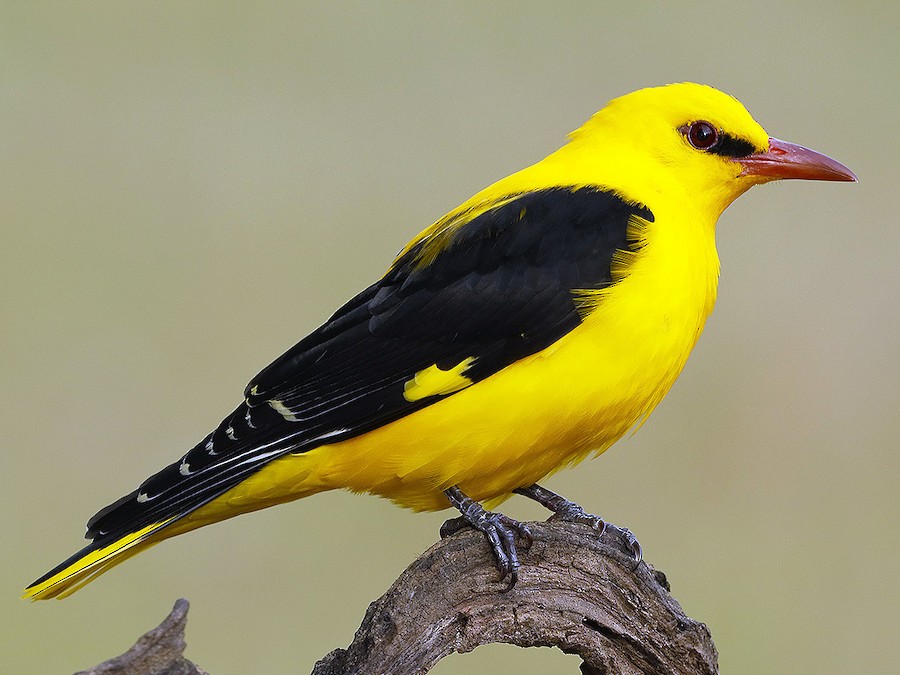
Adult males are unmistakable with brilliant golden-yellow body plumage, contrasting with black wings and a black tail with yellow tips. A black stripe extends from the lores through the eye. Females are duller, with yellowish-green upperparts, whitish underparts streaked with dusky markings, and dusky wings. Juveniles resemble females but are even duller and more streaked.
- 2
Beak shape
Shape and color of the bill: a key field mark.
Conical and relatively stout, reddish-pink in adults, darker in juveniles.
- 3
Eye color
Iris color and any distinctive eye markings.
Red in adults, dark in juveniles.
- 4
Leg color
Leg and foot color.
Greyish-blue
- 5
Distinguishing features
Standout features that separate this species.
The male's vibrant golden-yellow and black plumage is unique. The female's yellowish-green back and streaked underparts, combined with its size and habitat, are key. The distinctive flute-like song is often the first clue to its presence.
- 6
Juvenile appearance
How young birds differ from adults.
Resembles a duller female, with more extensive dusky streaking on the underparts and a darker bill. The eyes are dark brown, not red.
- 7
Seasonal changes
Plumage variation between breeding and non-breeding seasons.
No significant seasonal plumage changes beyond post-breeding molt. Breeding and non-breeding plumages are essentially the same for adults.
- 8
Sexual dimorphism
How males and females differ.
Pronounced. Males are bright golden-yellow and black; females are duller, yellowish-green and whitish with streaking.
Key field marks
- Plumage (Male). Look for the brilliant golden-yellow body, contrasting black wings, and black tail with yellow tips. The black eye-stripe is also a key feature.
- Plumage (Female/Juvenile). Observe the yellowish-green upperparts, whitish underparts with dusky streaking, and dusky wings. The reddish bill and eye (in adults) are helpful.
- Song. Listen for the unmistakable, rich, flute-like 'weela-wee-oh' song. This is often the most reliable way to detect its presence.
- Habitat. Search in open deciduous or mixed woodlands with tall trees, especially near water. They prefer the canopy.
- Behavior. They are shy and often remain hidden in the foliage, making visual identification challenging. Look for movement high in the canopy as they forage.
Explore the Eurasian Golden Oriole
Identify birds anywhere
Free on iOS, Android, and Web. Photo & sound identification, full species database, and your personal life list.