
Spotted a bird? Identify it instantly with the Birdby app
Open the appAbout
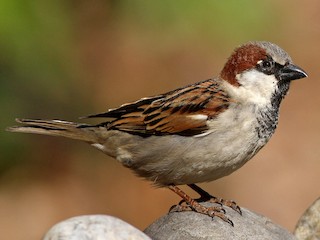
The House Sparrow is a small, robust passerine bird of the sparrow family Passeridae. It is one of the most widespread and abundant birds globally, primarily due to its close association with human habitation. Originally native to Eurasia and North Africa, it has been intentionally or accidentally introduced to most parts of the world, becoming a common sight in urban, suburban, and agricultural areas.
Size & lifespan
- Length
- 14-16 cm (5.5-6.3 in)
- Wingspan
- 21-25 cm (8.3-9.8 in)
- Weight
- 24-39.5 g (0.85-1.39 oz)
- Lifespan
- Typically 3-5 years in the wild, though individuals can live up to 13 years.
- Diet
- Omnivore, primarily granivorous. Feeds on seeds (especially cereal grains), insects (especially during breeding season for nestlings), buds, berries, and human-provided food scraps.
Physical characteristics
- Plumage
- Males have a distinctive grey crown, chestnut nape, black bib, and white cheeks. Their upperparts are streaked brown and black, and underparts are greyish-white. Females and juveniles are duller, with streaky brown upperparts, plain buffy-grey underparts, and a prominent buffy supercilium (eyebrow stripe).
- Beak shape
- Conical and stout, adapted for cracking seeds. Black in breeding males, horn-colored in females and non-breeding males.
- Eye color
- Dark brown.
- Leg color
- Pale brown to pinkish-brown.
- Distinguishing features
- Males are easily identified by their grey crown, chestnut nape, and black bib. Females and juveniles are more challenging but can be identified by their plain, unstreaked underparts and buffy supercilium, distinguishing them from other streaky brown sparrows.
- Juvenile appearance
- Resemble adult females, but often have a softer, looser plumage and a less defined supercilium. The beak is typically yellowish with a dark tip.
- Seasonal changes
- Males show slight seasonal variation; the black bib can appear duller in winter due to pale feather tips that wear off by spring, revealing the darker plumage. Females and juveniles show minimal seasonal changes.
- Sexual dimorphism
- Pronounced. Males are more brightly colored with distinct head patterns (grey crown, chestnut nape, black bib). Females are duller, mostly streaky brown above and plain greyish-buff below.
How to identify
- 1
Male Head Pattern
Look for the distinctive combination of a grey crown, chestnut nape, black bib (throat and upper breast), and white cheeks. This is the most reliable field mark for adult males.
- 2
Female/Juvenile Plumage
Observe the overall streaky brown upperparts, plain buffy-grey underparts, and a prominent buffy supercilium (eyebrow stripe). The lack of streaking on the underparts is key to distinguishing them from many other sparrows and finches.
- 3
Behavior and Habitat
House Sparrows are almost always found in close proximity to human habitation. Their bold, often noisy behavior, and tendency to forage on the ground in flocks are strong indicators.
- 4
Vocalization
Listen for their characteristic, repetitive 'cheerup' or 'chirrup' calls. This unmusical, chattering vocalization is very distinctive.
Habitat & range
- Biomes
- Urban, suburban, agricultural, and rural areas. Highly commensal with humans.
- Geographic range
- Native to Europe, Asia, and North Africa. Introduced and established in North and South America, Australia, New Zealand, and parts of Africa. Effectively cosmopolitan.
- Elevation range
- Sea level up to 4,500 meters (14,800 ft) in some parts of its range, particularly in the Himalayas, but most common at lower elevations.
- Preferred environments
- Human settlements, including cities, towns, villages, farms, and industrial areas. Rarely found in dense forests, grasslands far from human activity, or deserts without irrigation.
Behavior
- Activity time
- Diurnal. Most active during daylight hours, foraging and interacting.
- Feeding habits
- Forages primarily on the ground, often in flocks. Pecks at seeds, grains, crumbs, and insects. Will visit bird feeders readily. Can be quite bold around humans.
- Social behavior
- Highly social, typically found in flocks, especially outside the breeding season. Forms communal roosts. Can be aggressive towards other birds at feeders or nesting sites.
- Flight pattern
- Strong, direct, and undulating flight over short distances. Often flies in small, cohesive flocks.
- Migration pattern
- Generally a resident species throughout its range, though some northern populations may undertake short-distance, irruptive movements in harsh winters. Not considered a true migratory bird.
- Territoriality
- Males defend a small territory around the nest site during the breeding season, but foraging areas are often shared. Flocks maintain a loose social hierarchy.
Song & calls
- Song
- The 'song' is a series of monotonous, unmusical chirps and cheeps, often delivered rapidly. It lacks complex melodic structure.
- Call
- The most common call is a loud, distinctive 'cheerup' or 'chirrup', often repeated. Also gives alarm calls ('churrr') and contact calls ('chip').
- When they vocalize
- Vocalizes year-round, but most frequently and loudly during the breeding season, particularly in the mornings and evenings.
Breeding & reproduction
- Breeding season
- Highly variable depending on geographic location, but generally from early spring (March) to late summer (August). Can have multiple broods (2-4, sometimes more) per year.
- Nesting habits
- Nests are typically bulky, untidy structures made of grass, straw, feathers, string, and other debris. Built in cavities or sheltered spots on human structures (e.g., eaves, holes in walls, streetlights), dense shrubs, or tree cavities. Both sexes participate in nest building.
- Clutch size
- 3-7 eggs, most commonly 4-5.
- Egg description
- 3-7 eggs, typically 4-5. Eggs are whitish, greyish, or pale greenish-blue, heavily speckled or blotched with grey and brown, especially at the larger end. Size: approximately 22 x 15 mm.
- Incubation period
- 10-14 days, primarily by the female, but the male may assist.
- Fledging period
- 14-17 days after hatching. Young are fed by both parents.
- Parental care
- Both parents feed and care for the nestlings and fledglings. Young are dependent on parents for a short period after leaving the nest.
Where to find
Urban and Suburban Areas
Parks, gardens, city streets, building eaves, shopping centers, and residential neighborhoods are prime locations.
Agricultural Areas
Barns, farmyards, grain storage facilities, and fields with crops are common habitats.
Transportation Hubs
Train stations, bus terminals, and airports often host House Sparrow populations due to available food and shelter.
Field tips
- Look near human activity. House Sparrows are highly commensal; they are almost always found where humans are present. Check around buildings, outdoor cafes, and bird feeders.
- Listen for their calls. Their loud, chattering 'chirrup' calls are often the first indication of their presence, even before you see them.
- Observe feeding behavior. They are ground feeders and will readily visit bird feeders. Watch for small, brown birds pecking at crumbs or seeds.
- Check for nesting sites. Look for nests in cavities or sheltered spots on buildings, under eaves, or in dense climbing plants.
Similar species
Eurasian Tree Sparrow
Passer montanus
The Eurasian Tree Sparrow has a chestnut crown (House Sparrow male has grey), a distinct black spot on its white cheek (House Sparrow male has plain white cheek), and two prominent white wing bars (House Sparrow has one less distinct bar). Females and juveniles of both species are duller, but the Tree Sparrow retains the chestnut crown and black cheek spot.
American Tree Sparrow
Spizelloides arborea
Found only in North America. Has a rusty cap, a bicolored bill (dark upper mandible, yellow lower mandible), and a dark spot on its unstreaked breast. House Sparrows lack the rusty cap and breast spot, and have a uniformly colored bill (black in breeding males, horn in females/non-breeding males).
Female/Juvenile Finches (e.g., House Finch, Purple Finch)
Haemorhous mexicanus, Haemorhous purpureus
Female House Sparrows have plain, unstreaked underparts and a buffy supercilium. Female finches typically have streaked underparts and often lack a distinct supercilium. Finches also tend to have more conical, slightly larger bills relative to their head size.
Quick facts
- Global Distribution:
- One of the most widespread bird species globally.
- Dietary Flexibility:
- Highly adaptable diet, consuming seeds, insects, and human food scraps.
- Social Nature:
- Typically found in flocks, especially outside the breeding season.
- Nesting Habits:
- Nests almost exclusively in or on human structures.
- Conservation Status:
- Least Concern, though some localized declines have been noted in parts of Europe.
Fun facts
- The House Sparrow was intentionally introduced to North America in 1851-1852 in Brooklyn, New York, with the aim of controlling insect pests and for nostalgic reasons.
- Despite its common name, the House Sparrow is not closely related to American sparrows (family Passerellidae) but belongs to the Old World sparrow family (Passeridae).
- In some parts of its native range, particularly Western Europe, House Sparrow populations have experienced significant declines, prompting conservation efforts.
- House Sparrows are known for their dust-bathing behavior, which helps to remove parasites and maintain feather condition.
- They are highly intelligent and adaptable, capable of learning complex behaviors, such as opening automatic doors to access food.
Scientific classification
- Kingdom
- Animalia
- Phylum
- Chordata
- Class
- Aves
- Order
- Passeriformes
- Family
- Passeridae
- Genus
- Passer
- Species
- Passer domesticus
Explore the House Sparrow
Identify birds anywhere
Free on iOS, Android, and Web. Photo & sound identification, full species database, and your personal life list.