
How to identify the House Sparrow
Passer domesticus
Spotted a bird? Identify it instantly with the Birdby app
Open the appTo correctly identify the House Sparrow (Passer domesticus), check each of these features. Birds can be tricky: habit, habitat, and call often confirm a sighting that a single photo cannot.
Size at a glance
- Length
- 14-16 cm (5.5-6.3 in)
- Wingspan
- 21-25 cm (8.3-9.8 in)
- Weight
- 24-39.5 g (0.85-1.39 oz)
Physical features to check
- 1
Plumage
Overall feather coloration and pattern.
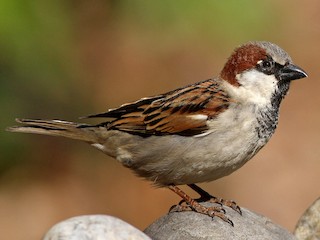
Males have a distinctive grey crown, chestnut nape, black bib, and white cheeks. Their upperparts are streaked brown and black, and underparts are greyish-white. Females and juveniles are duller, with streaky brown upperparts, plain buffy-grey underparts, and a prominent buffy supercilium (eyebrow stripe).
- 2
Beak shape
Shape and color of the bill: a key field mark.
Conical and stout, adapted for cracking seeds. Black in breeding males, horn-colored in females and non-breeding males.
- 3
Eye color
Iris color and any distinctive eye markings.
Dark brown.
- 4
Leg color
Leg and foot color.
Pale brown to pinkish-brown.
- 5
Distinguishing features
Standout features that separate this species.
Males are easily identified by their grey crown, chestnut nape, and black bib. Females and juveniles are more challenging but can be identified by their plain, unstreaked underparts and buffy supercilium, distinguishing them from other streaky brown sparrows.
- 6
Juvenile appearance
How young birds differ from adults.
Resemble adult females, but often have a softer, looser plumage and a less defined supercilium. The beak is typically yellowish with a dark tip.
- 7
Seasonal changes
Plumage variation between breeding and non-breeding seasons.
Males show slight seasonal variation; the black bib can appear duller in winter due to pale feather tips that wear off by spring, revealing the darker plumage. Females and juveniles show minimal seasonal changes.
- 8
Sexual dimorphism
How males and females differ.
Pronounced. Males are more brightly colored with distinct head patterns (grey crown, chestnut nape, black bib). Females are duller, mostly streaky brown above and plain greyish-buff below.
Key field marks
- Male Head Pattern. Look for the distinctive combination of a grey crown, chestnut nape, black bib (throat and upper breast), and white cheeks. This is the most reliable field mark for adult males.
- Female/Juvenile Plumage. Observe the overall streaky brown upperparts, plain buffy-grey underparts, and a prominent buffy supercilium (eyebrow stripe). The lack of streaking on the underparts is key to distinguishing them from many other sparrows and finches.
- Behavior and Habitat. House Sparrows are almost always found in close proximity to human habitation. Their bold, often noisy behavior, and tendency to forage on the ground in flocks are strong indicators.
- Vocalization. Listen for their characteristic, repetitive 'cheerup' or 'chirrup' calls. This unmusical, chattering vocalization is very distinctive.
Explore the House Sparrow
Identify birds anywhere
Free on iOS, Android, and Web. Photo & sound identification, full species database, and your personal life list.