
Spotted a bird? Identify it instantly with the Birdby app
Open the appAbout
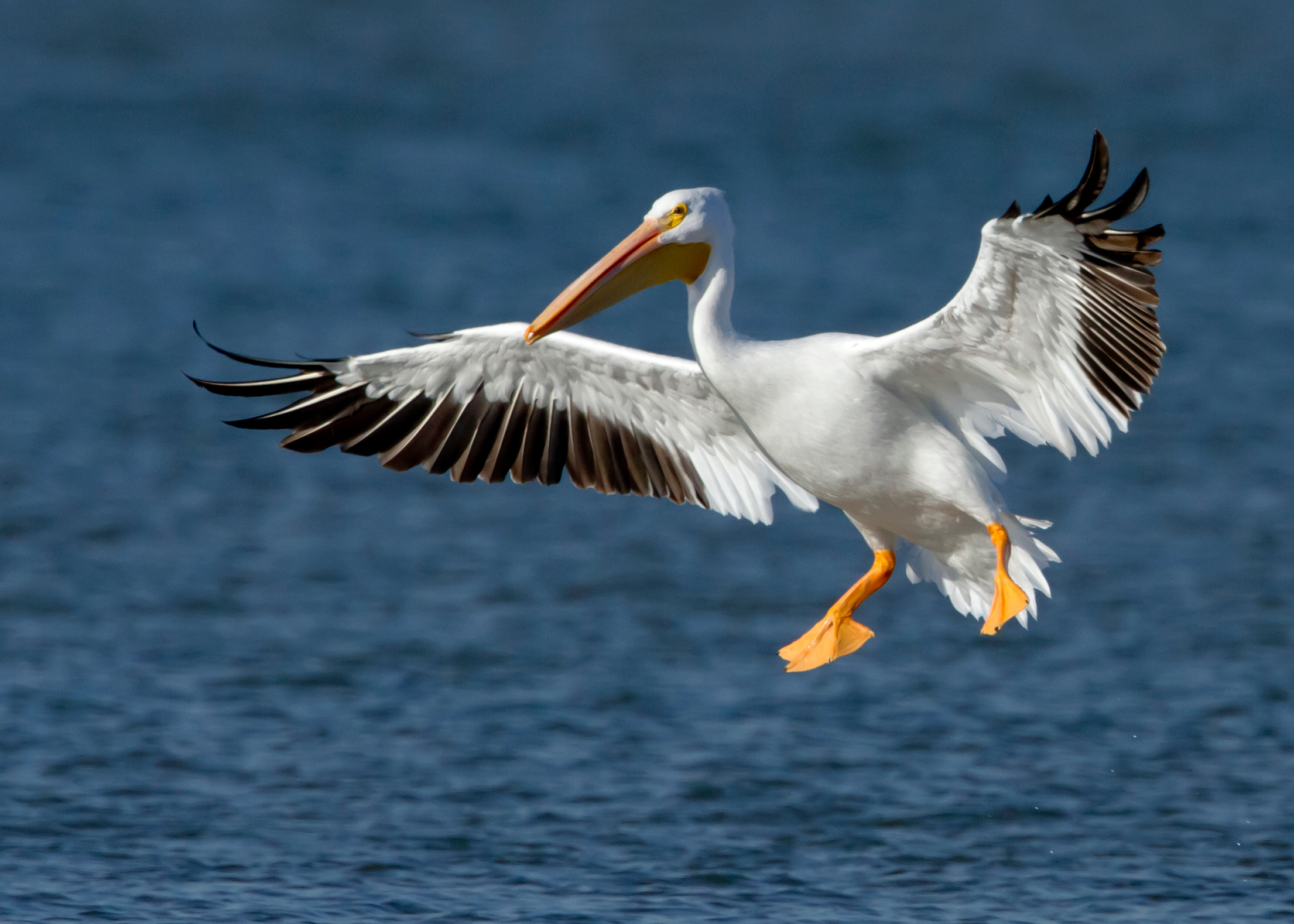
The American White Pelican is one of the largest birds in North America, easily recognized by its immense size, brilliant white plumage, and enormous orange bill. Unlike its brown pelican relatives, it does not plunge-dive for fish but instead fishes cooperatively in shallow waters.
Size & lifespan
- Length
- 127-178 cm (50-70 in)
- Wingspan
- 244-290 cm (96-114 in)
- Weight
- 3.5-13.6 kg (7.7-30 lbs)
- Lifespan
- 10-17 years in the wild, up to 34 years in captivity
- Diet
- Carnivore (primarily fish)
Physical characteristics
- Plumage
- Adults are entirely white except for black primary and outer secondary flight feathers, which are visible only in flight. The underwing coverts are white. Juveniles have a dusky gray wash on the head and neck, and some dusky markings on the back, which fade with age.
- Beak shape
- Very large, flattened, and orange-yellow to pinkish-orange. During the breeding season, adults develop a prominent, fibrous 'horn' on the upper mandible, which is shed after egg-laying.
- Eye color
- Dark brown with a pale orbital ring
- Leg color
- Bright orange to pinkish-orange
- Distinguishing features
- Immense size, all-white body with black flight feathers (visible in flight), large orange bill with a gular pouch, and the unique breeding horn on the bill.
- Juvenile appearance
- Juveniles have a grayish wash on the head, neck, and sometimes the back, and their bill and legs are duller, more yellowish-pink. The black flight feathers are present but may appear browner.
- Seasonal changes
- The most notable seasonal change is the development of the fibrous 'horn' on the upper mandible of both sexes during the breeding season. The bill and leg coloration also become more vibrant orange during breeding.
- Sexual dimorphism
- Males are generally larger than females, with a slightly larger bill and a more prominent breeding horn. Otherwise, plumage is identical.
How to identify
- 1
Size and Color
Look for a very large, all-white bird. If seen on the water or ground, its immense size and bright white body are unmistakable. In flight, the black primary and outer secondary feathers contrast sharply with the white body and inner wings.
- 2
Bill and Pouch
Observe the enormous, orange-yellow bill with a large gular pouch underneath. During breeding season, look for the distinctive fibrous 'horn' on the upper mandible.
- 3
Flight Pattern
Watch for their characteristic soaring flight, often in V-formations or long lines, with slow, powerful wingbeats interspersed with long glides. They fly with their neck retracted, unlike cranes or storks.
- 4
Feeding Behavior
Note their cooperative feeding strategy, where groups of pelicans herd fish. They do not plunge-dive like Brown Pelicans.
- 5
Habitat
They are typically found on large, open bodies of freshwater or brackish water, often in groups.
Habitat & range
- Biomes
- Freshwater and brackish wetlands, including large shallow lakes, marshes, rivers, and coastal lagoons.
- Geographic range
- Breeds in interior North America, from British Columbia and Alberta south to California, Colorado, and Minnesota. Winters along the Pacific, Gulf, and Atlantic coasts of the United States, and south into Mexico and Central America.
- Elevation range
- Typically found at low elevations, from sea level up to approximately 2,000 meters (6,500 feet) in some western breeding areas.
- Preferred environments
- Large, shallow, productive freshwater lakes and marshes for breeding, often with islands free from mammalian predators. Wintering grounds include estuaries, coastal lagoons, and large inland lakes with abundant fish.
Behavior
- Activity time
- Diurnal
- Feeding habits
- Primarily piscivorous. Unlike Brown Pelicans, they do not plunge-dive. Instead, they typically feed cooperatively in groups, herding fish into shallow water by dipping their bills and scooping them up. They can also feed solitarily. Their diet consists mainly of rough fish species like carp, minnows, and suckers, but also includes salamanders and crayfish.
- Social behavior
- Highly colonial, breeding and roosting in large groups, often on isolated islands. They are also social feeders, frequently engaging in cooperative fishing. Non-breeding birds may form large flocks.
- Flight pattern
- Powerful and graceful in flight, often soaring on thermals to great heights. They fly with their necks retracted (S-shaped) and their large wings held flat. They often fly in V-formations or in long, undulating lines.
- Migration pattern
- Long-distance migrant. Most populations breed in the interior of North America and migrate to warmer coastal and southern inland waters for the winter. Migration occurs in large flocks, often at high altitudes.
- Territoriality
- While they nest colonially, individual pairs defend a small territory immediately around their nest site. Feeding grounds are generally not defended.
Song & calls
- Song
- American White Pelicans are generally silent birds. They do not have a complex song.
- Call
- They produce a variety of low, guttural grunts, croaks, and hisses, especially during breeding season or when disturbed at the colony. Chicks make begging calls.
- When they vocalize
- Mostly vocal during breeding season at the colony, or when alarmed. Otherwise, largely silent.
Breeding & reproduction
- Breeding season
- Typically begins in April-May, with eggs laid from late April to early June, depending on latitude.
- Nesting habits
- Nests in large, dense colonies, usually on isolated islands in freshwater lakes or marshes, which provide protection from predators. Nests are shallow depressions on the ground, lined with gravel, soil, and vegetation, built by both parents.
- Clutch size
- 1-6 eggs (average 2-3)
- Egg description
- 1-6 (typically 2-3) dull white, chalky eggs, often stained brown from the nest material. They are large, oval, and rough-textured.
- Incubation period
- 29-36 days, incubated by both parents.
- Fledging period
- Young pelicans fledge (become capable of flight) at about 63-84 days (9-12 weeks) after hatching. They remain dependent on parents for some time after fledging.
- Parental care
- Both parents share incubation duties and feed the young by regurgitating fish into their gular pouch. Chicks often form 'creches' or groups within the colony, guarded by a few adults.
Where to find
Large Freshwater Lakes
Especially those with islands for nesting, such as those in the prairie pothole region of the central U.S. and Canada.
Coastal Estuaries and Lagoons
During winter months, along the Gulf Coast, Pacific Coast, and parts of the Atlantic Coast of the U.S. and Mexico.
Major Rivers
Large, slow-moving rivers can also host pelicans, particularly during migration or in winter.
Wildlife Refuges and Sanctuaries
Many protected wetland areas are crucial for their breeding and wintering populations.
Field tips
- Look for large white birds on the water. Their size and bright white plumage make them stand out, even from a distance. Scan large open water bodies.
- Observe their feeding behavior. If you see a group of large white birds swimming in a coordinated line, dipping their bills simultaneously, you've likely found American White Pelicans feeding.
- Watch the skies for soaring birds. They often soar high on thermals, sometimes in large groups. Look for their distinctive black flight feathers against the white body.
- Visit breeding colonies (from a distance). During breeding season, they gather in large, conspicuous colonies on islands. Always observe from a respectful distance to avoid disturbing them.
Similar species
Brown Pelican
Pelecanus occidentalis
The Brown Pelican is smaller, has dark brown plumage, a white head with a dark stripe down the neck (adults), and plunge-dives for fish. It lacks the breeding horn and is primarily coastal.
Whooping Crane
Grus americana
While also large and white, Whooping Cranes have black primary feathers (visible in flight), but also a red crown and black facial markings. They have long legs and a straight bill, and are typically found in marshes, not large open water bodies like pelicans. They fly with their necks extended, unlike pelicans.
Tundra Swan
Cygnus columbianus
Tundra Swans are also large and white, but lack black flight feathers (except for very dark wingtips on some individuals) and have a long, graceful neck and a black bill. They are much smaller than pelicans and lack the gular pouch and breeding horn.
Quick facts
- Largest North American Waterbird:
- One of the largest birds in North America by wingspan and weight.
- Cooperative Fishermen:
- Known for their unique group fishing strategy.
- Breeding Horn:
- Develops a distinctive fibrous horn on the bill during breeding season.
- Silent Soarers:
- Generally quiet birds, especially outside of breeding colonies.
- Long-distance Migrants:
- Undertake extensive migrations between interior breeding grounds and coastal/southern wintering areas.
Fun facts
- The breeding horn on their bill is unique among pelicans and is shed after the eggs are laid.
- Despite their large size, they are incredibly graceful in flight, often soaring for hours without a single wingbeat.
- Their gular pouch can hold up to 3 gallons (11 liters) of water and fish, though it's primarily used as a scoop, not for storage during flight.
- Pelican chicks are born naked and blind, developing a downy covering within a few days.
- They are highly sensitive to human disturbance at their nesting colonies, which can lead to nest abandonment.
Scientific classification
- Kingdom
- Animalia
- Phylum
- Chordata
- Class
- Aves
- Order
- Pelecaniformes
- Family
- Pelecanidae
- Genus
- Pelecanus
- Species
- Pelecanus erythrorhynchos
Explore the American White Pelican
Identify birds anywhere
Free on iOS, Android, and Web. Photo & sound identification, full species database, and your personal life list.