
Spotted a bird? Identify it instantly with the Birdby app
Open the appAbout
The Brown Pelican is a large, distinctive seabird known for its impressive plunge-diving fishing technique and its large gular pouch. It is the smallest of the pelican species and the only one that feeds by diving from the air. Its presence is a quintessential sight along coastal areas of the Americas.
Size & lifespan
- Length
- 106-137 cm (42-54 in)
- Wingspan
- 1.83-2.5 m (6-8.2 ft)
- Weight
- 2.7-5.0 kg (6-11 lbs)
- Lifespan
- 15-25 years in the wild, with records up to 31 years
- Diet
- Carnivore (primarily fish)
Physical characteristics
- Plumage
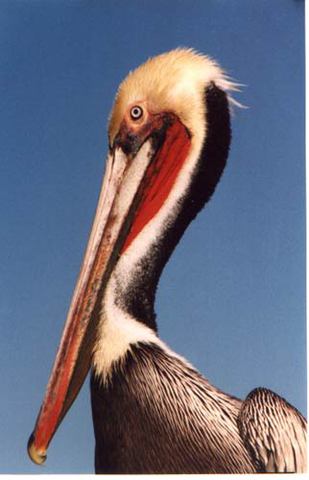
- Adults have a dark gray-brown body, a white neck, and a pale yellow wash on the head. The back of the neck is dark chestnut-brown during breeding season. Non-breeding adults have a white neck and head with a yellowish wash. Juveniles are duller, with a grayish-brown head and neck and a pale belly.
- Beak shape
- Long, flattened, and straight bill with a large, distensible gular pouch underneath. The bill is grayish-pink to yellowish in non-breeding adults, becoming brighter yellow and reddish-orange at the tip during breeding.
- Eye color
- Pale yellow to white
- Leg color
- Dark gray to blackish
- Distinguishing features
- Large size, distinctive plunge-diving behavior, prominent gular pouch, and the unique head and neck coloration patterns that vary with age and season.
- Juvenile appearance
- Juveniles are uniformly dull grayish-brown on the head, neck, and upperparts, with a pale, often whitish, belly. They lack the distinct white neck and yellow head of adults.
- Seasonal changes
- During the breeding season, adults develop a rich chestnut-brown hindneck and a brighter yellow wash on the crown. The gular pouch and bill also become more intensely colored with yellow, orange, and reddish hues. Outside of breeding, the hindneck is white, and the head is mostly white with a pale yellow wash.
- Sexual dimorphism
- Males are generally slightly larger than females, but plumage is identical.
How to identify
- 1
Plunge-diving behavior
The most distinctive identification feature. No other pelican species or large coastal bird regularly dives headfirst into the water from significant heights to catch fish.
- 2
Overall coloration
Dark brown body, contrasting with a white neck and yellowish head (adults). Juveniles are uniformly dull brown.
- 3
Bill and Pouch
The very long bill with a large, expandable gular pouch is unmistakable. Note the color changes with age and season.
- 4
Flight profile
Flies with slow, deep wingbeats, often in V-formations or single lines, frequently gliding low over the water. The long neck is typically tucked back in an S-curve during flight, unlike herons which fly with their necks extended.
Habitat & range
- Biomes
- Coastal marine environments, estuaries, lagoons, and large bays.
- Geographic range
- Coastal areas of North, Central, and South America. From Nova Scotia (rarely) and Maryland south along the Atlantic and Gulf Coasts of the U.S., throughout the Caribbean, and south to the Amazon River in Brazil. On the Pacific Coast, from British Columbia (rarely) and Washington south through California, Mexico, Central America, and down to Chile.
- Elevation range
- Primarily sea level, rarely found inland.
- Preferred environments
- Shallow coastal waters, sandy beaches, rocky shores, mangrove swamps, and offshore islands for nesting and roosting. They require calm, fish-rich waters for feeding.
Behavior
- Activity time
- Diurnal, active during daylight hours for feeding and roosting.
- Feeding habits
- Feeds almost exclusively on fish, primarily schooling fish like menhaden, anchovies, and sardines. They are renowned for their spectacular plunge-diving technique, where they dive headfirst from heights of 6-18 meters (20-60 feet) to catch fish in their gular pouch. They typically surface, drain the water from their pouch, and then swallow the fish whole. They may also steal fish from other birds or fishermen.
- Social behavior
- Highly social birds, typically found in flocks. They roost and nest colonially, sometimes in very large numbers. They are generally tolerant of other pelicans and seabirds.
- Flight pattern
- Strong, graceful flight with slow, powerful wingbeats, often interspersed with long glides. They frequently fly in V-formations or single lines, often just above the water's surface, utilizing ground effect to conserve energy.
- Migration pattern
- Northern populations (e.g., those breeding in the Carolinas) are migratory, moving south for the winter. Southern populations are largely resident or undertake short-distance dispersal movements. Juveniles often disperse widely after fledging.
- Territoriality
- Generally not territorial outside of the immediate nest site during breeding season. Feeding grounds are shared.
Song & calls
- Song
- Brown Pelicans are largely silent birds. They do not have a complex song.
- Call
- Adults are mostly silent. Nestlings and juveniles produce a variety of grunts, squawks, and hisses, especially when begging for food or interacting with siblings. Adults may emit low grunts or croaks during courtship or when disturbed at the nest.
- When they vocalize
- Primarily vocal during the breeding season, especially by young birds and during nest interactions. Adults are generally silent outside of the colony.
Breeding & reproduction
- Breeding season
- Varies geographically: December-May in Florida, March-August in the Carolinas, March-July in California, and year-round in tropical regions.
- Nesting habits
- Colonial nesters, often on isolated islands, coastal dunes, or in mangroves. Nests are typically large, bulky structures made of sticks, reeds, and other vegetation, built on the ground or in low trees/shrubs. Both parents participate in nest building.
- Clutch size
- 2-3 eggs, typically.
- Egg description
- 1-3 (occasionally 4) dull white, chalky eggs, often stained brown from nest material.
- Incubation period
- 28-30 days, incubated by both parents.
- Fledging period
- Chicks fledge (become capable of flight) at about 75-80 days old, but remain dependent on parents for several weeks thereafter.
- Parental care
- Both parents share incubation duties and feed the young by regurgitating partially digested fish into their gular pouch, from which the chicks feed directly.
Where to find
Coastal beaches and jetties
Often seen perched on pilings, jetties, or along sandy beaches, especially where fishing boats are active.
Estuaries and bays
Look for them fishing in shallow, protected coastal waters, particularly where schooling fish are present.
Offshore islands and mangrove swamps
These are preferred nesting and roosting sites, though access may be restricted during breeding season.
Field tips
- Watch for feeding activity. Their spectacular plunge-diving is a key indicator of their presence. Look for birds circling high above the water before diving.
- Scan coastal structures. They frequently perch on man-made structures like piers, docks, and channel markers, offering excellent viewing opportunities.
- Observe flocks. Brown Pelicans are social; where you see one, you're likely to see more, often flying in characteristic lines or V-formations.
Similar species
American White Pelican
Pelecanus erythrorhynchos
The American White Pelican is significantly larger, entirely white (except for black flight feathers visible in flight), and feeds by cooperatively herding fish while swimming, rather than plunge-diving. It also has a prominent 'horn' on its bill during breeding season.
Peruvian Pelican
Pelecanus thagus
Found only along the Pacific coast of South America. It is larger than the Brown Pelican, has a darker overall plumage, and a more prominent crest on its head. Its gular pouch is often darker, and its head and neck pattern differs, with a dark stripe running down the side of the neck.
Quick facts
- Primary Food Source:
- Fish (e.g., menhaden, anchovies, sardines)
- Feeding Method:
- Plunge-diving
- Social Structure:
- Colonial
- Distinguishing Feature:
- Large gular pouch and plunge-diving
- Conservation Success Story:
- Recovered from DDT-induced population declines
Fun facts
- The Brown Pelican was once severely endangered due to the effects of DDT, which caused eggshell thinning. Following the ban of DDT in the U.S. in 1972, its populations made a remarkable recovery, leading to its removal from the endangered species list in 2009.
- When a Brown Pelican plunge-dives, it hits the water at speeds up to 40 mph (64 km/h). To protect itself, it has air sacs under its skin that act like bubble wrap, cushioning the impact.
- Despite its large pouch, the Brown Pelican does not store fish in it for transport. The pouch is used as a net to catch fish, which are then swallowed immediately.
- Young pelicans feed by reaching into their parent's pouch to retrieve regurgitated fish, a behavior that can look quite aggressive as they jostle for food.
Scientific classification
- Kingdom
- Animalia
- Phylum
- Chordata
- Class
- Aves
- Order
- Pelecaniformes
- Family
- Pelecanidae
- Genus
- Pelecanus
- Species
- Pelecanus occidentalis
Explore the Brown Pelican
Identify birds anywhere
Free on iOS, Android, and Web. Photo & sound identification, full species database, and your personal life list.